
|
|
|
|
Original Article
GANGA AND YAMUNA AT THE TEMPLE THRESHOLD: AN ICONOGRAPHIC AND SPATIAL STUDY
|
Simer Preet Sokhi 1* 1 Research Scholar, World
University of Design, Sonipat, Haryana, India 2 Dean, School of Performing Arts, World
University of Design, Sonipat, Haryana, India |
|
|
|
ABSTRACT |
||
|
This paper analyses the placement of the river goddesses Ganga and Yamuna at temple thresholds through formal, spatial, and ritual frameworks, situating their imagery within Vedic, epic, and Puranic traditions where both function as agents of purification and auspicious transition. It examines sculptural programmes at the entrance to the garbhagriha, focusing on doorjamb reliefs in which Ganga is marked by the makara and Yamuna by the kurma, each attended by subsidiary figures, their forms carved along the doorjambs in positions that flank and define the axis of entry. A spatial reading of this arrangement shows that the doorway operates as a regulated threshold that directs bodily movement rather than a neutral opening; the consistent placement of these figures on the lower sections of the doorframe establishes a visual and ritual field that must be crossed before access to the sanctum. Their iconographic attributes and fixed location structure a sequence in which entry aligns with the logic of ablution, allowing the threshold to be read as a tirtha, a point of crossing where movement acquires ritual value. Passing between Ganga and Yamuna produces a transition analogous to river bathing and prepares the devotee for proximity to the deity, which supports the argument that these figures function as mediating agents within a spatial system that encodes purification into the act of entry and shapes the experience of sacred space. Keywords: Ganga, Yamuna, Ritual, Iconography,
Temple Thresholds |
||


INTRODUCTION
Rivers occupy a
central position in Indian religious thought and practice. Among them, Ganga
and Yamuna hold a distinctive status. They function both as physical
watercourses and as personified goddesses who purify, protect, and sustain
cosmic order. Early Vedic hymns invoke them for fertility, healing, and ritual
cleansing. Epic and Puranic texts develop these roles further. The epics
present them as mothers and divine agents within human history. The Puranas
situate them within a sacred geography that connects heaven, earth, and the
underworld Singh
(2020).
The mythology of
Ganga’s descent through Shiva establishes her as a mediator between celestial
and terrestrial realms. Yamuna’s association with Krishna in the Braj region
links her to devotion, protection, and divine presence within lived space.
Through these textual traditions, both rivers come to signify transition. They
mark points where human and divine domains intersect. This symbolic meaning
extends beyond narrative into ritual and built form Kumari
(2018).
From the Gupta
period onward, temple architecture gives this symbolism a fixed visual
expression. Sculptors place Ganga and Yamuna on the doorjambs of sanctum
entrances. Each goddess stands on her vehicle and carries a water vessel (Purna
Kumbh). Their placement at the threshold is deliberate. Architectural and
ritual manuals describe the doorway as a liminal zone that requires
purification before entry. The river goddesses therefore act as agents who
prepare the devotee to cross into sacred space. Their presence becomes a
standard feature across regional styles, even as details of form vary Rao (1985).
Scholars have
examined the sacred geography of Indian rivers and the iconography of temple
doorways. Studies discuss the theological meaning of Ganga and Yamuna in
textual sources, and others analyse their sculptural representations. However,
fewer works systematically connect literary construction, architectural
prescription, and ritual experience within a single framework. This paper
addresses that gap.
The study argues
that Ganga and Yamuna function as architectural mediators. Their images
translate the theology of sacred water into spatial form. By analysing textual
descriptions, iconographic features, and temple placement, the paper shows how
the threshold becomes a ritualised tirtha within the temple complex. The paired
river goddesses structure the devotee’s movement from exterior space to sanctum
and give material shape to the idea of purification at the point of entry.
GANGA AND YAMUNA IN VEDIC LITERATURE
Hindu goddesses
are often understood as embodiments of complex ideas such as power and energy,
yet they also appear in simple and material forms, especially as water and
rivers across India Foulston
and Abbott (2009). In this context, water symbolizes
potentiality, fluidity, and the capacity for creation. Vedic literature
presents water as an all-encompassing element and as a fundamental basis of the
universe itself Baartmans
(2000). Rivers, therefore, are treated as sacred
beings and are described as “great descenders,” a term that reflects their
divine origin and salvific function. Later sections of the Rig Veda also state
that bathing at the confluence of the Ganga and Yamuna enables a person to
attain heaven Eck (2012).
Vedic texts
further refer to river goddesses as “mothers,” emphasizing their nurturing and
life sustaining roles. The earliest group is identified as the seven mother
rivers. In present day religious practice, worship commonly focuses on the saptanadi: the Ganga, Yamuna, Sindhu, Narmada, Godavari,
Krishna, and Kaveri Eck (2012). The waters of these rivers are symbolically
compared to maternal milk and also to soma, the sacred ritual substance. During
contemporary Hindu water rituals, mantras associated with these river goddesses
are recited, reinforcing their continuing ritual and theological significance Rodrigues
(2007).
LITERARY FOUNDATIONS OF GANGA
Many myths
describe Ganga having the origins of heavens. Ganga is known to be the consort
of Brahma, Vishnu, and Shiva Eck (2012). The Bhagavata Purana Shastri
and Bhatt (2004) traces the origin of Ganga to the
incarnation of Vishnu as Vamana. When Vamana measured the three worlds in three
strides, his raised foot pierced the upper boundary of the cosmos, and from
this opening the celestial waters emerged and flowed into heaven. The text
identifies this stream as Vishnupadi, a sacred tirtha whose waters remove sin.
For many yugas, Ganga remained in the upper cosmic region known as Vishnupada, also called Dhruvamandala,
the sphere associated with Dhruva, son of King Uttanapada,
who performs penance there. The seven sages who revolve around this sphere
bathe in the river, which confirms its status as a purifying and cosmic stream.
From Vishnupada, Ganga moves along the devayana, described as radiant with celestial vehicles, and
then descends to Chandramandala. Thereafter, it
divides into four tributaries: Sita, Caksus,
Alakananda, and Bhadra. Each follows a distinct course across the cosmic
geography. Sita flows from Mount Meru through Gandhamadana
and Bhadrasva varsa into
the eastern sea; Caksus descends from Mount Malyavan through Ketumala into
the western sea; Alakananda falls from Mount Hemakuta,
passes through Bharata Varsha, and enters the southern sea; and Bhadra flows
from Mount Srigavan through Uttarakuru
into the northern sea. Among these branches, Alakananda holds particular
importance because it traverses Bharata Varsha, thereby linking the cosmic
river with the terrestrial region of India and reinforcing its ritual
centrality.
The ninth canto of
Devi Bhagavata (n.d.) narrates another account of the descent of Ganga in the
context of a conflict among the wives of Mahavishnu. While Vishnu was in
Vaikuntha with Laksmi, Sarasvati, and Ganga, Ganga cast affectionate glances
toward him, which he returned discreetly. Sarasvati reacted with anger and
struck Ganga. When Laksmi attempted to calm the dispute, Sarasvati cursed her
to be born on earth. In response, Ganga cursed Sarasvati to take birth as a
river on earth. Sarasvati then cursed Ganga to be born as a river and bear the
sins of the world. Vishnu intervened and accepted these events as part of a
larger order. He declared that Laksmi would be born on earth in the house of
Dharmadhvaja, later become the plant Tulasi, marry the asura Sankhacuda, and eventually assume the form of the sacred
river Padmavati before returning to Vaikuntha. Ganga, he said, would descend to
earth as a holy river to purify humanity, brought down by King Bhagiratha and
therefore known as Bhagirathi. She would also be associated with King Shantanu
and later return in her divine form to Mount Kailasa as the consort of Shiva.
Sarasvati would likewise take birth as a river on earth and ultimately return
to Satya Loka to unite with Brahma. The narrative thus explains the terrestrial
manifestation of the three goddesses while reaffirming their cosmic identities
as the consorts of Vishnu, Shiva, and Brahma.
The Adi Parva The Mahabharata: Adi Parva (1893), Chapters 96 and 97, presents another
account of Ganga’s birth on earth, this time as the result of a curse by
Brahma. Mahabhisak, an emperor of the Iksvaku
dynasty, reached Satya Loka after attaining heaven and went there to worship
Brahma. Ganga was also present in that divine assembly. During the gathering, a
breeze displaced her garment slightly. Mahabhishak
looked at her with desire, and she returned his glance. Brahma observed this
exchange and became angry. He cursed Mahabhishak to
be born again on earth as a mortal king and declared that Ganga would also be
born on earth as his wife.
Ganga sought
relief from the curse. Brahma told her that she would regain her divine status
after giving birth to the Ashta-vasus. As a result of this curse, Mahabhishak was reborn as King Shantanu of the solar
dynasty. He later married Ganga on earth. This narrative explains her earthly
manifestation through the framework of divine transgression, curse, and
eventual restoration.
The descent of
Ganga to earth is narrated in the Bala Kanda of the Valmiki Ramayana The Ramayana of Valmiki (1962) and is also described in the Mahabharata Rajagopalachari (1968), the Brahmanda
Purana Shastri
and Bhatt (2004), and the Devi Bhagavata Purana (n.d.). King Sagara of the solar dynasty
had two wives, Sumati and Kesini; Kesini gave birth to Asamanjasa,
while Sumati bore sixty thousand sons. During Sagara’s performance of the
Ashvamedha sacrifice, the sacrificial horse disappeared near the seashore. The
princes searched for it across the earth and eventually entered Patala, where
they found the horse tied near the sage Kapila, who was absorbed in meditation.
Mistaking him for the thief, they attacked him and were reduced to ashes by the
power of his gaze. Sagara’s grandson Amshuman later approached Kapila with
respect and recovered the horse. Kapila declared that only the descent of Ganga
could purify the ashes of the princes. In a later generation, Bhagiratha
undertook severe penance in the Himalayas to bring Ganga down to earth. Ganga
agreed to descend but warned that only Shiva could bear the force of her fall.
Bhagiratha then propitiated Shiva, who received the river in his matted hair
and released her in controlled streams. On her descent, Ganga flooded the
hermitage of the sage Jahnu, who drank her waters and later released her, after
which she became known as Jahnavi. She then followed Bhagiratha to Patala and
purified the sons of Sagara, thereby establishing her role as a river that
removes sin and grants liberation.
The Anushasana Parva of the Mahabharata The Mahabharata: Adi Parva (1893) describes the divine nature and ritual power
of Ganga. The text states that the deposition of the bones of the dead in the
river ensures their ascent to heaven, and even a person who has committed sins
throughout life can attain Vishnupada through
devotion to Ganga. Bathing in her waters is presented as equal in merit to
performing a hundred yajnas. The river is also described as sustaining
spiritual benefit as long as a person’s remains stay within it, ensuring an
honoured place in heaven. Contact with Ganga’s water, even indirectly through
air or sand from its banks, is said to remove sin and confer radiance
comparable to that of the devas. The text further equates dying in the waters
of Ganga with the highest forms of austerity, such as prolonged penance over
many years. Through these statements, the narrative establishes Ganga as a
supreme purifying force whose waters grant spiritual merit, remove sin, and
secure liberation.
The Anushasana Parva of the Mahabharata The Mahabharata: Adi Parva (1893) further emphasizes the sacred status of
Ganga by stating that all regions through which the river flows become holy.
The river is described as a refuge for beings who seek ultimate spiritual
welfare. Daily worship of Ganga is believed to protect both maternal and
paternal lineages from misfortune. The text also assigns high ritual value to
simple acts connected with the river: drinking its water is said to yield merit
greater than long ritual observances, and worship performed for a single month
is equated with the benefits of multiple yajnas. Even those lacking knowledge
are believed to attain elevated spiritual status through devotion to Ganga. The
sight of the river, physical contact with its waters, and the act of drinking
them are all described as capable of removing sin and purifying large numbers
of people.
Another
theological interpretation appears in the Devi Bhagavata Purana (n.d.), which presents Ganga as a divine
manifestation linked with Radha and Krishna. The text states that Ganga
represents their essence in liquid form. In one narrative, Radha attempted to
absorb Ganga completely, causing her to hide at the feet of Krsna out of fear.
As a result, the world experienced severe distress due to the absence of water.
Krishna then restored Ganga and made her flow again on earth. This account
frames the river not only as a sacred purifier but also as a direct expression
of divine presence and cosmic balance.
|
Figure 1 |
|
|
|
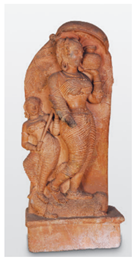
Figure 1 Ganga National
Museum Collection, New Delhi |
LITERARY FOUNDATIONS OF YAMUNA
Mythological
traditions associate Krishna closely with the Yamuna River, stating that he
spent his childhood in the regions along its banks and developed a deep
attachment to this landscape Eck (2012). The symbolic relationship between Ganga and
Yamuna is linked to their confluence at Prayag, a site regarded as highly
sacred. This meeting of rivers is believed to hold strong ritual value, and
earlier traditions considered death at this location to be spiritually
beneficial Dwivedi
(2007).
Yamuna is
described in textual and devotional traditions as the daughter of the Sun and
is often associated with themes of love and devotion. Pilgrimage practices
include the singing of hymns and ritual visits to the Divya Shila and the Maa
Yamuna temple at Yamunotri, where the goddess is
worshipped in iconic form Eck (2012).
Kalindi, also
known as Yamuna, is regarded as one of the sacred rivers of India and is
personified as the goddess Kalindi devi. She is described as the daughter of
the Sun and is said to originate from the Kalinda mountain, from which she
derives the name Kalindi. A well-known narrative in the Bhagavata Purana
associates the river with the birth of Krishna. According to the text, when
Vasudeva carried the newborn child across the flooded river during heavy rains,
Kalindi parted her waters to provide him safe passage. This episode reinforces
the river’s role as both a divine being and a protective sacred presence Shastri
and Bhatt (2004). Another narrative in the 10th Skandha of
the Bhagavata Purana describes an episode involving Balarama and the river
Kalindi. While staying in Ambadi, Balarama once went to the riverbank with the gopis. Under the influence of liquor, he wished to enter
the waters and called the river to approach him. When Kalindi did not respond,
he pulled her toward him with his plough. The text states that the river,
personified as a goddess, then submitted in fear, after which Balarama sported
in her waters with his companions. This episode reflects the anthropomorphic
treatment of rivers in Puranic narratives and their integration into divine
myth cycles. Another account presents Kalindi as one of the wives of Krishna.
During a visit to Indraprastha, Krishna and Arjuna encountered a woman
performing penance on the banks of the river. She identified herself as Kalindi
and stated that her austerities were undertaken to obtain Krishna as her
husband. After Arjuna conveyed this to Krishna, he took her to Dvaraka and married
her. The text further records that Kalindi later gave birth to ten sons by
Krishna.
An account in the
Sabha Parva of the Mahabharata The Mahabharata (1893) records an episode connected with Kalindi during the conflict between
Krishna and Jarasandha. The son of Jarasandha’s minister Hamsa, mistakenly
believing that his father had been killed in battle, ended his life by jumping
into the river. When Hamsa later returned alive and learned of his son’s death,
he too entered Kalindi and died. Other references in epic and Puranic
literature emphasize the ritual and sacred importance of the river. The Adi
Parva describes Kalindi as one of the principal tributaries of the Ganga and
states that drinking its water removes sin. The Vana Parva notes that the
Pandavas refreshed themselves by drinking its waters during exile, and it also
records several royal and ascetic activities on its banks, including yajnas
performed by Bharata, Ambarisa, and Shantanu, as well
as penance undertaken by the sage Agastya. A tradition preserved in the Vamana
Purana explains the dark colour of the river by linking it to a myth in which
Shiva, distressed after the death of Sati, entered the river, causing its
waters to turn black. These narratives collectively present Kalindi as both a
sacred landscape and an active participant in mythological history.
The Padma Purana. (n.d.) illustrates this belief through the
narrative of the merchant Hemakundala and his sons.
While the father attains spiritual merit through charity and asceticism, his
sons fall into moral decline. After their deaths, one is condemned to hell, but
the other attains heaven solely because he had unknowingly bathed in the Yamuna
for two months while residing near a Brahmana hermitage. The episode emphasizes
the theological idea that ritual contact with sacred rivers could remove sin
and grant liberation independent of intentional religious practice. This belief
also contributed to the personification of Yamuna as a goddess.
|
Figure 2
|
|
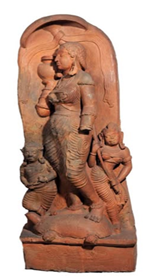
Figure 2 Yamuna National
Museum Collection, New Delhi |
ICONOGRAPHY OF GANGA AND YAMUNA
The iconography of
Ganga and Yamuna follows a clear and stable visual grammar that remains
consistent across regions and historical phases. Their representations are
shaped mainly by ritual function rather than narrative context. In most
sculptural settings they appear as liminal figures placed at architectural
thresholds, especially on temple door jambs. This placement establishes their
primary symbolic role as agents of purification before entry into sacred space.
From the early medieval period onward, both river goddesses are positioned on
the lower sections of door frames, usually flanking the entrance symmetrically.
Their presence marks the transition between the outer and inner zones of the
temple. Passing between them symbolically replicates ritual bathing, so that
the devotee enters the sanctum in a purified state.
In sculptural
representations, the goddess Ganga is shown standing upon her vahana, the
makara Darian
(1978). This aquatic composite creature is
understood as a symbol connected with water, vegetation, and the sustaining
basis of life. At the same time, it also conveys associations with the unknown
depths of the sea and the element of danger linked to powerful waters. Ganga is
commonly depicted holding a kumbha, or water vessel, which signifies abundance
and life-giving capacity. As a divine figure, Ganga is often described as
embodying the benevolent energy of the gods. Her destructive force is believed
to have been restrained and regulated through her descent into the matted hair
of Shiva. In visual and literary traditions, she also appears in a maternal
role, marked by qualities of nourishment, protection, and forgiveness rather
than anger.
In visual
representation, goddess Yamuna is usually shown standing upon a tortoise that
serves as her vehicle. She commonly holds a blue lotus, a fly whisk, and a
water pot, objects that indicate purity, fertility, and ritual use Jones
and Ryan (2006). The Agni Purana Shastri
and Gangadharan (2013) describes Yamuna as dark in complexion,
riding a tortoise, and holding a water pot, reinforcing her status within the
sacred river cult tradition.
The Vishnudharmottara Purana Kramrisch
(1993) provides a clear iconographic description of
the river goddesses Ganga and Yamuna as attendant figures placed beside major
deities, especially Varuna. In this account, Ganga is described as fair in
complexion, compared to the brightness of the moon, and shown standing upon a
makara. She typically holds a chamara in one hand and
a lotus in the other, indicating both royal service and purity. Yamuna is
distinguished by a dark blue or black complexion, likened to the nilotpala flower, and is shown standing upon a tortoise.
She also carries a chamara along with a blue lotus,
which functions as her identifying attribute.
Sculptural
examples follow these textual prescriptions closely. Both goddesses appear as
graceful female figures placed symmetrically on architectural thresholds,
particularly on temple door jambs. They often stand beneath trees and are
accompanied by attendants. In several carvings they hold a purna
kumbha, reinforcing their association with fertility, abundance, and ritual
purification. Their placement at entrances is not merely decorative but
symbolic, marking the transition into sacred space and signifying ritual
cleansing before worship. The visual contrast between Ganga’s light complexion
and makara vehicle and Yamuna’s darker tone and tortoise mount remains a
consistent iconographic device used to differentiate the two river goddesses in
early and medieval temple art Rao (1985).
SYMBOLIC AND RITUAL FUNCTION
The Narada Purana Shastri
and Bhatt (2004) repeatedly presents sacred rivers as agents
of purification and merit, placing Ganga at the highest level among them while
also including Yamuna within the same sacred geography. The text states that
bathing in these rivers removes sin, grants religious merit, and supports
progress toward liberation. Ganga is described as especially powerful because
her waters purify even grave moral faults, while Yamuna is mentioned alongside
her in lists of holy rivers whose waters produce similar ritual effects. The
Purana also links their sanctity to pilgrimage practice, explaining that
visiting their banks, performing offerings, and conducting rites for ancestors
bring lasting spiritual benefit. Their sacredness is therefore framed not only
in mythic terms but also through repeated ritual use, where contact with their
waters functions as a direct means of purification and religious
transformation.
The ritual
symbolism of the Ganga is rooted in her understanding as both a supreme
purifier and a liminal presence that mediates between different planes of
existence. In Hindu ritual thought, flowing water possesses inherent cleansing
power, and the Ganga, believed to originate in the celestial realm before
descending to earth, embodies this purificatory capacity in its most potent
form. Contact with her waters through bathing, sprinkling, or ritual use is
understood to remove accumulated pollution and restore ritual purity, while the
immersion of ashes in the river ensures the safe passage of the soul to the
ancestral realm. At the same time, the Ganga functions as a symbolic threshold,
reflected in her association with the concept of tirtha, a crossing place
between worlds. This liminal role explains her placement at temple doorways in
the Gupta and early medieval periods, where she marked the transition from the
human to the divine sphere. As a continuous link between heaven, earth, and the
realm of the dead, the Ganga thus represents both purification and passage,
embodying the ritual idea that spiritual transformation occurs through
processes of cleansing and crossing Kinsley
(1998).
Texts belonging to
the epic and Puranic corpus contain extensive mahatmayas
that praise ganga’s purifying power. Devotional literature also reflects this
maternal imagery. One well known example is the hymn Ganga Lahari composed by
Jagannatha, where the river is described as a compassionate mother who accepts
and shelters even those rejected by others Eck (1996), Eck (2012). In iconographic terms, the lotus and the
water pot function as her primary attributes and indicate auspiciousness,
fertility, and purification. Her waters are frequently compared to milk and are
understood as a sustaining substance essential for life itself Eck (2012).
Ritual traditions
across Sanskrit sources consistently emphasize the purificatory and sacred
efficacy of the river Ganga. In the Mahabharata Rajagopalachari (1968), Ganga is explicitly described as a sacred
river whose remembrance itself removes sin, while ritual immersion in her
waters produces spiritual purification, placing her within the broader
framework of tirtha practices associated with sacred geography. This ritual
function is reinforced in the Ramayana, where Ganga water is used in formal
rites and is associated with hermitages and ascetic landscapes, indicating her
centrality in ritual life and sacrificial contexts. Puranic sources further
elaborate the theological basis of this ritual potency. The Devi Bhagavata
Purana (n.d.) affirms her status as a divine being whose sacred nature enables
ritual cleansing and spiritual merit. Across these textual traditions, Ganga
emerges not merely as a physical river but as a ritual medium through which
purification, merit, and sacred contact with the divine are achieved.
All three
traditions; textual, ritual and visual signify that the Ganga and Yamuna have
not only mythological stories about them but that they also continue to be seen
as representations of purification and transformation. Sacred water was first
defined by the Vedic conceptions found in the epics and puranas and then later
through visual representation. That definition can be found in temple
architecture, where the river goddesses are clearly positioned at the entrance
of the sanctum in order to clearly create meaning within the threshold. By
placing the river goddesses at the door into the sanctum, the door itself now
has meaning as a point of transition from the external everyday world into the
internal sacred space. Crossing the threshold is a symbolic act of purification
similar to that of a ritual bath and prepares the devotee for meeting God.
Therefore, the threshold serves as something more than a physical boundary; it
is a conceptual tirtha, a place where the concepts of movement and change come
together.
The relationship
between text-based resources and sculpture forms along with aspects of ritual
practices exhibit how these thoughts can be expressed through both an image and
space. As figures of transition, Ganga and Yamuna serve to highlight the process
of moving into the sacred from one space (the profane) to another. In addition,
because they are consistently placed at temple entrances shows the continual
design feature of an entry into a temple’s inner sanctum to have been a
defined/mediated space, as opposed to an act of freely entering.
CONCLUSION
Ganga and Yamuna,
located at the entrance of the temple, exemplify how Indian sacred architecture
reflects theological concepts through physical and visual means, thus moving
from abstract definitions of both purification and transitioning to ritual behaviour
as a lived experience. The sacred rivers Ganga and Yamuna evolved out of the
Vedic, epic, and Puranic traditions as sacred rivers with purifying qualities.
As such, they are represented as liminal figures in temple iconography and in
the temple, act as intermediaries for the worshiper's movement into the
sanctum. Located at the entrance of the temple, Ganga and Yamuna define the
tirtha, the entrance, as a site of ritual purification; as a result of
entering, the ritual act of passing through the tirtha represents the ritual
act of entering and being immersed in the water of Ganga and Yamuna. Therefore,
myth, ritual, and architectural form converge to make a significant encounter
with the divine and not only does the individual pass through the physical site
of the temple, but they also undergo transformation. The continuous presence of
Ganga and Yamuna in temple forms reflects a central idea in Hindu religious
thought: the movement from the profane to the sacred occurs through
purification at a point of transition where the sacred is encountered and
embodied.
ACKNOWLEDGMENTS
None.
REFERENCES
Baartmans, F. (2000). The Holy Waters: A Primordial Symbol in Hindu Myths. B.R. Publishing Corporation.
Darian,
S. G. (1978). The
Ganges in Myth and History. Motilal Banarsidass.
Devi
Bhagavata. (n.d.). Gita Press.
Dwivedi, A. K. (2007). Encyclopaedia of Indian Customs and Rituals. Anmol Publications Pvt. Ltd.
Eck, D. L. (1996). Ganga: The Goddess Ganges in Hindu Sacred Geography. In J. S. Hawley and D. M. Wulff (Eds.), Devi: Goddesses of India ( 137–153). University of California Press. https://doi.org/10.1525/9780520916296-010
Eck, D. L. (2012). India: A Sacred Geography. Harmony Books.
Foulston, L., and Abbott, S. (2009). Hindu Goddesses: Beliefs and Practices. Sussex Academic Press. https://doi.org/10.2307/j.ctv3029v69
Jones,
C., and Ryan, J. D. (2006). Encyclopedia of Hinduism.
Infobase Publishing.
Kinsley,
D. (1998). Hindu Goddesses: Visions of the Divine Feminine
in the Hindu Religious
Tradition. Motilal Banarsidass Publishers.
Kramrisch, S. (1993).
The Vishnudharmottara (Part III):
A Treatise on Indian Painting and Image-Making. Motilal Banarsidass.
Kumari,
M. K. (2018). Iconography of Gaṅgā
and Yamunā. Aryan Books International.
Padma
Purana. (n.d.). Gita Press.
Rajagopalachari, C. (1968). Mahabharata. Bharatiya
Vidya Bhavan.
Rao,
T. A. G. (1985). Elements of Hindu Iconography (Vol. 2, Pt. 2). Motilal Banarsidass
Publishing House.
Rodrigues, H. (2007). Hinduism: The eBook.
Journal of Buddhist Ethics
Online Books.
Shastri,
J., and Bhatt, G. P. (2004). The Bhagavata Purana (Pt. 2, Vol. 8).
Motilal Banarsidass.
Shastri,
J., and Gangadharan, N. (2013). The Agni-Purana (Pt. 1, Vol. 27). Motilal Banarsidass.
Shastri,
J., and Tagare, G. V. (2000). The Brahmanda Purana (Pt. 4, Vol. 25).
Motilal Banarsidass.
Shastri, J., and Tagare, G. V. (2004). The Narada-Purana (Pt. 1, Vol. 15). Motilal Banarsidass.
Singh, R. P. B. (2020). Sacrality and Waterfront Sacred Places in India: Myths and Making of Place. In C. Ray (Ed.), Sacred Waters: A Cross-Cultural Compendium of Hallowed Springs and Holy Wells ( 80–94). Routledge. https://doi.org/10.4324/9781003010142-9
|
|
 This work is licensed under a: Creative Commons Attribution 4.0 International License
© ShodhGyan 2026. All Rights Reserved.