
|
|
|
|
Food, Faith, and Festivity: A Cross-Cultural Comparison of Meitei Cheiraoba and Chakma Bizu Celebrations
Satabdi Chakma 1
 , Kshetrimayum
Premchandra 2
, Kshetrimayum
Premchandra 2
1 Research
Scholar, Department of English, Tripura University, Suryamaninagar,
Tripura, India
2 Assistant
Professor, Department of English, Tripura University, Suryamaninagar,
Tripura, India
|
|
|
ABSTRACT |
|
|
This paper
explores the intricate interplay of food, festivities, and faith in the New
Year celebrations of the Meitei community of Manipur and the Chakma community
of Tripura in the northeast region of India. The Meiteis observe their New
Year on the first day of the lunar month of Sajibu
(March–April), while the Chakmas celebrate Bizu from 13 to 15 April annually. This study foregrounds
the culinary traditions of both communities, situating
food as a central element of ritual and identity. Through an examination of
traditional food preparation, ritual offerings, and associated festivities,
the paper illustrates how these practices serve as vehicles for
intergenerational knowledge transmission and cultural continuity. The use of
indigenous ingredients, deeply embedded in local ecologies, reflects
sustainable dietary habits and health-conscious living. The analysis reveals
that these festive cuisines are not merely about sustenance but embody
symbolic meanings, reinforce community ties, and reaffirm the shared
relationship between people, land, and tradition. Ultimately, the paper
contends that the New Year foodways of the Meiteis and Chakmas
are critical expressions of heritage, collective memory, and community
harmony. |
|||
|
Received 12 October 2025 Accepted 20 November 2025 Published 19 December 2025 Corresponding Author Satabdi Chakma, satabdichakma670@gmail.com
DOI 10.29121/Shodhgyan.v3.i2.2025.69 Funding: This research
received no specific grant from any funding agency in the public, commercial,
or not-for-profit sectors. Copyright: © 2025 The
Author(s). This work is licensed under a Creative Commons
Attribution 4.0 International License. With the
license CC-BY, authors retain the copyright, allowing anyone to download,
reuse, re-print, modify, distribute, and/or copy their contribution. The work
must be properly attributed to its author.
|
|||
|
Keywords: Meitei,
Chakma, Cheiraoba, Bizu,
Culinary Practices, Ritual, Festival |
|||



1. INTRODUCTION
Culinary heritage and practices among the Meiteis (Manipuri) of Manipur and Chakmas of Tripura are deeply embedded in the broader matrix of traditions, belief systems, and mundane and sacred expressions of community energy and harmony. These practices are most vividly manifested in ritual observances, festive celebrations, and group feasts, wherein food functions not only as a key medium of cultural expression but also as a mechanism for preserving traditions and reinforcing social cohesion.
A closer look reveals that the Meitei and Chakma food practices are not arbitrary but shaped by historical, environmental, and societal influences, reflecting the community’s values, beliefs, and relationships with nature and society. As food systems are inherently shaped by the availability of local resources and by cultural and social practices, the Meitei and Chakma people have developed distinctive ways of preserving certain food traditions by integrating them into festivals and social occasions. Before examining other aspects of these two communities, it is essential to provide a brief contextual overview of the Meiteis and Chakmas, along with considering their points of convergence and divergence in the topics under consideration. This short introduction to the tribes/communities is intended to bring clarity to the cultural and historical background necessary for a more nuanced understanding of the analyses presented in this paper.
The entire region from the Brahmaputra Valley to Myanmar (Burma) and to the Chittagong Hills Tracts and the contiguous areas around them is home to many cognate tribes with their distinct cultures, languages, beliefs, and practices. Before the British made boundaries and their administrative nomenclature came into existence, this vast area of land had witnessed cultural exchanges between different communities, food practices were shared, stories were told and retold, and they made peace with one another when feuds and wars ravaged their lives. It is not surprising that variations of the same structurally similar tales, riddles, and sayings are found amongst many communities such as Mogs, Mizos, Mrus, Khumis, Chakmas, Tripuris, Meiteis, Nagas, Kukis, Avas, etc. Migration and trade also acted as a tool of acculturation and shared values and exchanges.
Manipuri chronicles the migration of groups, small and large, and talks about various tribes migrating from Takhel, the Manipuri name for present-day Tripura and beyond. There are series of ancient Manipuri texts such as Poireiton Khunthokpa, Nongshaba Khunthokpa, Angom Khonghou, Bamon Khunthok, Nongpok Haram, Nongchup Haram, Ukhongshanglon, and other similar migration and integration in old Manipuri chronicles. In this regard, renowned Manipuri scholar Ningthoukhongjam Khelchandra opines, “Most of those who migrated from outside the land integrated into one of the yek-salai (ethnic clans) of the original settlers. The descendants of those who migrated from the east, like Awa, and Khagi (present day China), took Manipuri yumnak-sagei (genealogy system), and settled in Manipur are known as ‘Nongpok Haram.’ Similarly, the descendants of those who migrated from the west and took Manipuri genealogy system and integrated into the Manipuri society are known as ‘Nongchup Haram’ (215). These groups integrated into the Meitei fold, taking Meitei clans and following their traditions and customs. To cite an example, it is part of the oral history that the people of Kakching followed their progenitor Khamlangba (who got deified later) from Takhel (Tripura) when he married a Tripuri princess and came back to Manipur. His migration is important because he brought the tools and technology of iron smelting from Tripura, which proved beneficial for the kingdom.
There are numerous commonalities between the Chakmas and Meiteis (Manipuris). Their similarities encompass aspects such as physical features, food habits, customs, family and social structures and traditions. These cultural and social similarities (though linguistically different) could have stemmed from historical interactions, migrations, sustained contacts, and episodes of acculturation that have shaped their shared characteristics, which are evident to date. Moreover, many different tribes and groups share similar stories of a shared common ancestry prior to a historical separation in their oral traditions. That said, with regard to certain social customs, the parallels between the Meiteis and Chakmas are numerous and significant, suggesting a shared cultural substratum that cannot be easily dismissed. Such implications warrant closer examination and will be explored in subsequent discussions.
According to Langoljam Birmangal Sinha, a Manipuri historian and author based in Agartala, the tribes of Tripura, including the Chakmas, refer to the Meiteis of Manipur as ‘Moglei’ or ‘Moglou’. This nomenclature may represent a linguistic corruption of ‘Mekhli’, the Bengali term used to denote the Meiteis of Manipur. In an interview with Niranjan Chakma at Kanchanpur, North Tripura District, on 8 February 2025, he also confirmed that the Chakmas use the above terms to denote Meiteis. In the same interview, Niranjan informed the authors that, according to both Chakma’s written and oral historical accounts, they passed through Manipur during their migration.
The Chakmas constitute one of the nineteen officially recognised tribes of Tripura, with a documented presence in the state spanning several centuries. As with many indigenous groups in Northeast India, the origins of the Chakma people remain a subject of scholarly debate, with contesting interpretations emerging from religious, historical, and anthropological perspectives. From an ethnographic and cultural standpoint, the Chakmas are generally identified as belonging to the Mongoloid racial stock, and their language is classified within the Tibeto-Burman linguistic family. As regards the meaning of the term Chakma, Lakshmi Bhusan Chakma writes that the term derives from the conflation of two terms, “Sakka’ meaning ‘able’ and ‘ma’ meaning ‘people’ (1). Many Chakma scholars identify them as descendants of the Sakka dynasty. Interestingly, noted Manipuri historian Prof. Gangmumei Kabui, quoting another historian, W.I. Singh, writes, “[…] ethnic group of Poireiton [one of the earliest migrants] was a Chakkha tribe and a descendant of Abhiraja of classical Sakya ruling house of Moriya in Kabaw valley” (81).
This observation is interesting because the Chakma oral history talks about their migration through Manipur from Burma, and there is no insinuation from the authors that the Chakkha tribe mentioned here is the Chakma tribe. Historical narratives and oral traditions indicate a protracted process of migration and settlement, suggesting a deep-rooted connection between the Chakma community and the geographical landscape in and around Tripura. It is generally accepted that they “migrated from mainland India to Burma and finally to the Chittagong Hill Tracts” Chakma (2015). Furthermore, “These ancient indigenous groups of people,” writes Niranjan Chakma, “are divided into three main groups: Anokya, Tonchongya and Dainnek. There are as many as sixty sects (Gozas) and more than one hundred and fifty clans (Gutthis). In recent times, the Tonchongyas of Bangladesh claim themselves as belonging to a separate ethnic group” (intro. iii). The ‘main groups’ referenced by Niranjan Chakma denote the various ‘ethnic groups or communities’ which merged to form the composite Chakmas identity. However, despite this amalgamation, sub-ethnic identity formation has taken place within the constituent ‘groups’, indicating a layered and dynamic construction of Chakma ethnicity.
As regards the Meiteis of Manipur, they are a conglomerate of different tribes and principalities that came under the Meitei fold during their nation formation process. To begin with, the social structure of the dominant community (Meiteis) was founded on a lineage/kinship/clan system known as yek-salai. Yek refers to a shared lineage or common blood ancestry originating from a patriarchal figure, while salai denotes the progeny or descendants through whom human beings are believed to have emerged Birchandra (2013). These yek-salais are like the Chakma ethnic groups such as Anokya, Tonchongya and Dainnek. Meiteis are divided into seven yeks: Ningthouja, Angom, Khuman, Khaba-Nganba, Moirang, Sarang-Leisangthem, and Luwang. The eminent scholar on Manipuri culture and traditions, Naoroibam Indramani, lists more than 33 such ethnic clans or groups in Manipur, which grew bigger and merged with one another either mutually or through suppression (5). These yeks are again divided into clans (lineage-based) and subclans (genealogy-based), locally known as yumnak and sagei, like the Chakma gozas and guthi. The Meiteis are traditionally animists and worship/ped their ancestors. The religion they follow is Sanamahi Laining, one of the principal gods associated with the Meitei creation myth. There are also umang lais, which are ancestral and tutelary deities which are appeased in an annual ceremony called lai Haraoba by maibas and maibis (male shamans and female shamans).
Meiteis of Manipur follow a dual religion. They are Vaishnavites but have not abandoned their old ways and faith. Chakmas are predominantly Buddhists, and they follow the Theravadin School of Buddhism. However, one can still find traces of many cultural and religious influences and absorptions evident in their oral narratives, rites and rituals, and other social and cultural practices. These communities enjoy ample freedom to celebrate and observe cultural and religious festivals without any constraints or restrictions. Amongst the festivals celebrated by the Chakmas and Meiteis, Bizu and Cheiraoba stand out because of the similarities between these celebrations.
A point to ponder is that both the Meiteis and Chakmas have an enduring preference for settling near rivers and other water bodies. Historical migration patterns consistently reveal that proximity to reliable water sources has been a key factor in their choice of settlement locations. In fact, the Mizos call the Chakmas Takham, which is derived from the word ‘Tui Kham,’ meaning people who live near the water (Chakma, South-East Asia 1). This preference is deeply rooted in their reliance on aquatic resources, particularly fish, shrimp, and other freshwater species, which are vital components of their diet and cultural practices. Furthermore, they have developed techniques and methods of fermentation, including drying vegetables and drying meat, food preservation, and other traditional methods. These practices not only extend the shelf life of seasonal foods but also enhance their nutritional value and flavour profiles, reflecting a deep-seated ingenuity in adapting to the challenges of their environment.
2. A Tale of Two Festivals
“Chakma Jidu Bizu Sidu, Bizu Jidu Chakma Sidu” This deeply resonant saying, translating to “Where there are Chakmas, there is Bizu, and where there is Bizu, there are Chakmas,” movingly captures the profound connection between the Chakma people and their most cherished festival, Bizu. More than just a celebration, Bizu embodies the Chakma cultural spirit, identity, collective memory, and, most importantly, food culture.
As regards the origin of the term ‘Bizu,’ Lakshmi Bushan Chakma opines that:
The word ‘Bizu’ might have come from the Sanskrit word ‘Bishuva’ (meaning the day on which the sun enters the Aries zodiac) since the Chakmas pronounce the words with middle and last ‘sa’, ‘sha’ as ‘za’, ‘jha’ (e.g., Voijhak> Vaishakha), Pojhak>poshak, Pojhu>posu), etc. It is an agriculture based festival of the Chakmas. Around this time people remains at home with stock of crops they harvested and no new work has also started. (224)
Bizu is a vibrant celebration deeply rooted in the rhythms of nature: it honours the beauty of flowers, the flow of rivers, the majesty of hills, and the richness of trees and forests. It reflects a deep connection between the Chakma people and their natural surroundings, symbolising renewal, growth, and the cycle of life. The Bizu festival is traditionally celebrated over three consecutive days, and they are known as Phool Bizu, Mhul Bizu, and Gochye-Pochye Bizu, from April 13th to 15th each year. This vibrant festival marks the Chakma New Year, coinciding with the end of Chaitra (March-April) and the beginning of Vaishakha (April-May) in the Bengali calendar. It is a symbolic passage between the old and the new, embodying gratitude for the year gone by and hope for prosperity, renewal, and joy in the year ahead. Bizu reflects the timeless cycle of endings and beginnings, resonating with the universal human aspiration for rejuvenation and continuity.
On the other hand, Cheiraoba is a conflation of two Manipuri words: chei, meaning ‘stick’ and raoba/laoba, meaning ‘to declare.’ The term comes from the cheithapa method introduced by King Kyampa in 1485 CE. The Royal Court Chronicle, Cheitharon Kumpapa notes that the practice of the cheithapa method began following a diplomatic meeting with the king of Pong, an ancient kingdom located in present-day upper Myanmar. So, what is cheithapa? As noted above, the term Cheithapa refers to a ‘stick’ (chei) and ‘to place’ or ‘to put down’ (thapa), meaning ‘to put down the stick.’ In ancient Manipur, counting was conducted by placing sticks to represent base numbers. Accordingly, cheithapa denotes the act of placing sticks to facilitate counting Parratt (2005). Therefore, from this tradition the counting of the new year began and Cheiraoba is the declaration of the new year in the spring season. When Manipur was still a kingdom, Cheiraoba was followed by the king’s symbolic tilling of the field at Harao Lou (field of joy).
The character of Cheiraoba has undergone a significant transformation since the 90s. This shift is closely linked to the ongoing Sanamahi Laining revival movement in Manipur, which seeks to reclaim and reassert an indigenous Meitei cultural identity distinct from external influences that have shaped it over several centuries. As part of this cultural resurgence, adherents of Sanamahi worship now observe Cheiraoba on the first day of the Manipuri lunar month of Sajibu (March-April). In contrast, Meitei Vaishnavites, who follow the Bengali calendar introduced during the spread of Gaudiya Vaishnavism in the region, continue to celebrate Cheiraoba on the first day of Vaishakha, thereby reflecting the religious and calendric bifurcation within the Meitei community.
There are both convergences and divergences between the festivals of Bizu and Cheiraoba. Both these festivals are observed around the same period in the spring season, and each comprises a blend of community-level programmes and household-based rituals. Additionally, both carry deep religious and cultural significance within their respective communities. While Meitei Cheiraoba, also referred to as the Manipuri New Year, is observed for a single day on the first day of the lunar month of Sajibu (March–April), the Chakma Bizu is celebrated over three days beginning on the first day of Vaishakh. Cheiraoba involves the preparation of elaborate meals that are ritually offered to Sanamahi, the principal deity in the traditional Meitei pantheon, to Leimarel Sidabi, the divine mother, and to the ancestral guardian spirits. The observance culminates in the evening with a symbolic ascent of a nearby hill, where further prayers are offered, signifying spiritual elevation and renewal.
3. OFFERings
On the occasion of Meitei Cheiraoba, very elaborate rituals are performed to express gratitude to the lai (deities) for the year that has passed. These rituals also serve as prayers for the protection of the king and his family, the bestowal of peace and harmony, a bountiful harvest, and a calamity and disease-free nation. The Chakma community also performs a series of intricate rituals over the three-day Bizu festival. These rituals underscore their deep spiritual and cultural connections with the various elements which have sustained them. Catherine Bell posits that “[...] the system of offerings communicates messages about the relative status of the invisible recipient, effectively distinguishing among groups of spirits that have different relationships with the living” (68). Thus, one can interpret the offerings made by these communities in the form of food, flowers, and fruits as illustrations of their rootedness within specific social structures and their function in sustaining those structures, such as their belief systems, cultural values, and culinary heritages. Ultimately, the true meaning of the system of offerings made by both communities can be believed to reside in the underlying structural patterns that are communicated through the message these offerings carry.
3.1. Flower Offerings
Figure 1
|
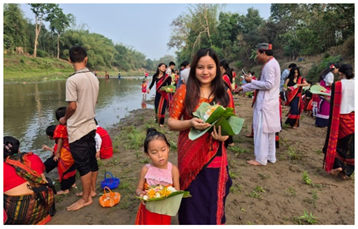
Figure 1 Chakmas Offering Flowers to Maa Ganga on Phool Bizu |
The first day of Chakma Bizu, known as Phool Bizu, is marked by the ceremonial offering of various flowers of different kinds and colours into a water body, typically a river, symbolically representing Maa Ganga. Freshly collected flowers, gathered early in the morning, are placed in clean banana leaves and offered to Maa Ganga as part of the ritual observance. A commonly followed guideline in this flower offering is the exclusion of thorn-bearing flowers, as they are traditionally regarded as inappropriate for offerings.
Figure 2
|
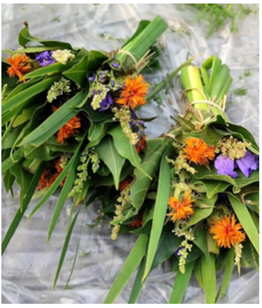
Figure 2 Flowers Offered in Meitei Cheiraoba |
Flowers offered in the Meitei Cheiraoba are more specific and traditionally followed. Among the must-offer flowers are kusumlei (also spelt Kushumlei, meaning safflower), kombirei (the Manipuri term for ‘iris’), chinglei, chagemlei (English terms not found), and various kinds of orchids. These flowers are usually tied together in bunches, and each bunch is offered along with other items to the principal God in the Meitei pantheon, Sanamahi, and His mother, Leimarel Sidabi, who reside inside the house. Three bunches are offered at the place where the ancestral deities reside.
In Manipuri society, the integration of flowers into Cheiraoba celebrations symbolises the onset of a new season and the process of spiritual rejuvenation. Beyond their aesthetic and ritualistic value, flowers hold profound cosmological significance in Meitei society. Ancient texts suggest that various parts of the supreme creator’s body were transformed into flowers, thereby sacralising their existence within cultural imagination. Floral taxonomy in these traditions is highly stratified, encompassing classifications such as flowers worn by deities and their consorts, those designated for appeasement rituals during festivals, and prescriptive norms regarding their appropriate adornment and usage Gourachandra (2012). Among the Chakmas, such offerings reflect a sustained connection with natural elements rooted in their pre-Buddhist traditions.
3.2. Fruit Offerings
On the concluding day of Bizu, devotees go to the temple to pray. On this day, Buddha Puja is performed and devotees offer fresh seasonal fruits. As regards the offerings made to Lord Buddha, Lakshmi Bhusan Chakma writes that, “It is an occasional puja or vowed puja offered before a Buddha idol consisting of rice, curry, sticky rice, jaggery, sweets, fruits and other materials” (221). Seasonal fruits are also offered at the foot of the designated big tree with green foliage. In contrast, the Meitei Cheiraoba is considered incomplete without the ceremonial offering of fruits to the deities. Similar to the offering of flowers, fruits are divided into five equal portions and offered to the two household deities and three ancestral deities outside.
Again, in Meitei Cheiraoba, some fruits such as malhei (apricot), heirit (auriculata (Lour.) Roxb), chorphon (floribundus Blume), tamarind, raw ground nut, raw yam, raw sweet potato, ripe banana, etc., must be offered to the deities. raw lotus root, sugarcane and other seasonal fruits are also offered at the two spots. As stated above, these offerings establish a ritualistic and symbolic connection with the benevolent deities and ancestral spirits, who are believed to ensure the well-being of the household and the community. The act of offering is also imbued with agrarian symbolism, representing prayers for a bountiful harvest and an abundance of fruits and flowers the earth bestows in the coming season.
3.3. How and where are these Offerings made?
On the occasion of Phool Bizu, the flower offerings to Maa Ganga are accompanied by the lighting of incense sticks and candles along the bank of the water body. In the evening of Phool Bizu and the following two evenings, an offering of candles, incense sticks and flowers is made beneath a large green tree. On the morning of Phool Bizu and the following morning before noon, offerings are made at the edge of the courtyard and again at the water body. Offerings made at each site hold symbolic significance for the Chakmas. The offering made at the courtyard is directed towards the sky, the one at the water body continues the veneration of Maa Ganga, and the offering at the tree reflects the reverence of nature. The sky represents the protective shield that protects every Chakma and provides sunlight and rain, which gives them a good harvest. The water is the lifeline and sustains them. And the tree points to the bounty of Mother Earth. Chakmas offer flowers and prayers to be protected from any untoward misfortunes in the future which they call apot-bipot. All these symbolic elements, which are venerated, point to the persistence of animistic and Hindu influences within their contemporary religious practices, demonstrating a syncretic cultural identity that blends older belief systems with more recent elements.
Offerings made during the Meitei Cheiraoba are more intricate and elaborate. It is to be noted that Hindu Meiteis also reserve a place for the gods of their ancestors in their houses, which serves as a puja place. At this location, which is the southwest corner of the house, the principal Gods Sanamahi and Leimarel Sidabi reside. After the food is cooked, two portions of each food cooked are neatly prepared and placed in front of the Sanamahi (symbolically represented by an earthen pot) and Leimarel Sidabi, along with flowers and fruits, incense sticks and candles. Curd or fresh milk is also offered with prayers for the new year and all the good things the year can bestow.
As previously noted, the offerings made outside the household are more elaborate in nature. A designated spot across the front from the home is selected and thoroughly wiped and cleaned either on the preceding day or early in the morning of Cheiraoba. This area is carefully demarcated to prevent animals from disturbing it. Following the offerings inside the house, three portions of the prepared food, along with flowers and fruits, are placed on banana leaves at the consecrated site, oriented towards the east. Candles and incense sticks are lit, and prayers are offered in a manner consistent with the indoor rituals. As within the household, fresh milk, drinking water, and sugarcane syrup are placed beside the food. These three offerings are dedicated to the ancestral deities, Hanuhal, Hanukoktong, and Hanuleikham. They are symbolically fed on this occasion to provide protective blessings, shielding their descendants from illness, death, and misfortune.
3.4. Other Cultural and Religious Activities
A noteworthy religious feature of the Chakma Bizu is the Bhavachakara, a maze created with bamboo slits fence with an entry leading to a statue of Lord Buddha at the exit. It is set up temporarily on an open ground. The long and winding walk in the maze is symbolic in both religious and philosophical contexts in the sense that it represents the cyclical nature of human existence and the treacherous path human beings must take to reach the Amitabha. The participants walk through the maze as a ritualistic enactment of life’s journey, culminating in an act of transcendence that signifies liberation from the cycle of rebirth to the attainment of moksha through Buddha and His paths.
A comparable example of a community participation event is the thabal chongba performed on the evening of Cheiraoba. Thabal Chongba literally translates to “dancing in the moonlight.” Like the Bhavachakra, thabal chongba is held on full moon nights and involves circular, participatory dancing by young men and women who hold hands and move rhythmically in unison. Rooted in the Manipuri creation myth, this dance fosters social cohesion and evokes themes of cosmic protection and eternal continuity. Both practices, though culturally distinct, embody a shared emphasis on cyclical time, community embodiment of faith and practices, and the symbolic transcendence of the human condition.
Another community activity during Meitei Cheiraoba is ‘Cheirao Ching Kaba’ or ‘climbing the Cheirao hill.’ This event takes place in the evening, and every Meitei village or town will have a designated spot atop a hill where it is believed that the lai (deity) resides. In the Hinduised version of the ‘Cheirao Ching’, Lord Shiva is often emulated in the form of a big stone where people go and pay tribute and offer prayers for well-being. The prayers offered at the hilltop mark the customary conclusion of Cheiraoba celebrations.
3.5. The Culinary Crossroads: Intersections and Contrasts
Figure 3

|
Figure 3 Food
Offering Across the Road on Cheiraoba Picture Credit: <kanglaonline.com> |
One distinctive feature shared by both festivals is the practice of preparing food not solely for the household but also extended social circles, such as friends, neighbours, and other relatives. Among the Chakmas, it is customary for individuals to visit the homes of neighbours, friends, and relatives to share food and festivities, even when abundant meals have already been prepared in their own homes. Similarly, among the Meiteis, delivering prepared dishes in bowls to the homes of relatives, friends and neighbours is common practice. These enduring practices reflect the community values deeply rooted in both cultures, strengthening social bonds, fostering mutual respect, and reinforcing a shared sense of identity during this essential cultural celebration. Therefore, each dish prepared on Bizu and Cheiraoba carries cultural significance, embodying the beliefs, traditions, and heritage of the Chakma and Meitei people.
Among the Meiteis, food holds profound ritual significance, as it must first be offered to deities before being consumed. They also follow the chang, shi, chang tradition while cooking on festivals and special occasions which means that dishes (not counting rice) are always cooked in odd numbers like one, three, five, seven, etc. Chang, shi, chang can be translated as the odd numbers which denote chang which means ‘alive’, while shi means ‘dead’. The Chakmas, as they must offer the cooked food to Lord Buddha before consuming it. In this context, food becomes deeply ritualised and sanctified, and consuming the sanctified food would be beneficial to the body and mind of the devotees. This act goes well with the famous maxim, “Let food be thy medicine and medicine be thy food,” in an intensified and sacred manner. While the notion that “we are what we eat” underscores the intimate relationship between food and identity, Meitei food practice elevates this further by consecrating it through rituals. As Plato observed, “We are bound to our bodies like an oyster to its shell,” suggesting that the body is inseparable from its material foundations.
Food, therefore, serves as the elemental substance shaping the human body from birth to growth. Thus, communities like the Meiteis and Chakmas developed their culinary traditions in line with their cultural, religious, and dietary knowledge through processes of experimentation and adaptation. The accumulated knowledge of food, dietary customs, and preservation techniques developed by their ancestors has been transmitted across generations, forming an essential component of their cultural heritage. In exploring the cultural dimension of food consumption, Wilkins emphasises the intricate interplay between necessity and symbolism, arguing that food consumption is not solely a biological imperative but also a deeply cultural act. As he noted:
Communities subsist on cereals, plants, and animals which are indigenous to a place (or are suitable for introduction) and supplement local agricultural production in two ways, with the capture of wild animals, birds, and fish and with goods imported from abroad. Few people eat at random and simply for fuel. Their choices of what to eat and how to eat it are culturally determined and tied to systems of religious and social belief, which are established by the culture in which they live. Wilkins (2000)
What we get from Wilkins’ assertion is that the act of eating transcends mere sustenance, encompassing a wide array of social, cultural and symbolic functions which we find in both communities.
Both Chakma and Meitei cuisines are characterised by their simplicity and balance, emphasising nutritional value, natural flavours, and minimal processing. Rice is the staple food for both communities, and a variety of dishes are cooked and eaten with it. A notable element in both cuisines is the use of fermented fish products, ngari in Meitei tradition and sidol in Chakma cuisine. The Chakma sidol can be fermented fish or shrimp paste, while the Meiteis use hentak, which is a paste of small fish and hong-ngoo (giant taro). Despite being misunderstood and mischaracterised as unhealthy within broader culinary discourse, these fermented ingredients are central to the gastronomic identity of both communities. Their intense aroma and distinctive flavour profile require an ‘acquired taste,’ underscoring the deep cultural conditioning of the taste buds and sensory specificity of these traditional dishes. About the dietary hypothesis, Weisberg asserts that “The purpose [of dietary hypothesis] has been to emphasise its logical derivation from the fact and mechanisms of evolution. And while the evolutionary bias is presently necessary in the selection of diet, there is no contention that nature cannot be improved upon” Weisberg (1973). Within this framework, the Meitei community’s strong preference for ngari (fermented fish) can be better understood not merely as a cultural idiosyncrasy but as a dietary practice shaped by geographical, cultural, and evolutionary contexts. This culinary attachment is encapsulated in the popular local idiom, “sangom yollaga ngari leiba” which translates as “to buy ngari by selling milk,” symbolising the high value placed on ngari within the Manipuri diet.
The festive cuisine associated with both Meitei and Chakma celebrations can be broadly categorised into four distinct types based on preparation methods and ingredients. The first category includes dishes prepared with fermented fish or shrimp, such as ngari and Chakma sidol. The second comprises boiled or oil-free preparations. The third category consists of items cooked with oil, which is a later addition, as both communities avoided oil in ancient times. Finally, the fourth category includes sweet dishes, which serve a celebratory function during the festival.
Dishes prepared with fermented fish, fermented fish paste or fermented shrimp paste
Figure 4
|
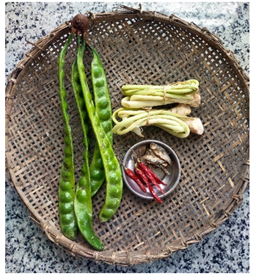
Figure 4 Eromba Ingredients: Yongchak (Bitter Bean or Petai) Loklei-Pullei (Types of Gallagans), Chilli, and Fermented Dry Fish, |
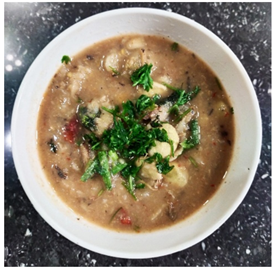
The Chakmas cook their comfort food called taba-di ton as part of Bizu celebrations. Taba is a mixture made of fermented shrimp paste with water, green chilli paste, salt, and a small amount of turmeric, while ton translates to “dish.” Tabadi ton or taba-di ton is unique in the sense that one can use any vegetable while cooking it, and it can be prepared within five minutes or more, depending on the types of vegetables used. Like the Chakmas, Meiteis also cook a similar dish called eromba, which consists of fermented fish, chilli, and vegetables. Both are consumed almost every day, and they are like food on the go. Both eromba and taba-di ton are oil-free dishes of a single or various vegetables. The only difference between the two is that vegetables, chilli, and heated or steamed ngari are smashed together in the case of Manipuri eromba. Taba-di ton is smashed; sometimes, whole or cut vegetables remain intact.
Figure 5
|
Figure 5 Manipuri Eromba |
A simple dish like taba-di ton or eromba invites reflection on the fundamental nature of human beings and the broader purpose of food consumption. It highlights that food is not merely a source of pleasure or taste but serves essential physiological and cultural functions. This perspective is reinforced by Goodman and Redcliff, who assert that:
Contemporary interest in food is not confined to pleasure in its consumption, but extends in every direction: to its economic importance, the semiotics of food taste, the dangers of food additives and the politics of food security. We live in societies as dominated by food preferences as by sexual preferences, as obsessed about eating too little as by eating too much. In addition our interest in food is associated, for good and evil, with our interest in ‘nature.’ (xi)
From the perspective of everyday food consumption of both the communities, it is established that they prefer minimal food items and dishes and abundance is reserved for festive and special occasions. Another widely consumed on the day of Cheiraoba is singju. It is the Manipuri version of the salad, but with lots of finely chopped raw green leafy vegetables mixed with chilli and fermented paste. It is spicy and adorns a Manipuri plate with grace. There is another fermented fish-based dish known as horbo, which can be considered the Chakma version of Manipuri singju. In horbo, one can use sour fruits or vegetables as the main ingredient and mix them with burnt fermented shrimp paste and chilli paste. Unlike singju, horbo is usually prepared with a single vegetable or fruit.
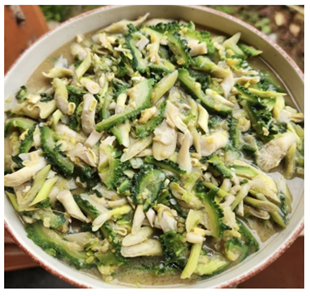
Within the Chakma community, there is a widely held belief that eating tideh gulo ton (bitter gourd dish) in seven households on Mhul Bizu is a protective measure against various illnesses. This practice is perceived as an act to enhance the body’s resistance to disease, symbolically marking the transition to a new year with renewed health and vitality.
Figure 6
|
Figure 6 Bitter Gourd and Tara (Galangal Stem) (@Chakma_Daily.Cooks Kitchen) |
The cooking process begins with the preparation of sidol. A slightly larger portion than usual is dissolved in water, thoroughly crushed, and then strained to extract the liquid. Among the Chakma people, it is believed that when cooking bitter or sour vegetables, using a greater amount of sidol and dried shrimp helps to balance and reduce the intensity of bitterness and sourness. Once prepared, the stock water is poured into a cooking pot, followed by the addition of dried shrimp, locally known as eje-guri, along with salt to taste, green chilli paste, and a small amount of turmeric powder. When the mixture begins to boil, sliced tideh gulo (bitter gourd) and tara (galangal stem) are added. The pot is then covered, and the dish is simmered until the vegetables are fully cooked and infused with flavour.
For the Chakmas, the importance of bitter vegetables, particularly bitter gourd, extends beyond festive traditions. It also plays a role in mourning rituals; following the cremation of a loved one, bitter gourd is consumed as a compulsory vegetable of the post-funeral dish.
3.6. Food cooked without oil (boiled food, but without fermented fish)
As stated, both communities enjoyed food without oil and have sustained themselves for centuries. Some oil-free dishes are boiled vegetables, which the Chakmas call ujono ton. And in Manipuri they are called chamfut or ‘boiled without ingredients’. However, a little bit of salt or sugar is added according to the vegetable used to enhance the taste. Some common vegetables are bottle gourd, ash gourd, beans, cabbage, mustard leaves, etc. Steamed vegetables also feature during the festival. Chakmas also use these vegetables in their ujono ton, but ash gourd and bottle gourd are not boiled as ujono ton.
3.7. Food items cooked with oil
In earlier times, the use of cooking oil was generally avoided in the culinary practices of both the Meitei and Chakma communities. During their respective festivals, both groups prepare various dishes that include vegetarian and non-vegetarian items cooked in oil nowadays. In Meitei households, the inclusion of fish curry typically marks the extent of non-vegetarian offerings. However, it is observed that more non-vegetarian items have been cooked and shared in recent times. For those who observe a vegetarian diet on Cheiraoba, the festive menu commonly features dishes such as various types of lentils, mixed vegetables, ooti, eromba, singju, etc. Similar culinary preferences are observed among the Chakmas during Bizu. Given the extensive range of food items associated with these festivals, it is not feasible to include all of them within the scope of this paper. Therefore, this study focuses on select dishes that are particularly distinctive, commonly prepared, and shared during these celebrations.
Chakma Bizu is incomplete without pajon ton. Pajon ton is a symbolic and shared dish prepared in every household and served to guests as a part of the Bizu celebration. There is a traditional belief among the Chakmas that eating pajon ton in seven different households during Bizu can make many diseases disappear, and it works as a gabon, which can be translated as a ‘protective shield’. It is also a commonly held belief among the Chakmas that pajon ton consumed on Mhul Bizu possesses a unique flavour that cannot be replicated when prepared on other occasions. Traditionally, the dish must be cooked on two consecutive days, specifically, the second and third days of Bizu, which fall on the 14th and 15th of April each year.
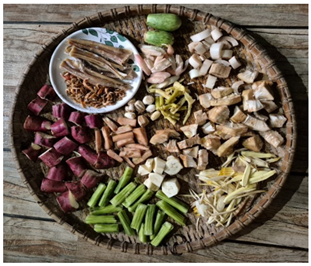
Pajon means mix in Chakma, and ton means dish. So, together, the term denotes the mix of seasonal vegetables that are cooked together. Pajon ton must consist of at least seven types of vegetables and more. The exact number of required ingredients or vegetables may vary across different regions and sections of the Chakmas.
Figure 7
|
Figure 7 An Array of Vegetables Used in Cooking Pajon Ton |
Though there is no direct equivalent to pajon ton in Manipuri cuisine, ingredient to ingredient, but Manipuris cook a similar dish known as ngouthong. Ngouthong is a Manipuri version of mixed vegetables but does not hold so much cultural significance as pajon ton. It is not a must cook dish and holds no value and stature as the Chakma pajon ton. However, one particular Manipuri dish is ooti which is cooked almost at every household during Cheiraoba.
Figure 8

|
Figure 8 Chive, Soaked Peas, Chopped Bamboo Shoot, Rice, Baking Soda, and Other Ingredients for Making Ooti |
Ooti is typically prepared using either fresh peas or dried ones, which must be soaked overnight, baking soda, whole rice or fragments, green and dried chilli, the peel of heiribob (citrus macroptera), freshly pounded spices, and chives, which are locally known as yenam nakupi and napakpi. Ooti is a versatile dish, and many ingredients can be used; some of the commonly used ingredients are raw papaya, bamboo shoots, ash gourd, etc. From an ingredient-based perspective, it can be categorised into two types: rice-based ooti (cheng ooti in which rice is the main ingredient) and pea-based ooti (hawai mangal ooti in which the quantity of peas is more than rice). Moreover, it is visually qualified as either green ooti or white ooti, depending on the ingredients used and the colour the end product produces. Getting the required taste, texture, and consistency requires meticulous attention and is regarded as a culinary skill not commonly mastered. Although there are variations in its method of preparation across households, the inclusion of baking soda (locally made khari was used in the olden days) remains a defining and indispensable element in all its cooking forms.
3.8. Sweet dishes
Sweet dishes are almost negligible in Manipuri cuisine, save for occasional consumption of sticky rice (both white and black) mixed with sugarcane syrup, banana, and milk. But nowadays, varieties of sweet dishes are cooked during Cheiraoba. Some of the common sweet dishes are black rice kheer, fruit dishes in sugar syrup, etc. But varieties of pancakes and dumplings made from rice flour are prepared and consumed by Manipuris on other ritual and festive occasions, but it is rarely seen in Cheiraoba festivities. However, in the Chakma cuisine, varieties of pithas (pideh in Chakma, which are similar to pancakes and dumplings) are prepared and shared. Some of the commonly cooked pidehs are described below.
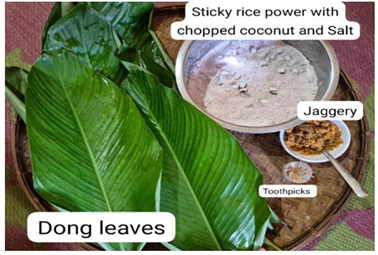
Bini Pideh is a traditional pitha served during Bizu. Bini pideh is prepared from sticky rice flour and wrapped in special leaves known as petteh pada or dong leaves. Petteh pada is notable for its distinctive flavour and aroma when used as a wrapping. Historically, the Chakma people made bini pideh for long journeys, especially during jhum cultivation or times of displacements, and long trips to seek manual labour for money known locally as haton or khaton. It is because these rice cakes are delicious, nutritious, easy to carry, and stay fresh for extended periods. Making it is not as complicated as one would believe it to be. The ingredients include hala bini shol o guri or black sticky rice powder, finely chopped coconut, and a little bit of salt. An optional filling, such as jaggery, may also be added for those with a sweet tooth. Jaggery and coconut are later additions.
Figure 9
|
Figure 9 Ingredients Used in Bini Pideh |
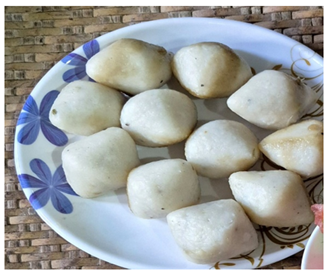
Another similar pideh is bini hoga is another similar to bini pideh. The fundamental difference is in the selection and choice of rice. Bini pideh uses sticky rice powder, while bini hoga uses whole sticky rice grains without grinding. There is also a slight variation in the ingredients: banana is added in bini hoga but not in bini pideh. Apart from this, the rest of the process remains the same. Another variation is sanne pideh, which is made from rice flour and uses the same variety of rice commonly consumed in daily household meals. It’s somewhat round, having a conical shape on both ends. Ingredients include regular rice that is used daily, shredded coconut, and jaggery or sugar.
Figure 10
|
Figure 10 Cooked Sanne Pideh |
4. Conclusion
From the discussions above, one can gather the idea that food practices are integral to a community’s cultural identity. They serve as markers of shared values, social cohesion, and collective memory. In communities that emphasise interdependence and community bonding, food sharing traditions are frequent and culturally significant. The intersection of food and festivity is particularly evident in celebrations such as Meitei Cheiraoba and Chakma Bizu, where culinary practices reflect seasonal abundance and reinforce community bonds and ritual obligations. Like other communities, the Chakmas and Meiteis also developed an understanding of various plants, recognising those beneficial to health and those harmful (food taboos). Through trial and error, they accumulated knowledge about edible plants and their effects on the human body, carefully preserving and transmitting this information across generations. Thus, These two communities developed a preference for food items and cooking methods.
The cultural significance of traditional festivals, particularly Bizu and Cheiraoba, cannot be ignored when promoting and furthering their food culture, associated rituals of their original faith, and festivals. The inclusive custom of sharing food with all visitors and near and dear ones reflects the deeply ingrained values of generosity and communal harmony within the Meitei and Chakma societies. Thus, through its food practices, rituals, and offerings, Meitei Cheiraoba and Chakma Bizu remain a celebration of joy and renewal and a deeply rooted cultural mechanism for ensuring communal resilience and spiritual harmony.
CONFLICT OF INTERESTS
None .
ACKNOWLEDGMENTS
None.
REFERENCES
Bell, C. (2009). Ritual: Perspectives and
Dimensions. Oxford University Press.
Birchandra, N. (2013). Yek Salaigi Houraklon Puwarigi Mityengda: Ethnic and Ethnicity in Pre-Colonial Manipur Society. G. M. Publications.
Chakma, A. M. (2015). Origin of the Chakmas. Chakma
Literary Journal, 1(1), 133. Chakma
Literary Academy.
Chakma, L. B. (2022). Chakma of South-East Asia:
Anthropological, Social and Cultural Study (S. K. Bardhan, Ed.). Yking Book.
Chakma, N. (2013). Chakma Folk and Modern Literature
(S. Chaudhuri, Comp. and Ed.;
Translation Ed.). Sahitya Akademi.
Chakma, N. (2025, February 8). Interview Conducted by K. Premchandra and
S. Chakma.
Devi, S. B. (2025, June 1). Interview Conducted by K. Premchandra.
Goodman, D., and Redclift, M. (1991). Refashioning Nature:
Food, Ecology and Culture. Routledge.
Gourachandra, M. (2012). Ariba Enatki Shaktamsing.
G. M. Publications.
Indramani, N. (2015). The Socio-Cultural and Historical Accounts of Manipur. N. I. Publications.
Kabui, G. (2003). History of Manipur: Pre-Colonial Period (Vol. 1). National Publishing House.
Kanglaonline. (2017, March 29). Observance of Sajibugi Nongma Panba, Cheiraoba at Different Places.
Parratt, S. N. A. (Trans.). (2005). The Court Chronicle of the Kings of Manipur: The Cheitharon Kumpapa (Vol. 1, 33–1763 CE). Routledge. https://doi.org/10.4324/9780203444276
Singh, N. K. (2011). Ariba Manipuri Sahityagee Itihas. Self-Published.
Sinha, L. B. (2025, March 12). Interview Conducted by K. Premchandra.
Weisberg, S. R. (1973). A Theoretical Basis for Food Selection. Perspectives in Biology and Medicine, 17(1), 145–146. https://doi.org/10.1353/pbm.1973.0023
Wilkins, J. (2000). Food, Culture, and People Moving. Journal of Mediterranean Studies, 10(1–2), 213–222.
|
|
 This work is licensed under a: Creative Commons Attribution 4.0 International License
© ShodhGyan 2024. All Rights Reserved.