
|
|
|
|
Aligning BSICC Curriculum with TVET Standards and Industry Demands
Natalie B. Narisma 1
 , Jomel B. Manuel1
 , Chirbet C. Ayunon 1
1 Cagayan
State University, Carig Campus, Tuguegarao City, Philippines
|
|
|
ABSTRACT |
|
|
This study
examines and maps the employment status and job placements of Bachelor of
Science in Industrial and Commercial Communication (BSICC) graduates to
determine the extent to which their current occupations align with their
academic training and specialization. Given that the program covers key areas
such as Medical Transcription, Call Center Operations, Advertising, and
Foreign Languages, it also compares the BSICC curriculum with TESDA Training
Regulations to assess its responsiveness to evolving industry demands. Using
a descriptive survey design, data were gathered from 44 BSICC graduates
(2016–2019) through a modified questionnaire and analyzed using frequency and
mean. A descriptive-comparative approach supported by documentary analysis
was likewise employed to evaluate the degree of alignment between the BSICC
curriculum and TESDA NC II competencies. Results revealed that most BSICC
graduates were female and single, reflecting a common trend in communication
and service-oriented disciplines. The majority secured employment within six
months of graduation, demonstrating the program’s effectiveness in providing
industry-relevant skills. Graduates rated the curriculum, teaching
strategies, and learning environment as relevant, highlighting the value of
interactive, student-centered, and technology-assisted instruction.
Institutional facilities and support services were generally adequate, though
improvements in comfort and transportation facilities were recommended.
Graduates exhibited strong communication, professionalism, and teamwork
skills, but findings emphasized the need to further strengthen interpersonal,
digital, and ethical competencies to meet global standards. Comparison with
TESDA standards revealed substantial alignment between the BSICC curriculum
and NC II requirements, underscoring the program’s consistency with national
training benchmarks. Overall, the study concludes that the BSICC program
successfully produces competent and employable graduates. However, continuous
curriculum enhancement, digital literacy integration, and international
linkages are recommended to ensure that graduates remain globally competitive
and responsive to the changing demands of communication-driven industries. |
|||
|
Received 16 October 2025 Accepted 20 November 2025 Published 20 December 2025 Corresponding Author Natalie
B. Narisma, natalie@gmail.com DOI 10.29121/Shodhgyan.v3.i2.2025.71 Funding: This research
received no specific grant from any funding agency in the public, commercial,
or not-for-profit sectors. Copyright: © 2025 The
Author(s). This work is licensed under a Creative Commons
Attribution 4.0 International License. With the
license CC-BY, authors retain the copyright, allowing anyone to download,
reuse, re-print, modify, distribute, and/or copy their contribution. The work
must be properly attributed to its author.
|
|||
|
Keywords: Bsicc
Curriculum, TVET Standards, Industry Demands |
|||



1. INTRODUCTION
The Bachelor of Science in Industrial and Commercial Communication (BSIC) program is a multidisciplinary degree that integrates communication proficiency and technical competence to meet the demands of modern industries. It was established on August 27, 2008, under the administration of President Roger Perez, and it officially opened in School Year 2009–2010, offering a ladderized curriculum designed to equip students with competencies in Medical Transcription, Contact Center Services, Advertising, Public Relations, and Translation. During its initial year, the program welcomed 159 pioneering students and later doubled its enrollment due to the growing demand for skilled workers in the Business Process Outsourcing (BPO) industry. Industry linkages were established through partnerships with E-Tanscribe Global Solutions, E-Link Transcriptions, MTC Academy, Phoenix Teleservices, I-Tech Solutions, and E-Performax to provide students with hands-on training and real-world experience. Over the years, the BSICC Program has continued to thrive, producing competent and ethically grounded graduates who are now employed in various BPO companies and communication-related fields nationwide.
It has been an observation that graduates of this program are largely employed in business process outsourcing (BPO) companies, particularly in call centers, where strong communication skills, industry knowledge, and adaptability are crucial for career success. As the program encompasses key areas such as Medical Transcription, Call Center Operations, Advertising, and Foreign Languages, it is vital that its curriculum remains responsive to the evolving needs of industry stakeholders and aligns with the standards set by the Technical and Vocational Education and Training (TVET) framework.
The Technical Education and Skills Development Authority (TESDA) under the Technical and Vocational Education and Training (TVET) framework establishes national competency standards that define the knowledge, skills, and work values expected of individuals performing specific occupational roles. One of these qualifications, the Medical Transcription NC II (TR-MEDTRN2-0615), outlines the required competencies for producing legally compliant and error-free medical reports from dictated recordings by physicians and other healthcare professionals. These competencies cover not only transcription accuracy but also the ethical use of information, the application of medical terminology, and the use of transcription software and digital tools
However, despite its relevance and industry-oriented design, there exists a research gap in evaluating the extent to which the BSICC curriculum aligns with TVET standards and national competency requirements. While similar programs under TESDA are guided by well-defined qualifications frameworks, limited studies have systematically examined whether BSICC graduates demonstrate competencies equivalent to those expected in the technical-vocational sector. This lack of alignment assessment may lead to mismatched skills, lower employability, and missed opportunities for national certification, which could otherwise enhance the professional credibility and marketability of graduates.
To address this gap, the present study aims to assess the congruence between the BSICC curriculum and the standards prescribed by TVET and related certification bodies. Specifically, it seeks to identify the extent to which program outcomes, instructional strategies, and competencies reflect the skills and qualifications demanded by industry.
2. METHODOLOGY
2.1. Research Design
A descriptive-comparative approach supported by documentary analysis was employed to evaluate the degree of alignment between the BSICC curriculum and TESDA NC II competencies. This allows the researchers to systematically compare two existing sets of standards without manipulating any variables. Since the objective is to determine the degree of alignment, this method is suitable for identifying similarities, gaps, and areas that require strengthening. It provides a structured way to analyze how well the BSICC courses correspond with TESDA’s nationally established competencies.
2.2. Respondents of the Study
The respondents of the study were forty-four (44) BSICC graduates from the batches of 2016 to 2019 of the College of Humanities and Social Sciences, Cagayan State University-Carig Campus.
2.3. Research Instruments
Two research instruments were utilized for data collection: a survey questionnaire and a document analysis checklist. The survey questionnaire gathered essential information on graduates’ current employment, the skills they frequently apply in the workplace, areas in which they felt insufficiently prepared, and the perceived relevance of their BSICC coursework to their present job functions. Meanwhile, the document analysis checklist was employed to systematically review and compare the BSICC curriculum with the relevant TVET Training Regulations (TRs).
2.4. Analysis of Data
Descriptive statistics, such as frequency, percentage, and mean, were employed to summarize the respondents’ demographic profiles and assess the alignment between the BSICC curriculum and industry requirements. The degree of match was then categorized as fully aligned, partially aligned, or slightly aligned based on alignment criteria.
3. RESULTS AND DISCUSSION
The profile of the Bachelor of Science in Industrial and Commercial Communication (BSICC) graduates offers a clear picture of the students who completed the program from 2016 to 2019. It highlights not only their numbers but also the diversity and characteristics of the graduates who have completed the program. By examining their demographic and academic backgrounds, the data provide a deeper understanding of the kind of students the program attracts and how it continues to nurture individuals prepared to meet the demands of communication and industry-related careers.
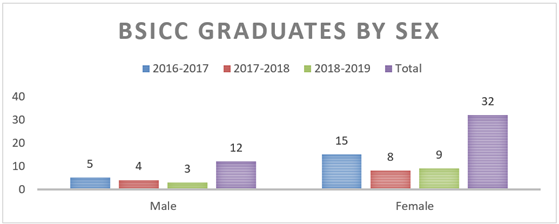
Figure 1
|
Figure 1 Distribution of BSICC Graduates by Sex Across 3 Academic Years |
Figure 1 reveals the distribution of BSICC graduates by sex across three academic years, from 2016 to 2019. It can be observed that female students consistently outnumbered their male counterparts in all batches. This pattern suggests that the BSICC program attracts more female enrollees, reflecting a trend that is also common in communication-related and service-oriented courses where women tend to dominate.
Figure 2

|
Figure 2 Distribution of BSICC Graduates by Civil Status Across 3 Academic Years |
The Figure 2 above shows that most BSICC students from 2016–2017 to 2018–2019 were single. Out of 44 students, 32 were single, and only 12 were married, highlighting that the majority of enrollees were unmarried during the three years.
Table 1
|
Table 1 Job Placement |
||||
|
2016-2017 |
2017-2018 |
2018-2019 |
Total |
|
|
Less than a month |
4 |
2 |
1 |
7 |
|
1-6 months |
10 |
4 |
6 |
20 |
|
7-12 months |
2 |
3 |
2 |
7 |
|
13-18 months |
2 |
1 |
0 |
3 |
|
19 months to 2 years |
0 |
1 |
0 |
1 |
|
25-30 months |
0 |
0 |
0 |
0 |
|
31 months to 3 years |
1 |
0 |
0 |
1 |
|
Others |
1 |
1 |
3 |
5 |
|
44 |
||||
Table 1 reveals that most BSICC graduates were able to find employment soon after completing their studies, with the majority securing jobs within six months. This suggests that the program effectively equips its students with the necessary skills and competencies that employers seek in the job market. Only a few graduates reported longer job-hunting periods, which could be influenced by individual choices, specific job preferences, or the level of competition in their chosen fields.
These results mirror findings from earlier studies. The Commission on Higher Education Commission (2019) noted that graduates from communication and business-related programs often enjoy high employability rates within six months because of their strong communication, technological, and interpersonal skills. Likewise, Parilla and Janer (2020) found that most state university graduates in Northern Luzon were able to land jobs within a year after graduation, highlighting the vital role of internships and practical training in preparing students for work. Similarly, Castillo and Palogan (2021) emphasized that programs combining communication and industry-based skills tend to produce graduates who are more adaptable and competitive in various professional settings.
Taken together, the results indicate that BSICC graduates are well-prepared to enter the workforce. Their quick employment supports the view that the program’s training and curriculum successfully align with industry needs, helping students develop the communication, adaptability, and technical skills that are essential in today’s evolving job market.
Table 2
|
Table 2 Present Job Position |
|||||
|
|
|
2016-2017 |
2017-2018 |
2018-2019 |
Total |
|
1. |
Job Order |
0 |
0 |
1 |
1 |
|
2. |
Visual operator |
0 |
0 |
1 |
1 |
|
3. |
Customer Service |
1 |
0 |
1 |
2 |
|
4. |
Clerk |
2 |
0 |
1 |
3 |
|
5. |
Technical Support Representative |
0 |
0 |
1 |
1 |
|
6. |
Dental Assistant |
0 |
0 |
1 |
1 |
|
7. |
Sales Associate |
0 |
0 |
1 |
1 |
|
8. |
Admin Aide |
1 |
1 |
0 |
2 |
|
9. |
Manager |
0 |
1 |
0 |
1 |
|
10. |
Content Moderator |
0 |
1 |
0 |
1 |
|
11. |
Technical Advisor |
0 |
1 |
0 |
1 |
|
12. |
Factory Worker |
0 |
1 |
0 |
1 |
|
13. |
Medical Assistant |
0 |
1 |
0 |
1 |
|
14. |
Finance Assistant |
0 |
1 |
0 |
1 |
|
15. |
Barista |
1 |
0 |
0 |
1 |
|
16. |
Supervisor |
2 |
0 |
0 |
2 |
|
17. |
Imaging Receptionist |
1 |
0 |
0 |
1 |
|
18. |
Helper |
1 |
0 |
0 |
1 |
|
19. |
CG SN2 |
1 |
0 |
0 |
1 |
|
20. |
Information Officer |
1 |
0 |
0 |
1 |
|
21. |
Project Development Officer |
1 |
0 |
0 |
1 |
|
22. |
Teacher |
0 |
0 |
0 |
0 |
|
23. |
Production specialist |
0 |
0 |
0 |
0 |
|
24. |
Data Analyst |
0 |
0 |
0 |
0 |
|
25. |
Training Specialist |
0 |
0 |
0 |
0 |
|
26. |
Pharmacy Assistant |
0 |
0 |
0 |
0 |
|
27. |
Senior Process Executive |
0 |
0 |
0 |
0 |
|
28. |
Agriculturist |
0 |
0 |
0 |
0 |
|
29. |
No Answer |
8 |
4 |
5 |
17 |
|
30. |
Administrator |
0 |
1 |
0 |
1 |
|
20 |
12 |
12 |
44 |
||
Table 2 presents the current job positions of BSICC graduates, showing that they have entered a wide range of employment fields. Many graduates are working in clerical and service-oriented positions, such as clerks, customer service representatives, and supervisors. Others have found employment in more specialized or technical roles, including technical support representative, medical assistant, dental assistant, and project development officer.
This diversity of employment demonstrates the program’s versatility in preparing graduates for different career paths within and beyond the communication industry. However, it is worth noting that a considerable number of respondents did not specify their current job positions, which may indicate transitions between jobs, ongoing studies, or employment in informal sectors.
The findings of this study align with earlier research highlighting the adaptability of communication and industry-related graduates. According to Parilla and Janer (2020), state university graduates in Northern Luzon often find employment in a wide range of clerical, administrative, and service-oriented roles, suggesting that their training equips them for various sectors. Similarly, Castillo and Palogan (2021) emphasized that graduates with strong communication, interpersonal, and technological skills are more likely to secure positions in customer service, clerical work, and supervisory roles—fields that value effective communication and multitasking. Meanwhile, a study by Salazar (2022) found that employability among graduates in communication-related programs is enhanced by exposure to internship experiences and industry linkages, which allow students to apply their learning in real-world settings.
The employment patterns of BSICC graduates reflect the program’s success in developing flexible and employable professionals capable of thriving in different workplace environments.
Table 3
|
Table 3 Assessment of Academic Curriculum |
|||||
|
2016-2017 |
2017-2018 |
2018-2019 |
Total |
DV |
|
|
General Education Courses |
3.7 |
3.58 |
3.50 |
3.59 |
Relevant |
|
Professional Courses |
3.4 |
3.50 |
3.42 |
3.44 |
Relevant |
|
Major Courses |
3.2 |
3.42 |
3.33 |
3.32 |
Relevant |
|
Elective Courses |
3.05 |
3.17 |
3.17 |
3.13 |
Relevant |
|
Cognate Courses |
3 |
3.25 |
3.08 |
3.11 |
Relevant |
The assessment of the academic curriculum reveals that graduates generally perceive the program as both relevant and satisfactory across its various course categories, namely General Education, Professional, Major, Elective, and Cognate Courses. As shown in Table 3, the overall ratings range from 3.05 to 3.70, with all components interpreted as “Relevant.” Among these, General Education Courses received the highest mean rating of 3.59, which suggests that students find the foundational courses highly applicable and supportive of their overall learning experience. In contrast, Cognate Courses obtained the lowest mean score of 3.11, though still within the “Relevant” range, indicating that while these courses are useful, they may require enhancement to strengthen their perceived significance within the curriculum.
Overall, the results affirm that the BSICC curriculum maintains a satisfactory level of relevance across all academic years, aligning with the findings presented in Table 3, which demonstrate consistent student approval of the program’s course design and content. This implies that the integration of General Education and specialized courses effectively supports the program’s goal of producing competent and industry-ready graduates.
Table 4
|
Table 4 Assessment of the Relevance of the Learning Condition |
|||||
|
2016-2017 |
2017-2018 |
2018-2019 |
Total |
DV |
|
|
Methods |
|||||
|
Teaching Strategies and
Methodologies |
3.95 |
3.92 |
3.83 |
3.9 |
Relevant |
|
Teaching Aides |
|||||
|
Visual |
3.7 |
4.00 |
3.92 |
3.87 |
Relevant |
|
Audio |
3.7 |
4.17 |
3.92 |
3.93 |
Relevant |
|
Audio-Visual |
3.65 |
4.25 |
3.83 |
3.91 |
Relevant |
|
Realia/Models |
3.45 |
4.00 |
3.67 |
3.71 |
Relevant |
|
Multi-Media |
3.55 |
4.25 |
3.67 |
3.82 |
Relevant |
|
Assessment |
|||||
|
Testing |
3.8 |
4.08 |
4.00 |
3.96 |
Relevant |
|
Written |
3.95 |
4.17 |
3.92 |
4.01 |
Somewhat Relevant |
|
Oral |
3.95 |
4.33 |
3.92 |
4.07 |
Somewhat Relevant |
|
Alternative Assessment |
3.85 |
4.08 |
3.83 |
3.92 |
Relevant |
|
Performance |
|||||
|
Project Assignments |
3.9 |
4.17 |
3.75 |
3.94 |
Relevant |
|
Classroom Individual
Activities |
3.9 |
4.00 |
3.92 |
3.94 |
Relevant |
|
Group Activities |
3.8 |
4.17 |
3.92 |
3.96 |
Relevant |
The results presented in Table 4 reflect students’ views on the relevance of their learning environment, particularly the teaching methods, learning materials, and assessment tools used in their classes. The data show that Teaching Strategies and Methodologies earned a total mean score of 3.90, interpreted as “Relevant.” This suggests that instructors are using effective and appropriate approaches that respond well to students’ learning needs and course goals. Likewise, Teaching Aides—which include audio, visual, and multimedia tools—received ratings between 3.71 and 3.93, also interpreted as “Relevant.” This finding indicates that the use of technology and multimedia resources helps make lessons more engaging and easier to understand, aligning with Cagayan State University’s commitment to providing interactive and student-centered learning experiences.
When it comes to assessment, written, oral, and alternative evaluation methods were rated between 3.92 and 4.07. Most were interpreted as “Relevant,” although written and oral assessments were described as “Somewhat Relevant.” This shows that while traditional assessments continue to play a role in measuring learning, students place more importance on performance-based or alternative assessments that allow them to demonstrate practical skills and apply what they have learned in real-world situations. Meanwhile, Project Assignments, with a mean score of 3.94, were also found to be “Relevant,” highlighting their effectiveness in developing creativity, problem-solving, and critical thinking. Overall, the results in Table 4 suggest that students view their learning environment and instructional approaches as effective and supportive of their academic and professional growth, consistent with the program’s goal of preparing competent, industry-ready graduates.
Table 5
|
Table
5 Assessment of the Adequacy of
Support Services |
|||||
|
2016-2017 |
2017-2018 |
2018-2019 |
Total |
DV |
|
|
Classrooms |
3.65 |
3.92 |
4.17 |
3.91 |
Relevant |
|
Comfort Rooms |
3.45 |
3.42 |
3.67 |
3.51 |
Relevant |
|
Computer Lab |
3.65 |
4.00 |
4.00 |
3.88 |
Relevant |
|
Science Lab |
3.25 |
3.67 |
3.83 |
3.58 |
Relevant |
|
Library |
3.95 |
4.08 |
4.33 |
4.12 |
Somewhat Relevant |
|
Communications (Internet
Connection) |
3.55 |
3.83 |
3.83 |
3.74 |
Relevant |
|
Audio-Visual Equipment |
3.55 |
3.83 |
4.00 |
3.79 |
Relevant |
|
Gymnasium |
3.7 |
3.75 |
4.17 |
3.87 |
Relevant |
|
Sports Facilities |
3.7 |
3.92 |
4.08 |
3.9 |
Relevant |
|
Clinic |
3.45 |
3.92 |
4.00 |
3.79 |
Relevant |
|
Student Centers |
3.2 |
4.00 |
3.83 |
3.68 |
Relevant |
|
Dormitories/Boarding Houses |
3.15 |
3.83 |
3.58 |
3.52 |
Relevant |
|
Transportation |
3.45 |
4.00 |
3.83 |
3.76 |
Relevant |
|
General Condition of
Buildings |
3.6 |
3.92 |
3.92 |
3.81 |
Relevant |
|
Recreational Facilities |
3.55 |
3.83 |
3.83 |
3.74 |
Relevant |
|
Guidance and Counseling
Services |
3.65 |
4.00 |
4.25 |
3.97 |
Relevant |
|
Registrar Services |
3.75 |
3.92 |
4.25 |
3.97 |
Relevant |
|
Accounting and Cashiering
Services |
3.65 |
3.83 |
4.25 |
3.91 |
Relevant |
|
Student Activities |
3.55 |
4.00 |
4.17 |
3.91 |
Relevant |
The results shown in Table 5 present students’ evaluation of the adequacy of institutional facilities and support services. The findings reveal that most services received mean scores ranging from 3.50 to 4.10, which fall under the “Relevant” category. This indicates that the university’s facilities—such as classrooms, laboratories, and libraries—generally meet the learning and welfare needs of students. Among these, the library (4.12), gymnasium (3.87), and Registrar Services (3.97) received the highest ratings, suggesting that students are satisfied with the accessibility, functionality, and responsiveness of these key support areas.
Meanwhile, comfort rooms (3.51) and transportation services (3.76) obtained the lowest ratings, though still considered “Relevant.” These scores point to areas that may benefit from further improvement to enhance students’ overall campus experience. Taken together, the results in Table 5 suggest that the university provides adequate and responsive support services that contribute to a positive and productive learning environment.
Table 6
|
Table 6 Adequacy of Development Skills for the Job |
|||||
|
2016-2017 |
2017-2018 |
2018-2019 |
Total |
DV |
|
|
Human Relations Skills |
|||||
|
Demonstrate Effective Social
Behavior in a variety of setting and under different circumstances. |
4 |
4.25 |
4.50 |
4.25 |
Somewhat Relevant |
|
Respond to the needs of
Colleagues in the Workplace. |
4.15 |
4.17 |
4.50 |
4.27 |
Somewhat Relevant |
|
Apply Effective Conflict
Resolution Skills. |
4.15 |
4.25 |
4.58 |
4.33 |
Somewhat Relevant |
|
Exhibit Cooperative and
Supportive Relation with Others. |
4.2 |
4.25 |
4.58 |
4.34 |
Somewhat Relevant |
|
Leadership Skills |
|||||
|
Collaborate with Colleagues
in the Workplace |
4.05 |
4.08 |
4.58 |
4.24 |
Somewhat Relevant |
|
Motivate, Mobilize, and
Inspire people to move towards the goal of the organization |
4.1 |
4.17 |
4.58 |
4.28 |
Somewhat Relevant |
|
Organize and Coordinate
people and task to achieve the organizational goals |
4 |
4.08 |
4.58 |
4.22 |
Somewhat Relevant |
|
Facilitate effective
implementation of programs of department and organization |
3.95 |
4.00 |
4.58 |
4.18 |
Somewhat Relevant |
|
Maintain Self-control in the
midst of stressful encounters with the group members |
4.1 |
4.08 |
4.50 |
4.23 |
Somewhat Relevant |
|
Take responsibility and risk
in making a decision. |
4.05 |
3.92 |
4.50 |
4.16 |
Somewhat Relevant |
|
Foster Exemplary actions and
behavior for others to emulate |
3.95 |
3.75 |
4.50 |
4.07 |
Somewhat Relevant |
Table 6 shows how well students feel the program prepares them with the interpersonal skills employers expect — things like good social behavior, teamwork, handling conflict, and cooperating with others. The average ratings for these items fall between 4.25 and 4.34, which the instrument labels “Somewhat Relevant.” In plain terms, students are saying: the program gives them a solid start in workplace people-skills, but there’s room to strengthen and make those skills more consistently reliable on the job.
The generally positive view of teaching approaches and project work reported in Table 6 helps explain why students feel moderately prepared in interpersonal skills — project assignments and interactive teaching methods support the development of teamwork and cooperation. Likewise, the adequacy of campus support services in Table 6 (e.g., library, labs, and extracurricular spaces) creates opportunities for group projects and activities where those soft skills can be practiced. Put together, the data suggest a coherent picture: the curriculum and learning environment are enabling soft-skill development to a useful degree, but intentional and scaffolded opportunities are needed to raise those skills from “somewhat” to clearly “highly” workplace-ready.
The “somewhat relevant” ratings (4.25–4.34) indicate graduates possess interpersonal skills at a functional level, yet students and employers may still notice gaps when it comes to consistently applying those skills in real workplace settings. This pattern is common in higher education; many studies show that universities impart communication and teamwork foundations but that these competencies improve markedly when learning is deliberately structured to practice them De et al. (2022), Orih et al. (2024).
Systematic reviews and empirical studies find that embedding soft-skill development into coursework — especially through project-based learning, cooperative learning, and work-integrated experiences — produces measurable gains in teamwork, conflict management, and interpersonal competence Orih et al. (2024), De et al. (2022). Local and discipline-specific research also points to teamwork and communication as among the most needed and valued employability skills, particularly for graduates entering service sectors such as BPO and customer-facing roles Patacsil and Tablatin (2017).
Table 7
|
Table 7 Information Literacy, Media, and Technology Skill |
|||||
|
2016-2017 |
2017-2018 |
2018-2019 |
Total |
DV |
|
|
Use of technology as a tool
for research, organize and evaluate communicative information. |
3.95 |
3.83 |
4.50 |
4.09 |
Somewhat Relevant |
|
Use digital tools (Computer,
PDAs, Media Players, GPS, etc.) Appropriately. |
3.95 |
3.92 |
4.50 |
4.12 |
Somewhat Relevant |
|
Apply Fundamental
Undertakings of the ethical/legal issues in the access of information
technologies. |
3.95 |
3.83 |
4.5 |
4.09 |
Somewhat Relevant |
Table 7 presents students’ assessment of their information literacy, media, and technology skills, which are crucial for success in both academic and workplace settings. The results show that all indicators—including the use of technology, use of digital tools, and ethical use of information technology—received mean ratings ranging from 4.09 to 4.12, interpreted as “Somewhat Relevant.” These findings suggest that students are generally comfortable and capable in using digital tools and platforms but may need stronger integration of these skills into research, communication, and professional applications. In other words, while students can operate technology effectively, they may not always use it critically or ethically in the context of their studies and future careers.
This moderate level of competency mirrors trends observed in other research. For instance, Patacsil and Tablatin (2017) found that although university students possess basic digital literacy, gaps remain in higher-order skills such as information evaluation, data interpretation, and ethical online behavior. Similarly, Saavedra and Meijers (2020) emphasized that higher education students often demonstrate familiarity with digital tools but struggle with integrating them into complex problem-solving and research-based tasks. Moreover, Alvarez and Dimalanta (2019) noted that the transition from basic to advanced information literacy requires deliberate instruction and assessment embedded within courses, not merely access to technology itself.
In the context of the BSICC program, these results highlight a need to reinforce the connection between technology use and academic inquiry—an important goal for a degree centered on industrial and commercial communication. Integrating digital research training, media literacy workshops, and ethics modules into the curriculum could help students not only use technology proficiently but also apply it responsibly and strategically. This finding aligns with earlier observations in Table 7, which showed that multimedia teaching aids are effectively used, yet could be leveraged further to develop deeper technological fluency.
Overall, the results in Table 7 suggest that while students demonstrate confidence in basic technological skills, the program would benefit from intentionally structured learning experiences that promote critical, ethical, and research-oriented use of digital tools. Strengthening this aspect would better prepare graduates for the demands of communication-driven industries, where digital competence and information ethics are essential for professional success.
Table 8
|
Table 8 Alignment of the CSU BSICC Curriculum with TESDA Contact Center NC II Competencies |
|||
|
TESDA Competency Unit Contact
Center Services NC II |
CSU BSICC Course |
Description of Competency
Relationship |
Degree of Alignment |
|
Basic Competencies |
|
||
|
500311105: Participate in
workplace communication |
GEC 107: Purposive
Communication |
Both emphasize effective
written and oral communication in professional and academic contexts.
“Participate in Workplace Communication” directly supports the applied skills
Purposive Communication develops. |
3-Fully Aligned |
|
|
ICC 71: Business
Communication |
Shares the same focus on
correspondence, meetings, and communication in organizational settings. The
alignment is strong in terms of objectives and competencies. |
3-Fully Aligned |
|
500311106: Work in a team
environment |
ICC 75: Service Culture |
Both emphasize teamwork,
cooperation, and positive interpersonal relationships in delivering quality
service. Teamwork is a core principle in service-oriented industries. |
3-Fully Aligned |
|
|
GEC 107: Purposive
Communication |
Focuses on clear and
effective communication — a vital element in teamwork. Collaboration through
written and oral communication aligns well with the teamwork competency. |
2-Fully Aligned |
|
500311107: Practice career
professionalism |
ICC 75: Service Culture |
The Service Culture course
emphasizes the values and behaviors that promote excellent customer service,
professional conduct, and organizational commitment, all of which align with
the learning outcomes of Practice Career Professionalism. |
3-Fully Aligned |
|
500311108: Practice
occupational health and safety procedures |
ELEC 11: Living in the IT
Era |
When it includes safe and
responsible use of digital tools and ergonomics in IT workspaces, it aligns
partially with OHS concepts related to ICT. |
2-Partially Aligned |
|
|
ICC 75: Service Culture |
Emphasizes professionalism,
discipline, and adherence to company policies, including safety and health
standards within service-oriented environments. |
2-Partially Aligned |
|
Common Competencies |
|
||
|
ICT315202: Apply quality
standards |
ICC 75: Service Culture |
Both focus on delivering
quality service and maintaining customer satisfaction. “Apply Quality
Standards” can be closely aligned with Service Culture, which emphasizes
consistent quality, professionalism, and client-centered performance. |
3-Fully Aligned |
|
ICC 70: Business Process
Outsourcing 101 |
BPO 101 covers workplace
standards, productivity, and quality monitoring — topics directly related to
maintaining performance standards and meeting client requirements. |
2-Partially Aligned |
|
|
ICT311203: Perform computer
operations |
ELEC 11: Living in the IT
Era |
Both courses focus on
computer literacy, digital tools, and information technology concepts.
ICT311203 covers practical computer operations (word processing,
spreadsheets, file management), which directly support the foundational ICT
competencies required in “Living in the IT Era.” Alignment is strong because
both emphasize understanding and using technology in everyday life,
education, and work. |
3-Fully Aligned |
|
ICC 57: Digital
Communication |
ICT311203 provides the
operational and technical foundation for using computers, while ICC 57
focuses on how digital tools are used for communication (email, social media,
multimedia platforms, etc.). The overlap lies in digital fluency, tool
operation, and familiarity with online communication platforms. However, ICC
57 extends beyond operations into communication theory, strategy, and ethics
in digital contexts. |
2-Partially Aligned |
|
|
Core Competencies |
|
||
|
ICT313332: Communicate
effectively using the English language |
Eng 101: English Language
Proficiency |
Both courses emphasize
grammar, vocabulary, and the correct use of English in oral and written
contexts. ICT313332’s focus on effective communication directly supports
English proficiency outcomes. |
3-Fully Aligned |
|
GEC 107: Purposive
Communication |
Both deal with practical
communication in academic and professional settings, including oral
presentations, written correspondence, and audience-specific communication. |
3-Fully Aligned |
|
|
ICC 65: Structures of
English |
ICT313332 applies
grammatical and syntactical knowledge in real communication, while ICC 65
focuses more on linguistic structure and analysis. Partial overlap exists in
grammar and language use. |
2-Partially Aligned |
|
|
ICC 71: Business
Communication |
ICT313332 develops general
communication effectiveness, while Business Communication applies these
skills to corporate contexts. Alignment is high in writing, speaking, and
interpersonal communication skills. |
2-Partially Aligned |
|
|
ICC 77: Communicating with
Style |
ICT313332 covers functional
English communication; ICC 77 emphasizes personal expression, tone, and
creativity in communication. There’s overlap in fluency, confidence, and
clarity, but ICC 77 extends to stylistic refinement. |
2-Partially Aligned |
|
|
ICT313333: Deliver Quality
Customer Services |
ICC 74: Business Process
Outsourcing 102 |
Focuses on performance
improvement, quality assurance, and specialized client servicing — all
integral to delivering quality customer service in a BPO environment. |
3-Fully Aligned |
|
ICC 72: Call Handling |
This course directly matches
TESDA’s “Deliver Quality Customer Services.” Both develop skills in
professional call management, empathy, problem resolution, and communication
standards in customer interaction. |
3-Fully Aligned |
|
|
ICC 76: Contact Center
Technology and Campaigns |
Both focus on delivering
excellent customer service using contact center tools and systems.
ICT313333’s emphasis on handling customer concerns, communication etiquette,
and maintaining service quality directly supports the competencies taught in
ICC 76. |
3-Fully Aligned |
|
|
ICT 313334: Perform computer
operations and internet navigation |
ELEC 11: Living in the IT |
Both courses emphasize ICT
literacy and the role of technology in modern communication and productivity.
TESDA’s focus on computer operations and internet use directly supports ELEC
11’s learning outcomes related to responsible, effective, and critical use of
technology in daily life, education, and work. |
3-Fully Aligned |
|
ICC 57: Digital
Communication |
While TESDA’s ICT313334
focuses more on the technical skills of using computers and navigating
the internet, ICC 57 advances these skills into the communication
dimension—using digital tools, social media, and online platforms for
creating and sharing messages. Alignment exists in digital fluency, online
ethics, and responsible technology use. |
2-Partially Aligned |
|
|
ICT313335: Demonstrate
understanding and knowledge of the American Culture and geography |
ICC 73: American Culture and
Geography |
Both courses share identical
objectives — developing awareness and understanding of American culture,
traditions, values, and geography. TESDA’s module emphasizes cultural
literacy and familiarity with U.S. settings as preparation for BPO and
communication-related work, while BSICC’s ICC 73 explores these topics in a
broader academic context. Both foster cross-cultural communication
competence and global readiness. |
3-Fully Aligned |
The findings revealed that the Cagayan State University (CSU) BS in Industrial and Commercial Communication (BSICC) curriculum is highly aligned with the TESDA Contact Center Services NC II competency standards. Most courses demonstrated a “Fully Aligned” (3) rating, particularly in the areas of communication, teamwork, professionalism, and customer service. Basic competencies such as Participate in Workplace Communication, Work in a Team Environment, and Practice Career Professionalism matched strongly with BSICC’s Purposive Communication and Service Culture courses, showing that CSU’s curriculum effectively builds interpersonal, collaborative, and ethical work behaviors. Common and core competencies, including Perform Computer Operations, Apply Quality Standards, and Deliver Quality Customer Services, were also well integrated into BSICC’s ICT, BPO, and communication-related courses, proving the program’s responsiveness to industry practices. However, a few courses, particularly Practice Occupational Health and Safety Procedures and Digital Communication, showed partial alignment, suggesting the need to reinforce safety, ergonomics, and responsible technology use within the curriculum.
4. CONCLUSION AND RECOMMENDATIONS
Overall, the findings present a positive outlook on the Bachelor of Science in Industrial Communication and Computing (BSICC) program’s academic and institutional quality. Students consistently view the curriculum, learning environment, and support services as relevant and effective in enhancing their learning experiences. The results indicate that the courses are thoughtfully designed and that teaching strategies are aligned with students’ needs. Moreover, the availability of well-maintained facilities and responsive administrative services fosters a learning atmosphere that supports both academic success and personal development. These insights reflect the institution’s continued commitment to providing education that meets the evolving needs of learners and industries alike. Further, the BSICC program successfully meets national TVET standards and adequately prepares graduates for employment in communication and service-related industries.
The findings imply that maintaining close alignment with TESDA standards strengthens employability, enhances workforce readiness, and supports national competency frameworks. Internationally, this alignment also positions BSICC graduates for global competitiveness, especially in the outsourcing and communication sectors where TESDA qualifications are recognized.
However, the study also identifies areas that need further attention, particularly in strengthening students’ interpersonal and technological competencies. While graduates exhibit adequate communication and digital skills, these are often limited in their application to real-world professional settings. This highlights the need to provide more opportunities for experiential learning, collaborative engagement, and technology-enhanced instruction. Therefore, aligning the BSICC curriculum with the standards of the Technical and Vocational Education and Training (TVET) framework becomes essential. Such alignment would ensure that the program not only upholds academic excellence but also equips students with industry-recognized, job-ready skills that enhance their employability and competitiveness in a technology-driven labor market.
CONFLICT OF INTERESTS
None .
ACKNOWLEDGMENTS
The researchers deeply express their gratitude to the Cagayan State University-Carig Campus for endorsing this study to be presented during the 2025 TVET International Conference. This is indeed a great opportunity for the College of Humanities and Social Sciences to establish the culture of research.
REFERENCES
Alvarez, J. F., Espinosa, M. L., and Dimalanta, G. (2019). Digital Literacy Among Tertiary Students: Basis for Technology Integration in Higher Education. Asia Pacific Journal of Education, Arts and Sciences, 6(3), 22–29.
Cagayan State University. (2017). Prospectus: BS Industrial and Commercial Communication (BSICC) – Carig Campus.
Cagayan State University. (2020). Final BSICC Curriculum 2020–2021.
Castillo, M. L., and Palogan,
R. T. (2021). Communication and Industry-Based
Skills as Predictors of Employability Among University Graduates. Philippine
Journal of Education and Development Studies, 5(2), 67–79.
Commission on Higher Education. (2019). Tracer Study of Higher Education Graduates in the Philippines. CHED Research and Development Division.
De Prada, E., Mareque, M., and Pino-Juste, M. (2022). Teamwork skills in Higher Education: Is University Training Contributing to Their Mastery? Psicologia: Reflexão e Crítica, 35, Article 5. https://doi.org/10.1186/s41155-022-00207-1
Orih, D., Okafor, C. N., Nwankwo, C. A., and Uche, J. I. (2024). A Systematic Review of Soft Skills Interventions Within Curricula from School to University Level. Frontiers in Education. https://doi.org/10.3389/feduc.2024.1383297
Parilla, J. R., and Janer, S. S. (2020). Employability of Graduates from State Universities in Northern Luzon: A Tracer Study. Asia Pacific Journal of Multidisciplinary Research, 8(3), 45–54.
Patacsil, F. G., and Tablatin, C. B. (2017). Exploring the Importance of Soft and Hard Skills as Perceived by Employers and Educators. Journal of Technology and Science Education, 7(2), 225–236. https://doi.org/10.3926/jotse.271
Saavedra, L., and Meijers, A. (2020). Assessing Digital Competence and Information Literacy in Higher Education. Education and Information Technologies, 25(6), 5855–5873. https://doi.org/10.1007/s10639-020-10267-4
|
|
 This work is licensed under a: Creative Commons Attribution 4.0 International License
© ShodhGyan 2024. All Rights Reserved.