
|
|
|
|
Perspectives of Selected PLM Mass Communication Faculty members on Integration of Artificial Intelligence in the curriculum of Communication programs of the University
Freddie Marcos De La Cruz 1
1 Doctor of Philosophy in Communication, Advanced Research Report Writing and Publication, Philippines
|
|
|
ABSTRACT |
|
|
Artificial
Intelligence is now progressing in the world. As different field have adopted
the new technology, Communication Education is now facing challenges like
other sectors. The study focused on the perspectives of PLM Mass
Communication faculty in terms of: 1.) How Artificial Intelligence
effectively integrated in the curriculum of communication to enhance
students' learning? 2.) What is the potential success of Artificial
Intelligence in the curriculum? 3.) What are the factors that influence the success
of implementation of AI in the program? 4.) In what ways the AI can be
personalized in teaching communication subjects? 5.) How AI will help in
promoting creativity, critical thinking, problem solving and skill
development? The study made use of case study. The data was analyzed using
narrative analysis. There are five faculty from PLM-Department of Mass
Communication were interviewed. The study was grounded on Wayne k. Hoy Open
System Theory. The integration of AI in the courses according to the faculty
is for academic contents, validation of works, seminars, student’s
narratives, news and social media. Majority of the faculty revealed that AI
still have flaws and unstable to use based on the popularity right now. They
also tackled that this new technology may somewhat help them, but it should
be regulated by the University and Government to properly utilized it. The
department identified the factors that influence the success of
implementation of AI in the program like laziness to students, abuse, and misuse.
They also saw promising impacts if properly regulated like productivity,
efficiency, innovation and promoting globally competitive students. AI will
be deeply integrated into the field of communication, transforming how we
create, distribute, and consume media. AI will enhance efficiency,
personalization, and ethical practices while providing deeper insights and
predictive capabilities. The focus will be on leveraging AI to augment human
creativity and decision-making, ensuring that communication remains
impactful, relevant, and responsible in an increasingly digital world. |
|||
|
Received 15 October 2025 Accepted 18 November 2025 Published 20 December 2025 DOI 10.29121/Shodhgyan.v3.i2.2025.76 Funding: This research
received no specific grant from any funding agency in the public, commercial,
or not-for-profit sectors. Copyright: © 2025 The
Author(s). This work is licensed under a Creative Commons
Attribution 4.0 International License. With the
license CC-BY, authors retain the copyright, allowing anyone to download,
reuse, re-print, modify, distribute, and/or copy their contribution. The work
must be properly attributed to its author.
|
|||
|
Keywords: Artificial
Intelligence, Perspectives, Course, Integration, Communication |
|||



1. INTRODUCTION
Artificial
Intelligence is now in the media and technology. As a new way of being
productive in different fields and different sector, how communication as a
field will cope up to this new wave of changes. Artificial Intelligence is now
on use by the students and some faculty which help the Academe. For now, there
were no restrictions but as the time progresses, University and colleges will
have the proper guidelines in using this technology advancement. Filipino is
doing their best in coping up with the technology that will help achieve their
goals and developments.
University
right now specially in the United States and Canada were coping their pace in
advancing this technology and the academe to cope up in giving their capacity
to fully utilize the new advancements. Even in the developing nations like
South Africa and Mexico are now in the use of Artificial Intelligence. Now in
the Philippines, how university will cope up with
these changes specially in the use of AI in the field of Communication.
Pamantasan
ng Lungsod ng Maynila (PLM) is in Intramuros Manila.
PLM is a local university in the Philippines which served the nearby cities to
help the Filipino Youth. The PLM helps the Filipino in achieving the Filipino
goals and ambitions. PLM also helps in nation-building and promoting equal
opportunity to All. Under the College of Humanities, Arts and Social Sciences,
Department of Mass Communication have two courses Bachelor of Arts in
Communication and Bachelor of Arts in Communication specializing in Public
Relation. These two courses will be the subject of study of this paper and the
result will be based on the perspectives of the Faculty of Department of Mass
Communication.
Their
perspectives shed light to the preparedness and capacity of the department to
accept the changes that will help achieve its goal in giving relevant and
timely changes in the course curriculum of the department. As the TV Networks
in the Philippines is changing from analog to digital tv Dela (2024), it is timely now to study how AI
transform the programming of these networks and academe.
Based on
the research gap and since Artificial Intelligence is new in this time, the
research on this study is very few as of now and also may help the academe to
understand the Artificial Intelligence in these faces of challenges brought by
uncertainties of its capability and use. As well as the impact of this new
technology in bringing the best in the field of communication.
The
researcher used Open System Theory by Hoy and Merkel in explaining the
phenomenon underlying the use of Artificial Intelligence as a course subject in
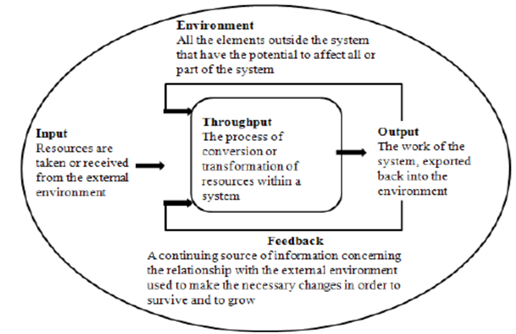
the courses of Department of Mass Communication. Open System Theory by Hoy and Merkel (1962) is consisting of three
essential elements. An organization receives resources such as equipment,
natural resources and the work of employees referred to inputs. The inputs are
transformed, called throughputs, and then yield products or services called outputs.
Outputs are released into the environment.
2. LITERATURE REVIEW
2.1. Perspectives
The term "perspective" refers to a particular way of regarding situations, facts, or events and judging their relative importance. It can also refer to the proper or accurate point of view from which something is seen or understood (Merriam and Webster dictionary).
According to Oxford Dictionary, Perspective is defined as the art of drawing solid objects on a two-dimensional surface so as to give the right impression of their height, width, depth, and position in relation to each other when viewed from a particular point. In this statement the word defined based on the impression of the subject or object where the observer view the subject based on different angle as he/she perceived it.
2.2. PLM-CHASS-Department of Mass Communication-Faculty
The Pamantasan ng Lungsod ng Maynila is a local university funded by the city of Manila. It composes of colleges where College of Humanities, Arts and Social Sciences have the Department of Mass Communications. It composes of full-time faculty and contract of service, part-time faculty. The College of Humanities, Arts, and Social Sciences (CHASS) emerged through the reorganization/merging of the College of Liberal Arts (CLA) and the College of Mass Communication (CMC), as recommended by the PLM University Council and approved by the Board of Regents on the latter’s special meeting on June 4, 2015. By virtue of the reorganization, the Bachelor of Science in Social Work from the College of Human Development (CHD) and the Master of Arts in Communication Management from the Graduate School of Arts, Science, and Education (GSASE) also became part of CHASS. The merging was also based on the vertical articulation prescribed by the Commission on Higher Education’s Education Reform Agenda(https://plm.edu.ph/).
The college has four (4) departments and one office handling the graduate course:
· Department of Languages and Literature
· Department of Social Sciences and Humanities
· Department of Mass Communication
· Department of Social Work
· Communication Management Graduate School Program
2.3. Bachelor of Arts in Communication and Bachelor of Arts in Communication specializing Public Relation
The courses of Bachelor of Arts in Communication and
Bachelor of Arts in Communication specializing Public Relation composed of
general education courses, core courses, institutional or program outcomes,
electives, Thesis/Special Project and Internship, Physical Education, National
Service Training Program (https://ched.gov.ph/wp-content/uploads/2017/10/Sample-Curricula-Bachelor-of-Arts-in-Communication1.pdf).
2.4. Artificial Intelligence
Artificial intelligence (AI) refers to the development of computer systems that can perform tasks that typically require human intelligence, such as learning, problem-solving, and decision-making. AI systems are designed to mimic human thought processes and can be trained to perform specific tasks through machine learning and deep learning algorithms Fayoyin et al. (2021).
Key Features of AI
1) Machine Learning: AI systems learn from data and improve their performance over time through machine learning algorithms.
2) Deep Learning: AI systems use deep neural networks to process complex data and make predictions or classifications.
3) Natural Language Processing: AI systems can understand and generate human language, enabling applications like speech recognition, machine translation, and virtual assistants.
4) Computer Vision: AI systems can analyze and interpret visual data from images and videos, enabling applications like facial recognition, object detection, and autonomous vehicles Khan (2023)
Applications of AI
1) Robotics and Automation: AI is used in robotics and automation systems to perform complex tasks in manufacturing, healthcare, logistics, and exploration.
2) Natural Language Processing: AI is used in NLP to analyze and understand human language, powering applications like speech recognition, machine translation, sentiment analysis, and virtual assistants.
3) Image and Video Analysis: AI is used in image and video analysis to detect objects, track movements, and recognize patterns, enabling applications like facial recognition, object detection, and autonomous vehicles.
4) Recommendation Systems: AI is used in recommendation systems to personalize user experiences in e-commerce, streaming platforms, and social media.
5) Financial Services: AI is used in financial services to analyze data, detect fraud, and make predictions about market trends and customer behavior Oke (2007)
Challenges and Limitations of AI
1) Data Quality: AI systems require high-quality data to learn and improve, which can be challenging to obtain and maintain.
2) Bias and Fairness: AI systems can perpetuate biases and unfairness if trained on biased data or designed with flawed algorithms.
3) Explainability and Transparency: AI systems can be difficult to explain and understand, which can lead to mistrust and lack of transparency.
4) Ethical Considerations: AI systems raise ethical concerns about privacy, security, and accountability, which must be addressed through responsible AI development and deployment.
Future Directions of AI
1) Edge AI: AI is being developed for edge devices, enabling real-time processing and decision-making at the edge of the network.
2) Explainable AI: AI systems are being designed to provide explanations and transparency about their decision-making processes.
3) Human-AI Collaboration: AI is being developed to collaborate with humans, enabling more effective and efficient decision-making.
4) AI for Social Good: AI is being developed to address social and environmental challenges, such as healthcare, education, and climate change (https://www.ibm.com/topics/artificial-intelligence).
2.5. Philippine University policy in Artificial Intelligence
The University of the Philippines (UP) is drafting a policy on responsible AI use, emphasizing the need for ethical considerations and transparency in AI development and deployment. The policy outlines 10 principles for responsible AI use, including the common good, empowerment, cultural sensitivity, privacy, accountability, and more. The principles aim to ensure that AI benefits the Filipino people and promotes inclusive economic growth, sustainable development, and enhanced well-being while protecting the environment.
Key Points of the Policy
· Common Good: AI should benefit the Filipino people and humanity by fostering inclusive economic growth, effective governance, sustainable development, and enhanced well-being while protecting the environment.
· Empowerment: AI should promote self-determination and bolster the capacity of humans to shape their future, particularly empowering vulnerable and marginalized groups.
· Cultural Sensitivity: AI systems must be culturally responsive and culturally sustaining, respecting cultural norms, values, beliefs, and practices of users.
· Privacy: AI systems must incorporate privacy-by-design principles, upholding informed consent and maintaining the confidentiality of personal information.
· Accountability: Individuals and groups involved in AI development and deployment must take responsibility for the consequences of their actions, with mechanisms in place to hold stakeholders accountable.
Challenges and Concerns
1) Ethical Misuse: The 2023 AI Index Report notes that the ethical misuse of AI has increased 26 times since 2012, with concerns about AI slipping out of human control.
2) Job Losses: AI deployment in the economy could lead to massive job losses, inhibiting certain Sustainable Development Goals (SDGs).
3) Data Collection and Processing: AI systems must ensure ethical data collection and processing, avoiding systemic bias and privacy violations Vinuesa et al. (2020).
2.6. Artificial Intelligence in Broadcast Media
Artificial Intelligence (AI) has significantly impacted the broadcast media industry, transforming the way content is created, curated, and consumed. Here are some key points about AI in broadcast media:
1) Content Creation: AI is revolutionizing content creation by automating tasks such as video editing, content organization, and even the creation of new content. For example, AI-driven cameras can track and focus in real-time, ensuring high production quality.
2) Content Curation and Personalization: AI helps in content curation and personalization by analyzing viewer preferences, viewing patterns, and emotional reactions. This enables platforms like Netflix and Spotify to provide tailor-made content recommendations, enhancing viewer engagement.
3) Operational Efficiency: AI excels in automating monotonous tasks such as transcription, translation, and content labelling, freeing up resources and increasing productivity.
4) Predictive Analytics: AI-powered predictive analytics helps broadcasters understand viewer behavior and anticipate future trends. This enables them to make data-driven decisions about content choice, advertising, and engagement.
5) Unified Collaboration: AI integration in broadcasting enables unified collaboration between different departments, ensuring seamless content creation and distribution.
6) Future Prospects: AI has the potential to transform the broadcast industry further by enabling real-time emotion detection, virtual reality experiences, and more.
7) Ethical Implications: AI raises ethical concerns about deepfakes, echo chambers, and the potential for AI-driven content to deceive audiences.
8) Industry Trends: AI is seeing rapid adoption in broadcast environments due to its cost and efficiency benefits, and the barriers to entry are dropping fast.
9) Machine Learning: Machine learning algorithms are used in AI applications for broadcasting, such as content organization, video enhancement, and personalized recommendations.
10) Future of AI in Broadcast: The future of AI in broadcast media is promising, with the potential for AI-driven audio and video enhancement, participatory AI, and more Mayne (2022).
The study
sought to answer, “Perspectives of Selected PLM Mass Communication Faculty
members on Integration of Artificial Intelligence in the curriculum of
Communication programs of the University. In particular, it asks the following
questions:
1)
How Artificial Intelligence effectively
integrated in the curriculum of communication to enhance students' learning?
2)
What is the potential success of Artificial
Intelligence in the curriculum?
3)
What are the factors that influence the success
of implementation of AI in the program?
4)
In what ways AI can be personalized in teaching
communication subjects?
5)
How AI will help in promoting creativity,
critical thinking, problem solving and skill development?
The research gap of this study tackled more on the empirical data. As of this time there are few research pertaining and relating to Artificial Intelligence integration in courses in Communication even from University of the Philippines which still drafting policy regarding the Artificial Intelligence in their courses.
3. THEORETICAL ANCHORS
The study used System Theory. Systems theory, as developed by Wayne K. Hoy, provides a framework for understanding organizations as complex, dynamic systems that interact with their environment. Hoy's work emphasizes the importance of viewing organizations holistically, rather than focusing solely on individual parts or subsystems Hoy (2008).
Figure 1
|
Figure 1 Open System Theory Model by: Katz and Kahn Open System Model |
Key principles of Hoy's systems theory include:
1) 1.Organizations are open systems: They constantly interact with and adapt to their external environment.
2) 2.Organizations are goal-oriented: They have specific objectives they aim to achieve through their activities and interactions.
3) 3.Organizations are composed of interdependent subsystems: These subsystems, such as departments or teams, work together to support the overall functioning of the organization.
4) 4.Organizations exhibit equifinality: There are multiple paths or ways for an organization to achieve its goals.
5) 5.Organizations strive for homeostasis: They seek to maintain a stable, balanced state, even in the face of external changes or disturbances.
4. Researcher Framework
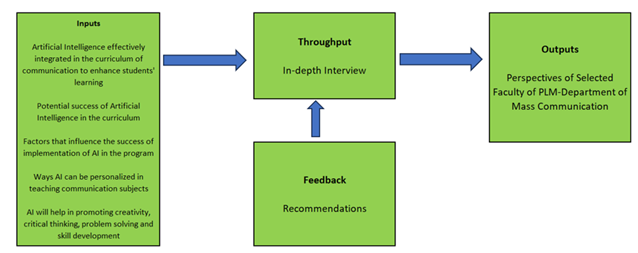
Figure 2
|
Figure 2 Researcher Framework |
The researcher framework used the Open system theory by Hoy (2019). In the study the inputs were the Artificial Intelligence effectively integrated in the curriculum of communication to enhance students' learning, the potential success of Artificial Intelligence in the curriculum, factors that influence the success of implementation of AI in the program, Ways AI can be personalized in teaching communication subjects, and AI will help in promoting creativity, critical thinking, problem solving and skill development. The throughput is the In-depth Interview, and the outputs are the perspectives of selected faculty of PLM-Department of Mass Communication.
5. METHODOLOGY
The researcher used qualitative research design. The research design used to have an in-depth description, understanding, and analysis of the faculty perspectives.
A case study is a detailed examination of a specific situation or phenomenon, often used in research to gain a deeper understanding of a particular issue or problem. It typically involves a detailed analysis of a single case or a small number of cases, and the findings are used to draw broader conclusions or recommendations.
An in-depth interview is a qualitative data collection method that involves a one-on-one conversation between the researcher and the participant. It is a flexible and interactive method that allows the researcher to explore the participant's thoughts, feelings, and experiences in detail.
The study selected five key informants from PLM Department of Mass Communications. There are three full time faculty and two part-time faculty. They were one year to 15 years in the organization teaching communication subjects for Bachelor of Arts in Communication and Bachelor of Arts in Communication specializing in Public Relation.
The study used first the narrative analysis. The narrative analysis is used to understand how research informants construct story and narrative from their own personal experience. That means there is a dual layer of interpretation in narrative analysis. First the research informants interpret their own lives through narrative. Then the researcher interprets the construction of that narrative.
Narratives can be derived from journals, letters, conversations, autobiographies, transcripts of in-depth interviews, focus groups, or other types of narrative qualitative research and then used in narrative research.
The study also used thematic analysis. It is a constant comparative method that involves reading and rereading the transcripts in a systematic way and looking for patterns to derive emerging themes. This consisted of basic approaches of analysis such as familiarization, coding, generating themes, reviewing, defining and naming and writing up Damyanov (2023).
The thematic analysis steps are: 1.) familiarization. The first stage in thematic analysis is examining your data for broad themes. This is where you transcribe audio data to text., 2.) Look for themes in codes, uncovering subthemes and subdivisions of themes that concentrate on a significant or relevant component.,3.) Review themes. classified as a theme matches the data and whether it exists in the data.,4.) Finalize themes. Ensure the themes match the research questions. The final report must meet the research goals and objectives., lastly, 5.) Report writing. In report there are:1.) a starting, 2.) An approach, 3.)The results, 4.) Outcome.
6. RESULTS AND DISCUSSION
The discussion is divided into two parts, namely: (1) narratives generated from the faculty perspectives of the in-depth interviews; and (2) themes generated from the codes of the interviews. An integration of the two parts is provided at the end of the discussion.
Matrix 1
|
Matrix 1 Profile of the Faculty of Department of Mass Communication |
|
|
What is your current position in Department
of Mass Communication? |
|
|
Informant 1 |
Instructor 2 |
|
Informant 2 |
Full Time Faculty Instructor 3 |
|
Informant 3 |
Assistant Professor 3 |
|
Informant 4 |
Assistant Professorial Lecturer 1 |
|
Informant 5 |
Lecturer 1 |
Based on the interview, the faculty position in the department is lecturer 1, Instructor 2, Instructor 3, Associate Professor 2 and Assistant Professor 3. The department have been small in number due to the reorganization last 2015 where the then College of Mass Communication became Department of Mass Communication (https://plm.edu.ph/).
Matrix 2
|
Matrix 2 Profile of the Faculty of Department of Mass Communication |
|
|
How many years are you teaching in PLM? |
|
|
Informant 1 |
2 yrs |
|
Informant 2 |
9 years |
|
Informant 3 |
15 years |
|
Informant 4 |
12 years |
|
Informant 5 |
1.5 years |
There are three veteran faculty of the department they were 9 years and 15 years in the university while two faculty were 1.5 years and 2 years in the department. According to PLM, the faculty has 3 full time and around less than 20 contract of service part time faculty as of this year. They were some practitioners coming from GMA 7, some from theaters and some from Public Relations organization (https://plm.edu.ph/).
Matrix 3
|
Matrix 3 The Potential Success of Artificial Intelligence in the Curriculum |
|
|
What do you know of AI in the Academe? |
|
|
Informant 1 |
Useful
in terms of creation of all sorts of academic content such as: syllabus,
rubrics, course outline, ppt, etc. May also be used in checking, research,
curating art, etc. |
|
Informant 2 |
Turnitin |
|
Informant 3 |
Basically thru seminar, symposium, movies,
colleagues, thru abroad from friends |
|
Informant 4 |
AI
in the academic context is a multifaceted and rapidly evolving field. It
covers various domains such as machine learning, natural language processing,
robotics, and computer vision. Universities often collaborate with industries
and governmental bodies to push the boundaries of AI technology and its
applications. For example, AI and data science courses are increasingly
integrated into university curriculums, often as standalone programs or
specializations within computer science and engineering degrees. AI is also
being studied in conjunction with other fields like biology (bioinformatics),
linguistics (computational linguistics), and social sciences (AI ethics and
policy). |
|
Informant 5 |
From
the broadcast industry and social media |
The relevance of AI in the courses were explained by the faculty in terms of academic contents, validation using Turnitin, for seminars, students’ narratives, AI in the academic context is a multifaceted and rapidly evolving field. It covers various domains such as machine learning, natural language processing, robotics, and computer vision. Universities often collaborate with industries and governmental bodies to push the boundaries of AI technology and its applications, news and social media. According to IBM, Artificial Intelligence is used in robotics and automation system to perform complex tasks in manufacturing, healthcare, logistics, and exploration. Used in NLP to analyze and understand human language, powering applications like speech recognition, machine translation, sentiment analysis and virtual assistants, used in image and video analysis to detect objects, track movements, and recognize patterns, enabling applications like facial recognition, object detection, and autonomous vehicles, used in recommendation systems to personalize user experiences in e-commerce, streaming platforms, and social media and lastly, used in financial services to analyze data, detect fraud, and make predictions about market trends and customer behavior (https://www.ibm.com/topics/artificial-intelligence).
Matrix 4
|
Matrix 4 The potential success of Artificial Intelligence in the Curriculum |
|
|
In your opinion, what is the potential
success of AI in the courses of PLM-Department of Mass Communication? |
|
|
Informant 1 |
Success
in terms of its basic use in grammar checking, descriptive use in
terminologies and concepts, summarizing contents, and outlining paperworks. |
|
Informant 2 |
Means
Of Communication, Tools For Better Performance And Delivery |
|
Informant 3 |
We cannot escape it. In terms of equipment we are behind it. For the student to help them
and to integrate with AI. Student concept and idea and that the collaborate
way with AI. |
|
Informant 4 |
Incorporating AI into the Mass
Communication curriculum at PLM can prepare students to navigate and lead in
a rapidly evolving media landscape, equipping them with the skills and
knowledge needed to leverage AI effectively in their future careers and introducing
courses focused on AI applications in media, such as AI in journalism,
AI-driven content creation, and data analytics for communication. For
example, AI tools can optimize real-time advertising campaigns, adjusting
strategies based on performance metrics and audience engagement. |
|
Informant 5 |
It is needed in the broadcast industry like
in the news |
The faculty also explained it can be used in grammar
checking, terminologies and concepts, tools for better performance and
delivery, student concept and idea, for university guidelines, Incorporating AI into the Mass
Communication curriculum at PLM can prepare students to navigate and lead in a
rapidly evolving media landscape, equipping them with the skills and knowledge
needed to leverage AI effectively in their future careers and introducing
courses focused on AI applications in media, such as AI in journalism,
AI-driven content creation, and data analytics for communication, and
for broadcast media industry. The Artificial intelligence (AI) refers to the
development of computer systems that can perform tasks that typically require
human intelligence, such as learning, problem-solving, and decision-making. AI
systems are designed to mimic human thought processes and can be trained to
perform specific tasks through machine learning and deep learning algorithms.
It key features include 1.) Machine Learning: AI systems learn from data and
improve their performance over time through machine learning algorithms., 2.)
Deep Learning: AI systems use deep neural networks to process complex data and
make predictions or classifications.,3.) Natural Language Processing: AI
systems can understand and generate human language, enabling applications like
speech recognition, machine translation, and virtual assistants., and lastly,
4.) Computer Vision: AI systems can analyze and
interpret visual data from images and videos, enabling applications like facial
recognition, object detection, and autonomous vehicles (https://www.ibm.com/topics/artificial-intelligence).
Matrix 5
|
Matrix 5 Artificial Intelligence Effectively Integrated in the Curriculum of Communication to Enhance Students’ Learning |
|
|
Do you agree in implementing it in our
major subjects? Why or Why not? |
|
|
Informant 1 |
Implementation
is a strong word. I'm not against its usage but I wont encourage or discourage students to use it. AI has its flaws, implementing such technology
that we are not experts of is not the best idea. |
|
Informant 2 |
Not yet, Only with
guidelines in placed |
|
Informant 3 |
Yes. It should have guidelines. This is a
trend and have a check and balance, for the student and the department |
|
Informant 4 |
In keeping up with rapid changes,
Implementing AI in the major subjects of the Department of Mass Communication
at PLM is a strategic move that aligns with industry trends and prepares
students for future challenges. By addressing ethical concerns, investing in
resources, and fostering interdisciplinary collaboration, the department can
enhance its curriculum and provide a cutting-edge education that equips
students with the skills and knowledge needed to thrive in a rapidly evolving
media landscape. For example, regularly updating the curriculum to reflect
the latest advancements in AI ensures that students are learning the most
current and relevant information. In addition, collaborating with industry
professionals and organizations can provide insights into the latest AI
trends and applications, keeping the curriculum aligned with real-world
needs. Therefore, I agree in implementing AI in major subjects in Mass
Communication. |
|
Informant 5 |
Yes because we need to integrate so that we can warn the student in using it. |
The faculty also explained that it is not yet advisable since it still have flaws, should have guidelines, it is still not stable, in keeping up with rapid changes, Implementing AI in the major subjects of the Department of Mass Communication at PLM is a strategic move that aligns with industry trends and prepares students for future challenges. By addressing ethical concerns, investing in resources, and fostering interdisciplinary collaboration, the department can enhance its curriculum and provide a cutting-edge education that equips students with the skills and knowledge needed to thrive in a rapidly evolving media landscape. And must be integrate for the student advancement. Based on the faculty assessment, the Artificial Intelligence is still not stable and have so many flaws that need to be considered before dealing with it entirely.
Matrix 6
|
Matrix 6 Artificial Intelligence Effectively Integrated in the Curriculum of Communication to Enhance Students’ Learning |
|
|
If AI will be used in our courses, to what
extent it should be utilized? |
|
|
Informant 1 |
Limit
it for basic use such as grammar checking, outlining, simplifying concepts.
It should no t be the main tool for studying. |
|
Informant 2 |
To
ease creative works of the students, to aid the faculty in checking |
|
Informant 3 |
More or less, production classes that the
industry need. If the student will graduate, they will idea on AI. It could
be theoretical...REgualted and capacity of AI and
student. More on theoretical and in practice we do not have equipment. We can
study in theoretical and research. |
|
Informant 4 |
If AI is to be integrated into the courses
of the Department of Mass Communication at PLM, its utilization should be
strategic and balanced. For example, in the Curriculum Integration Core
Courses like Introduction to AI in Media. This is a foundational course
covering basic AI concepts, its applications in media, and ethical
considerations. This ensures all students have a baseline understanding of
AI. AI in Journalism explores how AI can assist in automated reporting,
fact-checking, and content personalization. Courses focusing on how AI can
analyze audience data, social media trends, and public opinion to inform
communication strategies. In conclusion, AI should be utilized to a balanced
extent that enhances learning and practical application without overshadowing
the fundamental principles of mass communication. By integrating AI
thoughtfully into the curriculum, providing necessary resources and support,
and continuously evaluating its impact, the Department of Mass Communication
at PLM can prepare students for the future while maintaining a strong ethical
foundation. |
|
Informant 5 |
In practice so that it still be in process |
The faculty explained that it should be utilized by basic use in grammar checking, for creative works, for production classes, If AI is to be integrated into the courses of the Department of Mass Communication at PLM, its utilization should be strategic and balanced, for ethics and for practice and processes in the department. According to Vinuesa et al. (2020). There were challenges in implementing AI in the academe. 1.) Ethical Misuse: The 2023 AI Index Report notes that the ethical misuse of AI has increased 26 times since 2012, with concerns about AI slipping out of human control, 2.) Job Losses: AI deployment in the economy could lead to massive job losses, inhibiting certain Sustainable Development Goals (SDGs).,3.) Data Collection and Processing: AI systems must ensure ethical data collection and processing, avoiding systemic bias and privacy violations.
Matrix 7
|
Matrix 7 Ways the AI can be Personalized in Teaching Communication Subjects |
|
|
In what ways the AI can be personalized in
teaching communication subjects? |
|
|
Informant 1 |
In Mass Communication, yes. Communication
is a skill course that explores writing, creativity and art. You wont master the technique when you make use of AI, at the
same time, mastering it will lose the personal touch in your work. |
|
Informant 2 |
Yes, explain. Integrity of works, ethical
issues, cultural values |
|
Informant 3 |
Yes. That the reason. We need to have a
policy and personalization on it. We can assure that
all researcher are guided by the teachers who
handled the research. |
|
Informant 4 |
Yes, adopting AI in the courses of the
Department of Mass Communication at PLM comes with several challenges. The
first one is Technological Infrastructure like resource availability.
Implementing AI technologies requires significant investment in software,
hardware, and network infrastructure. Ensuring that all students have access
to the necessary tools can be costly. Another challenge is maintenance and
updates. Keeping AI tools and systems updated requires ongoing investment and
technical support. Another challenge is faculty training and expertise. There
is a huge skill gap among faculty members and may not have the necessary
expertise in AI. This requires substantial training and professional
development. In addition, faculty may be resistant to adopting new
technologies, especially if they are accustomed to traditional teaching
methods. While there are significant challenges in
adopting AI in the Department of Mass Communication at PLM, they are not
insurmountable. With careful planning, strategic investment, and a focus on
training and support, these challenges can be addressed, paving the way for a
more innovative and future-ready curriculum. Implementing AI thoughtfully and
responsibly can greatly enhance the educational experience and better prepare
students for careers in the rapidly evolving media landscape. |
|
Informant 5 |
Yeah specially for the old school policy in the university |
The faculty also explained the challenges of adopting and personalizing AI, in creativity, personal touch, ethical issues, cultural values, policy, unstable yet, Technological Infrastructure like resource availability, faculty training and expertise, and lastly university still in old tradition. This entails so many concerns specially in students who need to have creativity and keen knowledge of arts. As mentioned earlier AI have lots of concerns that must be addressed first. In addition, Challenges and Limitations of AI were:, 1.) Data Quality: AI systems require high-quality data to learn and improve, which can be challenging to obtain and maintain., 2.) Bias and Fairness: AI systems can perpetuate biases and unfairness if trained on biased data or designed with flawed algorithms.,3.) Explainability and Transparency: AI systems can be difficult to explain and understand, which can lead to mistrust and lack of transparency., and 4.) Ethical Considerations: AI systems raise ethical concerns about privacy, security, and accountability, which must be addressed through responsible AI development and deployment (https://www.ibm.com/topics/artificial-intelligence).
Matrix 8
|
Matrix 8 AI will Help in Promoting Creativity, Critical Thinking, Problem Solving and Skill Development |
|
|
How AI will help in promoting creativity, critical thinking, problem
solving and skill development? |
|
|
Informant 1 |
In general, losing
personal touch and lack of mastery. It also encourages laziness for students,
since there is not critical thinking present. |
|
Informant 2 |
Efficiency in the
Delivery at the Same Time Abuse or Misuse |
|
Informant 3 |
Not really for the department but to the student, They
will be able to know it and knowledgeable. To be globally competitive. |
|
Informant 4 |
Let's dive into the specific impacts of AI adoption on the following
courses in the Department of Mass Communication at PLM: 1. Introduction to Mass Communication Impact: Enhanced Learning Materials: AI can help create interactive
and personalized learning materials that cater to diverse student needs and
learning paces. Real-Time Data and Case Studies: AI tools can provide access to
up-to-date data and real-world case studies, making the course content more
relevant and engaging. 2. News Writing and Reporting Impact: Automated Content Generation: AI can assist in drafting
articles and reports, allowing students to focus on refining their writing
and critical thinking skills. Enhanced Research Capabilities: AI tools can quickly analyze large
datasets to uncover trends and insights, aiding in investigative journalism. 3. Broadcast Journalism Impact: Streamlined Production: AI can automate video editing,
transcription, and captioning, making production processes more efficient. Audience Analytics: AI tools can analyze viewer data to help students
understand audience preferences and tailor their content accordingly. 4. Public Relations and Corporate Communication Impact: Enhanced Media Monitoring: AI can monitor various media
platforms in real-time, providing insights into public sentiment and
potential PR crises. Optimized Campaigns: AI tools can optimize communication strategies by
analyzing data and suggesting improvements in real-time. 5. Advertising Principles and Practices Impact: Targeted Advertising: AI can analyze consumer data to create
highly targeted advertising campaigns, increasing their effectiveness. Creative Content Generation: AI can assist in generating ad copy and
visuals, enhancing the creative process. 6. Communication Research Methods Impact: Advanced Data Analysis: AI can process and analyze large
datasets, enabling students to conduct more comprehensive and accurate
research. Predictive Analytics: AI tools can forecast trends and behaviors,
providing valuable insights for research projects. The adoption of AI in these courses will significantly enrich the
learning experience, providing students with modern tools and techniques
relevant to the evolving media landscape. Each course will benefit uniquely
from AI integration, enhancing practical skills, analytical capabilities, and
ethical understanding. Thoughtful implementation of AI will ensure that
students are well-prepared for future challenges and opportunities in the
field of mass communication. |
|
Informant 5 |
I think it has an immense impact since we are turning into advanced
technology |
The
faculty views explained that it promotes student laziness, efficiency, misuse,
abuse, student will be globally competitive, policy making, Enhanced Learning
Materials, Automated Content Generation, Streamlined Production, Enhanced Media
Monitoring, Targeted Advertising and Advanced Data Analysis and innovation.
Matrix 9
|
Matrix 9 AI will Help in Promoting Creativity, Critical Thinking, Problem Solving and Skill Development |
|
|
In ten years from now, how do you see our
field (Communication) using AI? |
|
|
Informant 1 |
It’s here, we are seeing its use. But I
don’t see it as powerful as how we imagine it to be. AIs concepts are
outdated and basic, its content would remain generic. |
|
Informant 2 |
State Of The Art |
|
Informant 3 |
We can Work hand and hand. It requires
human content. If you have an idea. It requires human being input. I don’t
believe that we will be dominated by AI. |
|
Informant 4 |
In ten years, AI will be deeply integrated
into the field of communication, transforming how we create, distribute, and
consume media. AI will enhance efficiency, personalization, and ethical
practices while providing deeper insights and predictive capabilities. The
focus will be on leveraging AI to augment human creativity and
decision-making, ensuring that communication remains impactful, relevant, and
responsible in an increasingly digital world. |
|
Informant 5 |
Still surviving from the information
literacy and knowing the truth from fake news |
The future of AI according to the faculty were remain generic, state of the art, we still not dominated by AI, coping up with the trends, AI will be deeply integrated into the field of communication, transforming how we create, distribute, and consume media. AI will enhance efficiency, personalization, and ethical practices while providing deeper insights and predictive capabilities. The focus will be on leveraging AI to augment human creativity and decision-making, ensuring that communication remains impactful, relevant, and responsible in an increasingly digital world, and surviving from the information literacy. The Future Directions of AI:, 1.) Edge AI: AI is being developed for edge devices, enabling real-time processing and decision-making at the edge of the network., 2.) Explainable AI: AI systems are being designed to provide explanations and transparency about their decision-making processes., 3.) Human-AI Collaboration: AI is being developed to collaborate with humans, enabling more effective and efficient decision-making.,4.) AI for Social Good: AI is being developed to address social and environmental challenges, such as healthcare, education, and climate change(https://www.ibm.com/topics/artificial-intelligence).
7. THEMATIC ANALYSIS
Table 1
|
Table 1 Categories and Codes |
|
CATEGORIES |
|
Academic contents |
|
narratives |
|
Broadcast industry |
|
Ethics |
|
Guidelines |
|
Integrity |
|
Cultural Values |
|
Unstable |
|
Generic |
|
Information Literacy |
Selective
Codes
|
Academic contents |
Basic use |
Descriptive use |
idea |
|
narratives |
flaws |
guidelines |
ethics |
|
unstable |
Proper use |
In practice |
School policy |
|
Personal touch |
Lack of mastery |
efficiency |
abuse |
|
knowledgeable |
Globally competitive |
Advanced technology |
Broadcast media |
|
powerful |
generic |
dynamic |
Information literacy |
|
truth |
Fake news |
Policy making |
technology |
|
education |
AI |
Delivery |
laziness |
|
Not critical thinking |
Ethical issues |
Cultural values |
technique |
|
creativity |
art |
equipment |
Capacity of AI |
|
theoretical |
process |
concepts |
outlining |
|
research |
Creative works |
regulated |
production |
The study emerged themes were academic contents, narratives, broadcast industry, ethics. Guidelines, Integrity, Cultural values, unstable, generic and information literacy. In academic contents, faculty identified that Artificial Intelligence was used by the student in grammar checking and easy validation of summarized contents of the topics and research. They explained that this theme has wider help to students and also to the faculty where the most need in having narratives and content creation in writing research and narration.
In narratives, faculty admitted that it will help the students in having summarized thought and knowledge that they need in their feasibility and research. Having enough research references with the help of AI helps them identified the main points and have access to the scholarly works in an instant without having too much time in researching.
In broadcast industry according to the faculty, it helps the student be globally competitive because they know the use and practice of AI in the production and journalism which still used human intelligence and narratives.
They also emphasized the need to have ethics in the use of AI since as of now it is still unstable if not properly used and utilized. There are abuse and misuse of this technology that might affects the works of their creativity. Challenges and Concerns were:1.) Ethical Misuse: The 2023 AI Index Report notes that the ethical misuse of AI has increased 26 times since 2012, with concerns about AI slipping out of human control.,2.) Job Losses: AI deployment in the economy could lead to massive job losses, inhibiting certain Sustainable Development Goals (SDGs)., 3.) Data Collection and Processing: AI systems must ensure ethical data collection and processing, avoiding systemic bias and privacy violations Vinuesa et al. (2020).
The guidelines of using and deploying this technology might help in addressing this new technology. It can be regulated and reached the potentials of very efficient use and support to the field of communication here in the Philippines. The University of the Philippines (UP) is drafting a policy on responsible AI use, emphasizing the need for ethical considerations and transparency in AI development and deployment. The policy outlines 10 principles for responsible AI use, including the common good, empowerment, cultural sensitivity, privacy, accountability, and more. The principles aim to ensure that AI benefits the Filipino people and promotes inclusive economic growth, sustainable development, and enhanced well-being while protecting the environment Vinuesa et al. (2020).
In integrity as we dealt more on this technology by having enough regulations will help the industry specially media and broadcast industry having the most to give information and entertainment for the Filipino people.
In cultural values, It will create new perspectives and open mindset to know the latest and popularity of using this technology that drives efficiency and productivity. An online survey was conducted to examine the public’s existing knowledge, emotions, concerns, preferences, and expectations of AI in Chinese journalism industry. It was found that the public was in general familiar with the application of AI technology in the field of journalism and media, among which the most acquainted aspect was describing some news products that apply the AI. The public's emotions towards the news broadcast by AI simulated anchors were mainly positive. Compared with the news content, the public believed that the form of news report benefited more from the application of AI. The public preferred the types differently in terms of a series of media content and news production processes Sun et al. (2022). In this, public positively favor for AI in the future which will help the journalism and broadcast media by then.
Unstable and generic as a new technology may give us warn and new perspectives in having the technology but with the help of guidelines will help the media industry at far and utilize it properly for the benefits of quality, truthfulness and integrity of data and information.
All must be learned that new technology need polishing for us to understand it fully and prevent the instability that it may cause to the future directions of communication industry in the Philippines.
8. MAJOR FINDINGS
The following statements present the findings of the study entitled “Perspectives of Selected PLM-Department of Mass Communication Faculty on Artificial Intelligence deployment as a course subject in Bachelor of Arts in Communication and Bachelor of Arts in Communication specializing Public Relation“; the research objectives and findings are:
1) To know how Artificial Intelligence effectively integrated in the curriculum of communication to enhance students' learning.
According to Informants the relevance and integration of AI in the courses were explained by the faculty in terms of academic contents, validation using Turnitin, for seminars, students’ narratives, AI in the academic context is a multifaceted and rapidly evolving field. It covers various domains such as machine learning, natural language processing, robotics, and computer vision. Universities often collaborate with industries and governmental bodies to push the boundaries of AI technology and its applications, news and social media. Incorporating AI into the Mass Communication curriculum at PLM can prepare students to navigate and lead in a rapidly evolving media landscape, equipping them with the skills and knowledge needed to leverage AI effectively in their future careers and introducing courses focused on AI applications in media, such as AI in journalism, AI-driven content creation, and data analytics for communication. The faculty also explained it can be used in grammar checking, terminologies and concepts, tools for better performance and delivery, student concept and idea, for university guidelines and for broadcast media industry.
2) To determine the factors that influence the success of implementation of AI in the program.
The faculty also explained that it is not yet advisable since it still have flaws, should have guidelines, it is still not stable and must be integrate for the student advancement. In keeping up with rapid changes, Implementing AI in the major subjects of the Department of Mass Communication at PLM is a strategic move that aligns with industry trends and prepares students for future challenges. By addressing ethical concerns, investing in resources, and fostering interdisciplinary collaboration, the department can enhance its curriculum and provide a cutting-edge education that equips students with the skills and knowledge needed to thrive in a rapidly evolving media landscape. Based on the faculty assessment, the Artificial Intelligence is still not stable and have so many flaws that need to be considered before dealing with it entirely. The faculty explained that it should be utilized by basic use in grammar checking, for creative works, for production classes, for ethics and for practice and processes in the department.
3) To identify the ways the AI can be personalized in teaching communication subjects.
The faculty also explained the challenges of adopting and personalizing AI, in creativity, personal touch, ethical issues, cultural values, policy, unstable yet, and lastly university still in old tradition. Technological Infrastructure like resource availability. Implementing AI technologies requires significant investment in software, hardware, and network infrastructure. Ensuring that all students have access to the necessary tools can be costly. Another challenge is maintenance and updates. Keeping AI tools and systems updated requires ongoing investment and technical support. Another challenge is faculty training and expertise. There is a huge skill gap among faculty members and may not have the necessary expertise in AI. This requires substantial training and professional development. In addition, faculty may be resistant to adopting new technologies, especially if they are accustomed to traditional teaching methods. This entails so many concerns specially in students who need to have creativity and keen knowledge of arts.
4) To know how AI will help in promoting creativity, critical thinking, problem solving and skill development.
The faculty explained that it promotes student laziness, efficiency, misuse, abuse, student will be globally competitive, policy making and innovation. The future of AI according to the faculty were remain generic, state of the art, still not dominated by AI, coping up with the trends and surviving from the information literacy.
The specific impacts of AI adoption on the following courses in the Department of Mass Communication at PLM:
1) Introduction
to Mass Communication
Impact: Enhanced Learning Materials: AI can help create interactive and personalized learning materials that cater to diverse student needs and learning paces.
Real-Time Data and Case Studies: AI tools can provide access to up-to-date data and real-world case studies, making the course content more relevant and engaging.
2) News
Writing and Reporting
Impact: Automated Content Generation: AI can assist in drafting articles and reports, allowing students to focus on refining their writing and critical thinking skills.
Enhanced Research Capabilities: AI tools can quickly analyze large datasets to uncover trends and insights, aiding in investigative journalism.
3) Broadcast
Journalism
Impact: Streamlined Production: AI can automate video editing, transcription, and captioning, making production processes more efficient.
Audience Analytics: AI tools can analyze viewer data to help students understand audience preferences and tailor their content accordingly.
4) Public
Relations and Corporate Communication
Impact: Enhanced Media Monitoring: AI can monitor various media platforms in real-time, providing insights into public sentiment and potential PR crises.
Optimized Campaigns: AI tools can optimize communication strategies by analyzing data and suggesting improvements in real-time.
5) Advertising
Principles and Practices
Impact: Targeted Advertising: AI can analyze consumer data to create highly targeted advertising campaigns, increasing their effectiveness.
Creative Content Generation: AI can assist in generating ad copy and visuals, enhancing the creative process.
6) Communication
Research Methods
Impact: Advanced Data Analysis: AI can process and analyze large datasets, enabling students to conduct more comprehensive and accurate research.
Predictive Analytics: AI tools can forecast trends and behaviors, providing valuable insights for research projects.
The adoption of AI in these courses will significantly enrich the learning experience, providing students with modern tools and techniques relevant to the evolving media landscape. Each course will benefit uniquely from AI integration, enhancing practical skills, analytical capabilities, and ethical understanding. Thoughtful implementation of AI will ensure that students are well-prepared for future challenges and opportunities in the field of mass communication.
9. CONCLUSION
The Integration of AI in the courses according to the faculty is for academic contents, validation of works using Turnitin, seminars, student’s narratives, news, and social media. This explained that most of this is for the students who will be benefitted in the use of AI.
Majority of the faculty revealed that AI still have flaws and unstable to use based on the popularity right now. They also tackled that this new technology may somewhat help them, but it should be regulated by the University and Government to properly utilized it.
There were challenges of Adopting AI in the department like in creativity of making stories in creative writing, writing programs and script where human touch may not be available, there were also Ethical issues since there were no credible sources. It also creates new cultural values that must be watched for. Old tradition still there before fully acceptance of AI in the University.
There were specific impacts of AI adoption on the following courses in the Department of Mass Communication at PLM:
1) Introduction
to Mass Communication
Impact: Enhanced Learning Materials: AI can help create interactive and personalized learning materials that cater to diverse student needs and learning paces.
Real-Time Data and Case Studies: AI tools can provide access to up-to-date data and real-world case studies, making the course content more relevant and engaging.
2) News
Writing and Reporting
Impact: Automated Content Generation: AI can assist in drafting articles and reports, allowing students to focus on refining their writing and critical thinking skills.
Enhanced Research Capabilities: AI tools can quickly analyze large datasets to uncover trends and insights, aiding in investigative journalism.
3) Broadcast
Journalism
Impact: Streamlined Production: AI can automate video editing, transcription, and captioning, making production processes more efficient.
Audience Analytics: AI tools can analyze viewer data to help students understand audience preferences and tailor their content accordingly.
4) Public
Relations and Corporate Communication
Impact: Enhanced Media Monitoring: AI can monitor various media platforms in real-time, providing insights into public sentiment and potential PR crises.
Optimized Campaigns: AI tools can optimize communication strategies by analyzing data and suggesting improvements in real-time.
5) Advertising
Principles and Practices
Impact: Targeted Advertising: AI can analyze consumer data to create highly targeted advertising campaigns, increasing their effectiveness.
Creative Content Generation: AI can assist in generating ad copy and visuals, enhancing the creative process.
6) Communication
Research Methods
Impact: Advanced Data Analysis: AI can process and analyze large datasets, enabling students to conduct more comprehensive and accurate research.
Predictive Analytics: AI tools can forecast trends and behaviors, providing valuable insights for research projects.
The adoption of AI in these courses will significantly enrich the learning experience, providing students with modern tools and techniques relevant to the evolving media landscape. Each course will benefit uniquely from AI integration, enhancing practical skills, analytical capabilities, and ethical understanding. Thoughtful implementation of AI will ensure that students are well-prepared for future challenges and opportunities in the field of mass communication.
The department identified the impact of AI to students like laziness, abuse, and misuse. They also saw promising impacts if properly regulated like productivity, efficiency, innovation and promoting globally competitive.
In the near future the academe foresees this AI which is still generic and people still coping up and surviving for information literacy.
10. RECOMMENDATIONS
1) Conduct comparative assessment study from different universities in using AI in their courses curriculum.
2) Identify similar study using academe and broadcast media industry.
3) Assess the network broadcast production and broadcast journalism for using AI.
CONFLICT OF INTERESTS
None.
ACKNOWLEDGMENTS
None.
REFERENCES
Commission on Higher Education (CHED). (2024). Bachelor of Arts in Communication. June 8, 2024.
Dela Cruz, R. (2024). NTC Urges Switch to Digital TV as Analog Shutdown Looms. Philippine News Agency. Retrieved April 10, 2024.
Fayoyin, A., Aderibigbe, A., & Ukwela, C. (2021). Knowledge Societies: Artificial Intelligence and the Media. UNESCO. Retrieved April 12, 2024.
Hoy, W. (2019). Theory of the School as an Open-Social System. Retrieved June 8, 2024.
IBM. (2024). Artificial intelligence. Retrieved June 8, 2024.
Khan, M. (2023). The Impact of AI on the Media Industry. Retrieved April 10, 2024.
Khan, S. (2019). Managing a Leadership Transition in a Non-Governmental Organization [Case Study]. SAGE Business Cases Originals. https://doi.org/10.4135/9781526465061
Mayne, M. (2022, December 14). Top 10 Trends of 2022: FAST, AI, Virtual Production, and More. IBC.
Oke, S. A. (2007). A Literature Review on Artificial Intelligence. Retrieved April 10, 2024.
Pamantasan Ng Lungsod Ng Maynila. (2024). Pamantasan Ng Lungsod Ng Maynila. Retrieved June 8, 2024.
Sun, M., et al. (2022). Public Perceptions and Attitudes Towards the Application of Artificial Intelligence in journalism: From a China-Based Survey. Journalism, 13(2), 1–15. https://doi.org/10.1080/17512786.2022.2055621
Vinuesa, R., Azizpour, H., Leite, I., et al. (2020). The Role of Artificial Intelligence in Achieving the Sustainable Development Goals. Nature Communications, 11, 233. https://doi.org/10.1038/s41467-019-14108-y
APPENDICES
Interview Guide
Profile
1)
What
is your current position in Department of Mass Communication?
2)
How
many years are you teaching in PLM?
Relevance
1)
1.What
do you know of AI in the Academe?
2)
2.In
your opinion, what is the potential success of AI in the courses of
PLM-Department of Mass Communication?
Integration
to the courses
1)
1.Do
you agree in implementing it in our major subjects? Why or Why
not?
2)
2.If
AI will be used in our courses, to what extent it should be utilized?
Challenges
1)
Do
you see challenges in adopting AI in our courses? Explain.
2)
What
are the factors that influence the success of implementation of AI in the
program?
Impact
1)
How
AI will help in promoting creativity, critical thinking, problem solving and
skill development?
2)
In
what ways the AI can be personalized in teaching communication subjects?
3)
In
ten years from now, how do you see our field (Communication) using AI?
|
|
 This work is licensed under a: Creative Commons Attribution 4.0 International License
© ShodhGyan 2024. All Rights Reserved.