
|
|
|
|
Original Article
Men’s mental health in Cameroon amidst societal pressures and responsibilities
|
Tatamentan Derek Nying 1* 1 Center for Health
Implementation and Translational Research, Yaoundé, Cameroon |
|
|
|
ABSTRACT |
||
|
In sub-Saharan Africa Men’s mental health still remains one of the least addressed dimensions of public health in, despite its silent but rapidly growing burden on individuals, families, and communities. Through this study we explored how the myth of masculinity with its traditional expectations of emotional suppression and provision alongside socio-economic factors intersect to shape the psychological well-being of men in Cameroon. Pulling inspiration from some of the lyrical narratives of Daniel Nwosu Jr. (Dax)’s songs; particularly “From a man’s perspective,” “Lonely dirt road,” and “To be a man”, this paper conducts a thematic analysis that connects artistic expression and poetry with psychosocial constructs such as provider-role strain, internalized emotional control, and social isolation. This conceptual analysis examines how societal expectations of strength, provision, and emotional stoicism contribute to or amplify stress, anxiety, and depressive tendencies among men, while being a barrier to open communication and help-seeking within the Cameroonian socio-cultural context. These lyrical insights are examined in relation to empirical research on emotional suppression and health consequences Chapman et al. (2013), Tyra (2024), economic stress Ridley et al. (2020), barriers to help seeking and traditional masculinity norms in African sociocultural contexts Ezeugwu (2020), Baranov et al. (2024). We integrate Cameroonian health-system data and suicide case series Keugoung Kongnyu et al. (2013), World Health Organization (2020) to highlight gaps in efficiency and masculine vulnerability. Findings underline that normative expectations of stoicism and financial provision amplify stress, inhibit help-seeking, and contribute to elevated risks of depression and suicide. Policy amendments include culturally sensitive mental health interventions, a re-evaluation of harmful masculine norms in the Cameroonian context, promoting gender-sensitive outreach, integrating mental-health care into primary care systems, and addressing economic determinants of distress. This study bridges art, psychology, and sociology as an interdisciplinary synthesis to illuminate men’s lived mental-health struggles in sub-Saharan Africa. Keywords: Traditional Masculinity Norms,
Emotional Suppression, Men’s Mental Health, Cameroon, Barriers to Help
Seeking |
||


INTRODUCTION
Across the Globe,
opinions about mental health have grown prominence, yet men’s struggles remain
enveloped in silence. The idea that a “real man” must be strong, stoic, and
self-reliant is still shared across cultures, often leaving men emotionally
isolated and psychologically burdened. In sub-Saharan Africa, and particularly
in Cameroon, these expectations are even more complex combined to the economic
instability, patriarchal traditions, and limited mental health infrastructure,
thus placing Cameroonian men in a paradox where they are required on a daily
basis to be pillars of strength for their families and communities, even when
they themselves are collapsing within.
In the African
sociocultural context, masculinity is traditionally equated with control,
endurance, discipline, and resilience. Men are ‘men’ when they endure hardship
without complaint and are criticized when they display emotional vulnerability.
From a young age, boys are socialized into the ideal of toughness to be
protectors and providers who suppress fear, sadness, and fatigue. While these
expectations have deep historical and cultural roots, they often carry a
psychological cost.
Research has
increasingly recorded that emotional suppression; the deliberate inhibition of
emotional expression is linked to adverse mental and physical health outcomes Gross
and Levenson (1997), Nyklíček and Denollet (2009).
For men, this suppression is not simply an individual choice but a cultural
assignment; a means of maintaining social standing and fulfilling the moral
obligations of manhood. However, its long-term effects include increased risk
of anxiety, depression, drug and substance dependency, cardiovascular strain,
and suicide Chapman
et al. (2013), Tyra (2024).
Cameroon, with its
diverse ethnic groups and socio-economic disparities, provides a unique lens
for studying this phenomenon. The traditional expectations placed upon men, to
lead, to provide, to endure and remain powerful social pillars. Caught up amidst
these and the new economic and emotional demands of the modern world, men find
themselves entangled between cultural pride and psychological exhaustion.
This study
approaches this issue through an innovative lens: the music and poetry of
Daniel Nwosu Jr. (Dax), a Canadian artist whose lyrical narratives of pain,
resilience, and masculine struggle have resonated globally. Dax’s songs being
raw, confessional, and reflective, offer an artistic mirror to the emotional
struggles of men navigating identity, pressure, and silence. By engaging with
these lyrics as cultural texts, this research aims to reveal how men’s mental
health challenges are not isolated experiences but deeply embedded in the moral
and social fabric of humanity and masculinity itself.
Ultimately, this
paper seeks to humanize the conversation around men’s mental health in
Cameroon. It argues that understanding and addressing male distress requires
both cultural sensitivity as well as psychological and emotional literacy
through the willingness to see men not only as providers or leaders but as
human beings with inner worlds that deserve care and understanding.
BACKGROUND AND LITERATURE
The UNDER-LOOKED scope of men’s mental health in Africa
In Africa just
like several other countries across the Globe, discussions surrounding mental
health have traditionally centered on women,
children, and vulnerable groups. While these are critical domains, this
emphasis has inadvertently overshadowed men’s experiences particularly the
quiet forms of suffering that often go unnoticed or unspoken. Across many
African societies, men’s pain is masked behind endurance, their exhaustion
disguised as strength, and their silence mistaken for stability.
In Cameroon, this
silence is particularly striking where men are the custodians of lineage, the
economic pillars of families, and the moral figures of authority within both
traditional and modern institutions. Yet these social roles rarely accommodate
emotional openness. Instead, men are expected to absorb stress, maintain
composure, and fulfill their obligations without
visible strain or fragility. When mental distress happens to emerge, it is
often externalized as irritability, substance use and abuse, depression or
social withdrawal. These cultural masculine roles accompanied with stigma
contribute to an underreporting of mental health problems and targeted policies
and implementation gaps.
Studies from
Uganda, Kenya, and South Africa echo similar findings: masculine norms built
around emotional control and dominance are correlated with lower rates of
help-seeking and higher rates of self-harm and suicide among men Ssewanyana et
al. (2021), Morrell
(2001). The existing belief that emotional
vulnerability threatens one’s masculine identity remains deeply entrenched
across much of sub-Saharan Africa.
Emotional suppression and traditional masculinity norms
Emotional
suppression, defined as the conscious inhibition of emotional expression, has
long been associated with poor mental health outcomes Gross
and Levenson (1997), Mauss
and Gross (2004). When emotions such as fear, sadness, or
grief are consistently stifled, the body and mind bear the hidden cost. Over
time, suppressed emotions may manifest as chronic stress, cardiovascular
strain, or psychosomatic illness Nyklíček and Denollet (2009).
For many African
men, emotional suppression is not simply a coping mechanism but rather a social
obligation. To “be a man” means to portray strength and mastery, even when one
feels vulnerable. A man who cries, hesitates, or admits to emotional struggle risks
being seen as weak (“not man enough”). These perceptions are reinforced through
proverbs, religious teachings, and community expectations that valorize stoicism.
In Cameroon, such
cultural codes are vividly expressed in everyday language. Phrases like “un vrai ca homme ne pleure pas” (“a
real man doesn’t cry”) or “les emotions c’est pour
les femmes/filles” (“being emotional is for women/girls”) shape the emotional behavior of boys from a young age. Over time, these
messages build emotional internalization which hinders healthy which can lead
to social withdrawal and poor emotional processing. As Chapman
et al. (2013) demonstrate, long-term emotion inhibition is associated with increased
mortality risk due to physiological dysregulation. The burden of hiding pain
often becomes unbearable amidst societal pressure and economic uncertainty in
Cameroon.
The burden of provision and economic pressure
In most
Cameroonian communities, manhood is closely linked to financial capability. The
traditional provider role if often a measure a man’s social respect and
self-esteem as this even extends to his contribution to community stability.
Yet facing persistent unemployment, underemployment, and the rising cost of
living, many men are expected to be financially resilient but find themselves
unable to meet these expectations. The failure to fulfill
the “provider role” can produce deep feelings of shame and self-doubt and lead
to isolation.
Ridley
et al. (2020) emphasize that economic hardship and poverty
are not merely financial problems as they are stress factors that directly
impact mental well-being. When a man internalizes his inability to provide as
personal failure, the resulting emotional strain can lead to chronic anxiety or
depression. This burden is amplified by limited access to mental health
services, cultural stigma, and a lack of community dialogue around men’s
emotional suffering.
This results to a
silent cycle: distress in silence, loss of self-esteem, fearing judgment or
loss of respect. Families and communities, unaware of the amplitude of that
burden, interpret withdrawals as irresponsibility or pride.
Masculinity, music and emotions.
Over the years
music has been a mirror for human emotions as various genres significantly
influence us and determine how we process our emotions as a non-verbal way of
expressing the unspoken. Music and oral poetry have long served in Africa as
they are deeply interwoven with social commentary and cultural reflection.
Artists through songs do storytelling that exposes collective emotions,
struggles, and desires.
Daniel Nwosu Jr.
(Dax), a Canadian rapper and songwriter, offers a powerful example of this
tradition in modern form. His songs “From a man’s perspective,” “Lonely dirt
road,” and “To be a man” are lyrical expressions of male vulnerability
portrayed in an explicitly raw, reflective, and unflinchingly honest manner.
Through his music, Dax articulates the internal monologue of several men:
strength vs responsibility, pride vs pain, losing the upper hand.
Although operating
in another context, his themes resonate strongly within the African experience.
His narratives: guilt, fear of failure, the weight of expectations, not being
allowed to express feelings, are universal and familiar to Cameroonian men navigating
social and economic uncertainty. Pulling across these artistic narratives, this
paper repositions lyrical analysis as a valid entry point into understanding
masculinity and mental health in African contexts.
This approach
bridges disciplines, blending the interpretive richness of art with the
analytical rigor of psychology and sociology. Argumenting
that arts, particularly music can serve as an ethnographic approach, to
exploring the unspoken dimensions of masculinity and emotions.
Conceptual design
This research is
guided by a socio-psychological framework that places men’s mental health
within the crossroad influences of culture, economics, and gender performance.
Masculinity being viewed here as a social notion; a role that men must
continually enact and negotiate to satisfy cultural expectations Morrell
(2001).
By blending this
framework with Dax’s lyrical expressions, the study interprets masculinity as
both a personal identity and a social performance that carries emotional
consequences. This dual focus the sociocultural and silence breaking allows for
a nuanced exploration of how artistic narratives can portray and summon
real-life mental health struggles.
METHOD AND THEMATIC ANALYSIS
This study employs
a systematic review and qualitative thematic analysis of lyrical content from
Dax's specified songs and literature integration combining thematic coding with
empirical data sources World
Health Organization (2020), Chapman
et al. (2013), Keugoung et al.
(2013). The songs serve as primary artistic data,
reflecting perceived male experiences with societal expectations. These themes
are then extrapolated and discussed within the socio-cultural framework of
Cameroon, considering common patterns in patriarchal societies and traditional
provider roles in Sub-Saharan Africa. It is underlined that the lyrical themes
presented by Dax resonate with a significant portion of male experiences
regarding pressure and emotional expression. Therefore, discussions on data and
statistics are based on general knowledge of mental health trends in Cameroon
and similar contexts.
Selection of lyrical narratives
Dax’s three (03)
songs; 'From a man's perspective', 'Lonely dirt road' and 'To be a man' were
selected for their straightforward lyrical narratives on the internal silent
experiences, pressures, and emotional scenery of men. These songs offer an
extant, widely relatable perspective on the daily challenges of masculinity,
resonating with themes prevalent in many patriarchal societies, including
Cameroon. Though not an artistic work from a Cameroonian artist, the
universality of the struggles depicted provides a vital lens through which to
examine specific cultural manifestations.
Approach to thematic analysis
A qualitative
thematic analysis approach was employed to identify recurring patterns, ideas,
and messages within the lyrics Braun
and Clarke (2006). The process involved:
·
Familiarization: Repeated listening and transcription of the
lyrics.
·
Initial
coding: Identification of
specific phrases, lines, and verses portraying societal/cultural expectations,
emotional states, responsibilities, and internal struggles.
·
Searching
for themes: Grouping initial
codes into broader, overarching themes relevant to men's mental health.
·
Reviewing
themes: Refining themes to
ensure they accurately represent the data and relate to the research question.
·
Defining
and naming themes: Clearly
articulating the essence of each theme.
Thematic analysis of Dax's lyrics in the Cameroonian context
Dax's textual
narratives often explore the internal struggles men experience faced with rigid
societal conceptions of masculinity. Dax's music offers a modish voice to
exploring the mental health ramifications of traditional norms of masculinity
and societal pressures, resonating with global and localized experiences of
masculinity.
Title: From a man's perspective
This song vividly
describes the weight of responsibility and the expectation for men to be the
'rock' without cracks. Lyrical themes include:
·
Emotional
isolation: traditionally men
cannot express vulnerability or seek help without being judged as weak. “pain sounds different when it’s coming from a man. We are
not allowed to feel, be real, explain. Express and when we do we lose the upper
hand”. With this men tend to internalize emotions and
can’t seek help openly.
·
The
unseen burdens and sacrifices to fit into society: narrative of men sacrificing their own
well-being for their families, often in silence. The constant pressure to
provide and protect, often without recognition or emotional support. “we only value based
on what we can provide”, “I spoke your
love language you didn’t understand mine”
In Cameroon, these
themes are particularly striking. Amidst, challenging economic climates, men
are frequently expected to be the sole breadwinners, with cultural norms
discouraging open emotional expression and help seeking, leading to profound
isolation when facing personal struggles.
Title: Lonely dirt road
This track
explores the emotional and existential loneliness faced along the masculine
journey, endeavoring on a difficult path. The
metaphor, 'lonely dirt road' strongly reflects the reality of many Cameroonian
men striving through a challenging socio-economic context, against significant
odds, often feeling left alone. Key themes include:
·
Individual
struggle: the chorus and first verse explore the solitary nature of pursuing
goals and facing setbacks, often without a clear support system. “I needed
somewhere to take my mistakes. I didn’t want my family to see me cry. They’ll
never know I’m carrying all of this
weight, dealing with the pressure of trying to provide”
·
Strives
vs. Reality: The drive to achieve financial success contrasted with the harsh
realities of limited opportunities and facing setbacks. “I tried my best to
plant the seeds and I watered everything that was in
my life”.
·
Existential
burden and recognition: The internal antipathy and questioning of one's worth
when faced with continuous struggles yet no recognition. “but
as a man the only flowers you get is when you’re 6feet under on the day you
die”
Title: To be a man
Conceivably direct
and raw in its articulation, this song explores the societal expectations and
the hidden prize of 'being a man.' These themes profoundly echo Cameroonian
cultural expectations where stoicism is often equated with masculinity, and
public displays of emotion by men can be perceived as weakness, leading to a
profound impact on their mental health.
Noteworthy
themes include:
·
Maintaining
stature: men need to appear
strong, fearless, and composed, regardless of internal uncertainty. “you wanna scream but you won’t
make a sound. Got so much weight that you’ve been holding”
·
Suppression
of vulnerability: society
expects you to 'man up' and hide emotional pain. “but
you won’t show any emotions because as a man it goes unspoken. The we can’t cry
when life gets hard”
·
Feeling
unappreciated: The jeremiad
of men expected to be pillars of support, but getting no consideration in
return. “unconditional love is for women, children and
dogs,” “as a man we gotta pave our way, our only
function is to work and slave……You’re disregarded as a human
and you can’t complain”
These themes are
all grouped into four (04) Key themes identified which include:
1)
The
unyielding burden of provision:
Lyrical narratives constantly highlight the pressure to be the sole financial
provider, regardless of personal circumstances or emotional state. This has
always considered as a fundamental requirement to being regarded as a measure
one's manhood.
2)
Emotional
suppression and stoicism:
most often, men aren’t allowed or are unwilling to express vulnerability,
sadness, fear or any other forms of emotions. They’re expected to 'man up,'
internalize emotion, endure hardship silently, and avoid emotional displays not
to be seen as weak.
3)
The
performance of masculinity:
There is an emphasis on maintaining a façade of strength and control, a
constant performance to meet societal barometers of 'being a man' by achieving
financial and material success, and not appearing
dependent nor inferior.
4)
Isolation
and internal struggles:
Conforming by suppressing emotions and enduring constant pressures can lead to
profound feelings of isolation, unworthiness, and internal conflict between
one's true feelings and expectations.
DISCUSSION
The lyrical narratives of Dax's songs provide a powerful, albeit artistic lens through which to view the mental health challenges faced by men in contexts like Cameroon. The emphasis on stoicism, the relentless pressure to provide, and the fear of appearing weak are not merely artistic expressions but reflections of deeply ingrained societal expectations that can have detrimental effects on psychological well-being. Men are often caught in a paradox: expected to be strong and self-sufficient, yet facing immense pressures that require emotional resilience and support, which they are discouraged from seeking or expressing. The Cameroonian context, with its economic realities and traditional gender roles, often intensifies these pressures. This creates a silent epidemic where mental health struggles remain unacknowledged and untreated, leading to a cascade of negative outcomes.
The lyrical analysis of Dax's songs reveals three primary thematic areas that strongly align with the reviewed psychological and sociological literature on men's mental health, particularly pertinent to the Cameroonian context.
Theme 1: The burden
of responsibility and provision
Lyrics from 'To be a man' and 'From a man's perspective' frequently articulate the overwhelming pressure to provide and succeed financially. Phrases like "I gotta work hard, gotta make a lot of money, gotta feed my family" (paraphrased from 'To be a man') reflect the primary role assigned to men as economic providers. This responsibility is often a non-negotiable duty, regardless of personal cost. In Cameroon, where economic disparities are significant, this pressure can be crushing, leading to chronic stress and anxiety.
Theme 2: Emotional
suppression and stoicism
All three songs powerfully convey the expectation for men
to be emotionally resilient and to suppress vulnerability. Lines like "I can't
cry, I can't break down, I gotta be strong" ('from a man's perspective') and the
overall narrative of internal struggle in 'Lonely dirt road' highlight the
psychological cost of this stoicism. The lyrics
reflect a pervasive cultural norm where outward displays of pain, sadness, or
fear aren’t manly. This correlates directly with research on emotional
suppression, which demonstrates its detrimental effects on psychological and
physical health. The 'lonely dirt road' metaphor vividly portrays the
isolation that results when men feel they cannot share their burdens.
Table 1
|
Table 1 Traditional
Masculine Norms and Emotional Expression in Cameroonian Men |
|
|
Masculine
norm |
Common
consequence for emotional expression |
|
“real
men don’t cry” |
internalized sadness |
|
“Be
strong, your family counts on you” |
Suppression
of fear, pain and fatigue |
|
“Everybody has problems.
Handle yours” |
Isolation; reluctance to
seek help |
Theme 3:
Isolation and Lack of Support
The song 'lonely
dirt road' summarizes the deep sense of isolation many men experience daily.
The lyrics describe a lonely journey; no genuine companionship or
understanding, matching the reality or rare emotional support networks for men.
This theme is particularly common in contexts where traditionally, masculine
interactions and friendships never evolve beyond superficial interactions, nor
where discuss about personal struggles. The absence of emotional support
networks further exacerbates men's mental health challenges in Cameroon.
Societal
Pressures in Cameroon and mental health implications
In Cameroon,
traditional cultural norms often reinforce these lyrical themes:
·
Provider
role: Men are predominantly
expected to be the sole breadwinners, bearing the financial well-being of their
families, often including extended relatives. Economic instability, high
unemployment rates, and poverty can amplify this pressure, leading to immense stress.
·
Masculinity
ideals: Strength,
resilience, and dominance traits are traditionally imposed on Cameroonian men.
Outward display of emotions is discouraged, leading men to internalize their
struggles.
·
Family
and community expectations:
Men are expected to be leaders within their families and communities, capable
of solving problems and providing security. Failure to meet these expectations
can lead to social stigma and a perceived loss of respect.
Mental health implications
The convergence of
these societal pressures and the internal conflict depicted in Dax's lyrics can
have significant mental health consequences for men in Cameroon:
1)
Heightened
stress and anxiety: The
constant pressure to provide and succeed can lead to chronic stress and
generalized anxiety disorders.
|
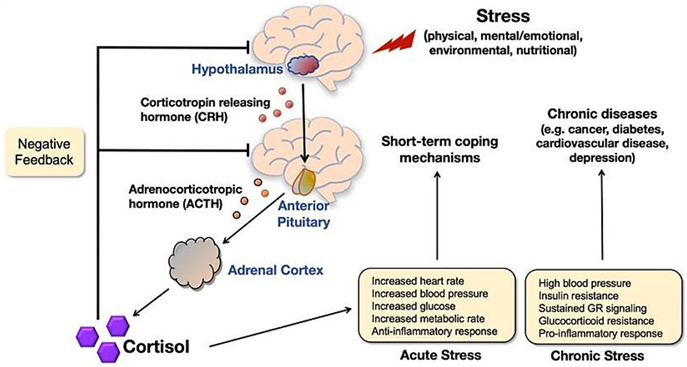
Figure 2
|
|
Table 2 Physiological
Response to Stresss |
2)
Depression
and suicidal tendencies:
Unexpressed emotions, feelings of hopelessness, and the inability to seek help
due to stigma can contribute to depression and, in severe cases, suicidal
ideation. While specific data for Cameroon is scarce, global trends indicate
that men are less likely to seek mental health support.
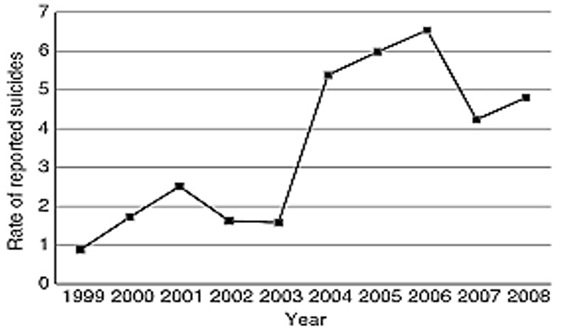
|
Figure 3
|
|
Table 3 Rates of Reported
Suicides from 1999 to 2008 in Guidiguis Health
District- Cameroon |
3)
Substance
abuse: some men turn to
alcohol or drugs, as a coping mechanism for stress and emotional pain, leading
to substance abuse disorders and dependency.
4)
The
inability to express emotions can hinder healthy communication and emotional
intimacy within families and relationships.
LIMITATIONS
This methodology,
while insightful, is based on artistic expression rather than empirical data
from the specific population of interest. It serves as a qualitative
exploration to inform and guide future empirical research rather than providing
generalizable quantitative findings. The interpretations are subjective and
reflect the analyst's understanding of the lyrics within the broader academic
framework
CONCLUSION AND RECOMMENDATIONS
Men's mental
health in Cameroon is a critical area requiring greater attention. The
pressures of societal expectations, as poetically highlighted in Daniel Nwosu
Jr aka Dax's music, particularly 'from a man's perspective,' 'lonely dirt
road,' and 'to be a man,' contribute significantly to psychological distress.
These lyrical narratives offer a compelling and relatable window into the
mental health struggles faced by men; struggles that are amplified by societal
pressures and traditional responsibilities in contexts like Cameroon. The
thematic analysis reveals that the burden of economic provision, the imperative
of emotional suppression, and the resulting isolation are critical factors
undermining men's mental well-being. These artistic insights are strongly
corroborated by existing psychological and sociological research on emotional
suppression, economic stress, and traditional masculinity in African cultures.
This study
underscores the urgent need for a paradigm shift in how men's mental health is
addressed in Cameroon and similar Sub-Saharan African contexts. Reversing this
trend requires more than clinical intervention; it calls for culturally
sensitive dialogue. Masculinity must be redefined not as a silent struggle but
as integrity that allows emotional transparency. Public discourse, education,
and media representation should challenge the myth that resilience requires
silence while creating safe spaces for men to express vulnerability and seek
help without fear of stigma.
Addressing this
requires a multi-faceted approach:
·
Deconstructing
masculinity norms: Promoting
healthier, more flexible definitions of masculinity that allow for emotional
expression and vulnerability.
·
Awareness
campaigns: Initiating public
health campaigns to destigmatize mental health issues among men and encourage
help-seeking.
·
Accessible
support services: Developing
culturally sensitive and accessible mental health services tailored to men's
needs.
FUTURE RESEARCH
Future studies
should empirically document the prevalence of depression, anxiety, and suicide
among men in both urban and rural Cameroon. Mixed-method designs combining
surveys, clinical assessments, and narrative interviews would yield more
comprehensive insight. Comparative studies between genders and cultural groups
could further clarify how social norms influence emotional coping.
Researchers might
equally explore the role of creative expression music, poetry, theatre as
therapeutic interventions for men. Such work would bridge academic inquiry with
community healing, continuing the dialogue between art and science that
inspired this study.
AUTHOR’S REFLECTION
This study was
born from observation and empathy; from seeing how often men around us smile
through fatigue, provide through struggle, and carry invisible weight in
silence. The project is not only an academic contribution but a human one: a
call to acknowledge that behind every act of strength lays a need for
understanding.
As a Cameroonian
scholar and family man, I have witnessed how social expectations of masculinity
can both inspire and injure. My hope is that this work sparks dialogue across
generations, that it helps fathers, sons, and brothers realize that vulnerability
does not diminish manhood; it dignifies it. In confronting silence, we
rediscover humanity.
DECLARATION STATEMENTS
Originality: I confirm that this manuscript is my
original work and has not been published, in whole or in part, in any other
journal or publication. It is not currently under consideration elsewhere.
Ethical
considerations: This
research involved no human or animal participants. It is based on secondary
data sources and literary/lyrical analysis. Therefore, no ethics committee
approval was required.
Data
availability: All data,
sources, and materials used in this article are publicly accessible and duly
referenced.
ACKNOWLEDGMENTS
I acknowledge full
responsibility for the accuracy and integrity of all aspects of this
manuscript.
REFERENCES
Baranov, V., De Haas, R., Grosjean, P., and Matavelli, I. (2024). Masculinity Norms: International Evidence and Implications for Economics, Health, and Politics (World Bank Policy Research Working Paper). World Bank.
Braun, V., and Clarke, V. (2006). Using Thematic Analysis in Psychology. Qualitative Research in Psychology, 3(2), 77–101. https://doi.org/10.1191/1478088706qp063oa
Chapman, B. P., Fiscella, K., Kawachi, I., Duberstein, P., and Muennig, P. (2013). Emotion Suppression and Mortality Risk Over a 12-Year Follow-Up. Journal of Psychosomatic Research, 75(4), 381–385. https://doi.org/10.1016/j.jpsychores.2013.07.014
Dax. (2024). From A Man’s Perspective; Lonely Dirt Road; To Be A Man [Recorded songs]. Records Label, LLC/Columbia.
Ezeugwu, C. R. (2020). Masculine Norms and Mental Health of African Men: A Sociocultural Analysis. Heliyon, 6(12), e05650. https://doi.org/10.1016/j.heliyon.2020.e05650
Gross, J. J., and Levenson, R. W. (1997). Hiding Feelings: The Acute Effects of Inhibiting Emotional Expression. Journal of Abnormal Psychology, 106(1), 95–103. https://doi.org/10.1037/0021-843X.106.1.95
Keugoung, B., Kongnyu, E. T., Meli, J., and Criel, B. (2013). Profile of Suicide in Rural Cameroon: Are Health Systems Missing Opportunities? Tropical Medicine and International Health, 18(2), 224–231. https://doi.org/10.1111/tmi.12140
Mauss,
I. B., and Gross, J. J. (2004). Emotion Suppression and Cardiovascular Disease:
Is Hiding Your Feelings Bad
for Your Heart? In L. R. Temoshok, A. Vingerhoets, and I.
Nykliček (Eds.), Emotional
Expression and Health: Advances
in Theory, Assessment and Clinical
Applications (62–81). Brunner-Routledge.
Morrell,
R. (Ed.). (2001).
Changing Men in Southern Africa. University
of KwaZulu-Natal Press.
Okello, E. S., and Neema, S. (2007). Explaining the High Prevalence of Depression in Uganda: A Qualitative Approach. African Health Sciences, 7(1), 4–13.
Ridley, M., Rao, G., Schilbach, F., and Patel, V. (2020). Poverty, Depression, and Anxiety: Causal Evidence and Mechanisms. Science, 370(6522), eaay0214. https://doi.org/10.1126/science.aay0214
Ssewanyana, D., Nalugya, R., and Namuli, J. (2021). Gendered Pathways to Mental Health Outcomes in Uganda: The Role of Traditional Masculinity and Alcohol Use. International Journal of Mental Health Systems, 15(1), 1–10.
Tyra, A. T. (2024). Emotion Suppression and Acute Physiological Responses to Stress in Healthy Populations: A Quantitative Review of Experimental and Correlational Investigations. Health Psychology Review, 18, 396–420. https://doi.org/10.1080/17437199.2023.2251559
World Health Organization. (2020). Mental Health Atlas 2020: Cameroon Country Profile. World Health Organization.
|
|
 This work is licensed under a: Creative Commons Attribution 4.0 International License
© ShodhGyan 2026. All Rights Reserved.