
|
|
|
|
Original Article
SEMANTIC SHIFTS OF INDIAN LOANWORDS IN RUSSIAN: THE CORPUS AND ASSOCIATIVE ANALYSIS
|
Olga V.
Glukhova 1* 1 PhD in Philology, Associate Professor, Deputy Dean,
Faculty of Linguistics and Journalism, Department of Linguistics and
intercultural communication, Rostov State University of Economics,
Rostov-on-Don, Russia 2 Doctor of Philology (Dr. Habil.),
Professor, Head of the Department of French and German Philology, Adygea
State University, Maykop, Russia |
|
|
|
ABSTRACT |
||
|
The study presents a comprehensive analysis of semantic changes in Indian loanwords within the Russian language, employing a mixed-methods approach combining corpus linguistics and psycholinguistic experimentation. The research analyzes a systematically compiled dataset of 83 lexemes, examining their frequency, collocational behavior. To outline the cognitive representation in Russian consciousness 6 most frequent loanwords were subjected to a free-association experiment with 135 native speakers. Grounded in theoretical frameworks linking semantic change to cognitive factors, the study specifically investigates the roles of word frequency and concreteness. The principal findings reveal a clear dichotomy in assimilation patterns. High-frequency, concrete loanwords demonstrate remarkable semantic stability, largely retaining their original meanings and showing predictable collocational patterns. In contrast, abstract and low-frequency terms, particularly from religious and philosophical domains, undergo profound semantic reconceptualization. The key transformations identified include: secularization of sacred concepts, metaphorical extension and semantic widening, development of pejorative connotations, and cultural re-attribution where modern Western cultural references displace original Indian cultural contexts. The research confirms that loanwords follow the same cognitive principles of semantic change as native vocabulary, with frequency and concreteness being primary determining factors. Methodologically, the triangulation of corpus data with associative experiment results proved particularly valuable, capturing emerging semantic shifts not yet fully conventionalized in written texts. The study concludes that lexical borrowing represents an active process of cognitive and cultural adaptation rather than passive assimilation, fundamentally reshaping conceptual structures through interaction with the recipient language's cognitive and cultural environment. This research contributes to contact linguistics by providing an integrated framework for analyzing loanword assimilation across linguistic and cognitive dimensions. Keywords: Loanwords, Russian, Indian, Semantic
Change, Free Associative Experiment, Corpus Analysis |
||


INTRODUCTION
The
intensification of Russian-Indian cultural contacts and the global
dissemination of Indian spiritual practices have prompted the borrowed concepts
of Indian origin to be widely used in everyday life. That entails a
reconfiguration of these concepts through individual and societal usage within
Russian linguistic context, a process involving not only semantic adaptation
but also a transformation of the semantic structure itself. Positioned at the
intersection of linguistics, cultural studies, and Russian language studies,
this research offers a methodological framework for analyzing loanword
assimilation across languages.
The historical
trajectory of Indian loanwords in Russian reflects broader sociocultural
exchanges, from Afanasiy Nikitin’s 15-th century travels to post-Soviet
globalization. Yet, prior studies remain fragmented, focusing narrowly on
derivational or phonetic features Akulenko
and Leontieva (2021) lacking systematic corpus analysis Sharma
(1994) list of 800 words lacks frequency data);
paying insufficient attention to semantic change of borrowed concepts.
Loanwords are a
phenomenon that no language can avoid. The Routledge Dictionary of Language and
Linguistics Bußmann
et al. (2006) defines loanwords as “words borrowed from
one language into another, which have become lexicalized (= assimilated
phonetically, graphemically, and grammatically into the new language)” (2006).
When functioning in a new language, loanwords often undergo conceptual semantic
change – such as widening, narrowing, or shifting Miller
(2015), Julul et
al. (2020) – or associative meaning change, including
metaphor, metonymy, pejoration, etc. Yuniarto
and Marsono (2016).
The study holds
interdisciplinary relevance as it examines a corpus of Indian terms in Russian,
contributing to the understanding of language contact, and provides empirical
data through corpus-based and psycholinguistic methods to track the semantic
change of Indian concepts in Russian.
Thus, this paper
aims to investigate the semantic change of Indian loanwords in Russian by means
of corpus analysis and free association experiment. The study addresses the
following research objectives:
·
To
identify the most frequent words of Indian origin in the National Corpus of
Russian Language (NCRL).
·
To
reveal the most frequent collocations of these loanwords.
·
To
conduct an associative experiment to determine how Russian speakers perceive
Indian loanwords.
·
To
classify the types of semantic changes these loanwords undergo in Russian
cognition.
THEORETICAL FRAMEWORK
Semantic change in
words generally correlates with factors such as age of acquisition,
concreteness /abstractness, emotionality, word length, and arousal Li et al. (2024). According to Li et al., the interplay of
these factors suggests that words engaging broader and more elaborate cognitive
processes are more resistant to change, thus influencing language evolution at
both macro and micro levels (ibid.).
The present study
of Indian loanwords in Russian focuses on several factors of the list above:
word frequency, concreteness, and emotionality. Li et al. (2024) explain that frequently used words with
concrete meanings and strong emotional connotations, being more cognitively
grounded, are prone to retain their original meaning and change less over time.
Conversely, words that are abstract, less emotional, and less frequent tend to
undergo the more significant semantic changes.
Semantic changes
can lead to conceptual shifts, such as re-categorization or change in a
conceptual domain. Such changes are linked to processes of conceptualization
which, according to Moffat
et al. (2015), refer to the acquisition of conceptual
knowledge through “situated conceptualization”. This means that both external
(agents, objects, events) and internal (emotions, introspections) environments
are important in forming concepts Barsalou
(2003). Conceptual knowledge encompasses the
meanings and understandings we have about concepts, grounded in our experience
and contexts in which those concepts appear. Thus, altering any constituent of
the conceptualization process leads to reconceptualization and the emergence of
new semantic meanings.
The study
investigates whether loanwords behave according to the same mechanisms. To
fulfill this aim and outline the current semantic state of Indian loanwords in
Russian, a special methodology was developed.
METHODOLOGY
The data for
analysis were extracted from the most recent edition of the Dictionary of
Foreign Words (2025). The dataset comprises 83 lexemes identified as loanwords
from either Hindi (12 items) or Sanskrit (61 items). Given the historical
relationship between Sanskrit and Hindi – where Sanskrit serves as the
precursor language – both categories were consolidated under the broader
classification of Indian loanwords for this study. It should be mentioned that
the specific pathways borrowings (e.g., via English, as in ‘jungle’, or
Portuguese, as in ‘veranda’) are not accounted for this analysis.
Subsequently, the
lexical units were systematically categorized according to semantic fields
(e.g., religious terminology, everyday vocabulary) and the concreteness /
abstractness criterion. Each term was then subjected to corpus-based frequency
analysis.
To identify
semantic changes and reconceptualization (e.g., the secularization of sacred
terms), an open associative experiment was conducted. The participants were
divided into two age groups: 18-35 years (n 67) and 36+ years (n 68), with a
total sample size of 135 participants. For the experiment, six Indian loanwords
were selected: two abstract words (karma, nirvana), two concrete words
(jungles, avatar), two words with both abstract and concrete meanings (guru,
yoga). Six filler words were also included: three non-borrowed words closely
related to the loanwords (i.e. fate, teacher, fitness) and three general
vocabulary words (i.e. яблоко [yabloko] –
apple, деньги [den’gi] – money, река
[reka] – river). The loanwords were selected based on two criteria: 1) semantic
change probability, i.e. being marked in dictionary as having a transferred
meaning 2) evidence of the transferred meaning’s usage in the corpus compared
to the dictionary definition.
To assess whether
the degree of exposure to Indian culture influences the results, participants
were asked to rate their frequency of encountering Indian culture on a scale
from “never” to “very often”.
The stimuli were
presented in written form and in randomized order to prevent sequence effects.
The resulting list of associations was subjected to quantitative analysis
(frequency of top associations per word) and qualitative analysis
(identification of concreteness / abstractness and positive/negative valence;
comparison of conceptual and associative meaning changes dictionary and corpus
data).
The final stage
involved visualization of semantic clusters and semantic changes for Indian
loanwords.
RESULTS AND DISCUSSION
INDIAN LOANWORDS: CLASSIFICATION AND FREQUENCY PARAMETERS
The analysis began
with a dataset of 83 Indian loanwords identification in the most relevant
Dictionary of Foreign Words (2025). A lexico-semantic classification yielded
five categories: religious terms (49 items, e.g., Рама
[Rama]– Rama, Вишну [Vishnu] – Vishnu,
карма [karma]– karma,
сансара [sansara]– samsara,
нирвана [nirvana]– nirvana,
йога [ioga]– yoga), health-related terms (2 items,
e.g., асана [asana]– asana,
аюрведа [aiurveda]– ayurveda),
musical terms (3 items, e.g., рага [raga]– raga,
бансури [bansuri]– bansuri,
cитара [sitara]– sitara) and general vocabulary (29items, e.g.,
шаль [shal’]– shawl,
шампунь [shampun’]– shampoo,
джунгли [djungli]– jungles,
веранда [veranda]– veranda). A
subsequent classification based on the of concreteness / abstractness criterion
resulted in 28 abstract words (predominantly from the religious sphere) and 55
concrete words (primarily from everyday vocabulary). In line with Li et al. (2024), we hypothesized that frequent, concrete
words demonstrate greater semantic stability.
The next step
implied the frequency analysis using General Subcorpus of National Corpus of
Russian Language (NCRL) which contains 389 million and provides a
representative sample of language usage. Frequency was measured using the
Instances Per Million (IPM) metric. The analysis confirmed that most Indian
loanwords exhibit low frequency, with IPM scores ranging from 0.01 (e.g.,
нансук – nainsook – [French: nansouk <
Hindi] thin cotton fabric, similar in texture to linen, used for making linen)
to 11,91 (e.g. веранда – veranda –
[English, Portuguese. veranda < Hindi veranda fence, balustrade] a one-story
unheated room with a roof, usually attached to a house along one of its walls).
The corpus usage of the words is illustrated in the examples (1), (2).
(1) At home it had been so clear
that for six dressing jackets there would be needed twenty-four yards of nainsook at sixteen pence the yard, which was a matter of thirty shillings besides the cutting-out and making, and these thirty shillings
had been saved. Tolstoy (1878)
(2) But in the evening - in a carriage, we went into the fields. From
there, we took a public ride, similar to our swing. From there to the Escolta,
there was ice cream. Then, we went to the square, where we listened to
excellent regimental music. After that, we had dinner, drank tea, and sat on
the veranda, admiring the tropical night. The night was moonlit and full
of amazing stars. It was warm, even hot. Goncharov (1859)
From this dataset,
13 of the most frequent loanwords were selected for detailed collocational
analysis. This subset comprised 7 religious terms and 6 general vocabulary
items, reperesenting a mixture of concrete and abstract concepts (e.g.
шампунь [shampun’] – shampoo,
шаль [shal’] – shawl,
веранда [veranda] – veranda,
лак [lak]– laquer, раджа
[radja]– raja, гуру [guru]– guru,
Будда [Budda] – Buddha,
Шива [Shiva]– Shiva, нирвана
[nirvana]– nirvana, карма [karma]– karma,
шаман [shaman]– shaman,
джунгли [djungli] – jungle,
йога [ioga]– yoga). It should be noted that that this
classification is not rigid; a word like ‘guru’ can possess both abstract and
concrete meanings. The word ‘avatar’ was added to the list due to its notably
higher frequency in newspaper (IPM 2,45) and social media (IPM) 7.3 subcorpus,
despite its lower frequency in the General Subcorpus. Furthermore, the corpus
shows the word is used in two grammatical genders: the masculine avatar and the feminine
avatara, reflecting both secular and religious meanings.
COLLOCATION ANALYSIS AND SEMANTIC CHANGES
A collocation
analysis was performed using the NRLC’s Word Portrait Sketch tool, with the
results summarized in Table 1. The data reveal distinct patterns of
assimilation.
Table 1
|
Table 1 Collocations of the Most Frequent
Loanwords of Indian Origin in Russian |
|||||
|
(IPM)
Loanword |
most
frequent* collocations |
|
|
||
|
|
modifier |
Direct
object verb |
Indirect
object verb |
Predicate |
Composed
nouns |
|
(2,4)
шампунь [shampun’]– shampoo |
Cosmetic
(7), therapeutic (6,28), dog’s (3,72) |
Try
IMPERF (5,41), recommend IMPERF (4,34) |
wash
PERF (10,45), IMPERF (8,85), lather PERF (8,41), IMPERF (9,19); wash oneself
up (8,15) |
- |
Balm
(11,22); Conditioner (10,09) |
|
(8,95)
шаль [shal’] – shawl |
down
(9,27); cashmere (9,2) |
throw
over PERF (9,51), IMPERF (8,16) |
wrap
in PERF (10,23); wrap up PERF (9,47); wrap up PERF (9,31); wrap IMPERF (8,3);
wind over PERF (8,36); wind around PERF (8,32) |
Drag
IMPERF (7,45) |
Overcoat
(8,09) |
|
(11,91)
веранда [veranda] – veranda |
Baalbeksky
(8,61); covered (8,26); kitchen (7,51); of a dacha (7,24) |
Build
on PERF (6,33), rebuild PERF (6,18) |
Serve
at PERF (6,99); drink at IMPERF (5,98); |
desert
PERF (5,98); |
Porch
(7,73); annex (7,41) |
|
(8,25)
лак [lak]– laquer |
Alcohol
(8,99), made from shellac (8,9), colorless (8,61) |
Boil
(5,74) |
Cover
IMPERF (9,72), PERF (9,59); paint (8,92) |
Gleam
IMPERF (6,28) |
Polish
(9,47), enamel (9,06), paint (8,56) |
|
(1,09)
раджа [radja]– raja |
Indian
(7,59); hindu (7,56); independent (3,96); local (2,58); young (0,82) |
- |
- |
- |
- |
|
(1,36)
гуру [guru]– guru |
Young
people’s (4,79); Indian (4,22); foreign (3.51), great (0,99) main (0,19) |
- |
- |
Teach
(4,23) |
Teacher
(4,69) |
|
(5,24)
Будда [Budda] – Buddha |
Emerald
(7,03); bronze (5,32); golden (3,47); alive (2,53) |
Meet
(0,79) |
|
Stand
(0.67), sit (0,23) |
Bodhisattva
(9,49); buddha (9,36); God (4,25) |
|
(1,03)
Шива** [Shiva]– Shiva |
- |
- |
- |
- |
God
(0,04 IPM) |
|
(1,58)
нирвана [nirvana]– nirvana |
Buddhist
(7,81); full (0,85), real (0,06) |
Obtain
PERF (4,46), achieve PERF (4,46) |
sink
into PERF (6,58); plunge IMPF (6,51); be plunged IMPF (6,27); fall into IMPF
(3,99). PERF (3,85) |
- |
Samsara
(10,38); non-existence (8,940; |
|
(1,92)
карма [karma]– karma |
Group
(5,3); negative (5,22); bad (3,15); ill (2,61); personal (2,4); public
(2,34); good (1,05); human’s (0,95) |
Work
off IMPERF (6,38); correct IMPERF (4,73); spoil PERF (3,87); change PERF
(3,21) |
- |
- |
Reincarnation
(10,89); karma (10,77) |
|
(6)
шаман [shaman]– shaman |
Tuvinian
(9,57); buryat (8,2), altaic (7,43); tungus (7,22); Indian (6,29) |
Call
PERF (3,56); invite (3,04) |
Dance
IMPERF (4,63); hand in PERF (2,46); give PERF (1,49); |
Perform
the kamlanye ritual IMPERF (7,03); travel IMPERF (5,52) |
Wizard
(9,25); lady-shaman (9,09) |
|
(4,49)
джунгли [djungli] – jungle |
Impassable
(8,72); Peruvian (8,52), Amazonian (8,49); impenetrable (7,94); tropical
(7,94); African (7,35); Australian (7,28); grassy (7,15); neon (7,05) |
Clear
away IMPERF (6,93); inhabit IMPERF (5,74) |
Get
lost PERF (7,38); force one’s way IMPERF (7,35) |
Surround
IMPERF (5,06) |
Savanna
(9,12); desert (6,67) |
|
(2,61)
йога [ioga] – yoga |
Indian
(7,08); Tibetan (6,39) |
Practice
IMPERF (7,47) |
Go
in for IMPERF (4,13); be keen on IMPERF (3,98) |
Help
IMPERF (2,94) |
Meditation
(8,88); starvation (8,84); Buddhism (7,89); physical training (7,33) |
|
(2,45**,
7,3***) Аватар [avatar] – avatar |
Cameron’s
(9,2); three-dimensional (6,48) |
acquire
PERF (7,05) |
Stay
PERF (3,69) |
Force
out PERF (6.07); retain IMPERF (4,55); |
Titanic
(11,2); overlord (10,52); avatar (9,42); mongrel (9,03) |
|
Legend: * LogDice metric is used; PERF – perfective form of the
verb; IMPERF – imperfective form of the verb; Shiva in not represented in
Word Portrait Sketch of National Corpus of Russian language; ** IPM and
collocations in Table are presented according to Word Portrait Sketch in
newspaper corpus; *** data presented according to Word Portrait Sketch in
social networks corpus |
|||||
The collocation
analysis shows that some loanwords, particularly anthroponyms like ‘Shiva’ and
‘Buddha’ preserve their original meaning and do not undergo any changes.
Similarly, as predicted in Li et al. (2024), high-frequency concrete nouns like ‘shawl’,
‘laquer’, ‘veranda’, ‘shampoo’, exhibit no semantic changes, collocating
primarily with wirds related to their core functions and properties.
However, the
concrete noun ‘jungles’ demonstrate a significant semantic extension. While the
dictionary defines its transferred meaning as referring to dangerous urban
neighborhoods or environments of moral degradation, the corpus data reveal a
more nuanced picture. The metaphor is frequently neutralized, used to describe
dense or illuminated cityscapes without inherent negative connotations, as seen
in Examples (3) and (4).
(3) We wandered with Panyushkin through the stone
jungle of the multilevel Monte Carlo, watched the changing of the guard at the
Grimaldi Palace, and saw the antique cars of Prince Rainier. Karabash
(2002)
(4) Herman drove through Moscow at night and
admired its lights and neon jungle, brightly glowing-colored signs and
advertisements. Rostovsky
(2000)
Furthermore, the
term underwent abstraction, metaphorically describing complex and impenetrable
systems, such as “the mathematical jungles of quantum string theories” (Example
5):
(5) Explaining how three-dimensional membrane
worlds "crystallize" in a multidimensional space with six or seven
extra dimensions would lead us into the mathematical jungle of quantum string
theory, various ways of compactifying (convolving) extra dimensions,
topological features of extra dimensions, and other very difficult and abstract
problems. Barashenkov
(2003)
The abstract
loanwords, such as ‘nirvana’ and ‘karma’, which have low frequency ranks, show
clear signs of semantic shift, consistent with the hypothesis. The collocation
profile of ‘nirvana’ centers on the conceptual frame of a “state” that one can
“sink into”, “plunge into” or “fall into” . This has facilitated a shift from
religious term to a general one for a state of bliss or relaxation, as in the
Example (6).
(6) At this time, their precious little feet are
washed, massaged, cajoled and in every possible way appeased to the full state
of foot nirvana. Shigapov
(2013)
Similarly, ‘karma’
was assimilated into common lexis, developing a pronounced negative connotation
(e.g., collocations bad, wrong). It frequently collocates with adjectives like
group, folk, human, personal. This reflects a reinterpretation where ‘karma’
signifies not just personal consequence, but also collective responsibility
(Example 7). In many contexts, it overlaps with the Russian key cultural
concepts of fate Stepanov (2004), which
implies predestination rather than self-determined consequence (Example
8). In other instances, it is used
synonymously with удача [udacha] – luck, as seen
in the phrase карма
подмигнёт [karma
podmignyot] – karma will wink (Example 9), a calque of the Russian idiom
удача
улыбнется [udacha
ulibnyotsya] – fortune smiles upon someone, that means «to be on roll».
(7) The real spirit that gave rise to the idea of
group karma is the spirit of nationalism. Pomerants
(1980)
(8) Mousie Rex: Oh, I guess that's my karma — I've
been on the editorial board all my life.…; -) Nashi
Deti: Podrostki [Our Children: Teenagers] (2004)
(9) Damn it. Okay, karma will wink at her again. I
bargain and discount an art album to a regular customer. Permyakov
(2016)
The loanwords,
‘guru’ and ‘yoga’, which straddle abstract and concrete meanings, exhibit
complex changes. The collocation analysis for ‘guru’ indicates a semantic
widening from a strictly religious “spiritual teacher” to a secular “mentor” is
in “gurus of the information world” (Example 10).
(10) Also, one of
the undisputed gurus of the information world, one of the creators of the Apple
computer, Steve Wozniak, did not disdain to take part in the show. Latkin
(2003)
Concurrently the
corpus provides evidence of pejoration, where the term is used ironically or
critically within quotation marks to denote a charlatan or leader of dubious
sect (Example 11). In spoken language that is marked by the context and the
prosody.
(11) Hence the
prosperity of all kinds of "gurus", psychoanalysts, sects and other
saviors of people from themselves, without whom, it seems, a good third of the
American population cannot do. Vzglyad
Vladimira Bukovskogo (1997).
The loanword
‘yoga’ retains conceptual link to Indian culture in its collocations (e.g.,
индийская [indiyskaya] –
Indian) Table 1. However, its primary meaning in the corpus
has shifted decidively toward the second dictionary definition: a system of
physical exercises. It is now firmly fixed in the semantic field of fitness and
wellness, often mentioned alongside athletics and other fitness programs
(Example 12), while its meaning as a spiritual practice appears less frequently
(Example 13).
(12) It's almost
impossible to isolate something. Some people like yoga, others like athletics.
I can list only a few successful programs that are currently in demand by the
fitness audience. Gurova
and Lukashov (2014)
(13) Yoga in this
case is considered as a spiritual practice in general. Rogov
(2012)
In summary, corpus
data reveal a spectrum of semantic changes, ranging from stability in
high-frequency concrete terms to significant reconceptualization in abstract
and less frequent words. The following section investigates whether these
documented semantic changes are reflected in the language consciousness of
native speakers.
OPEN ASSOCIATIVE EXPERIMENT: RESULTS AND ANALYSIS
The open
associative experiment yielded a total of 2,810 reactions, of which 1,746 were
reactions to the six target Indian loanwords’ stimuli (an average of
approximately 300 responses per stimulus). While most reactions were single
words, some participants provided phrases. All responses were included in the
analysis, even if participants provided fewer than the requested three
associations. Some of them (in personal
feedback) attributed this to inattention when reading the task instructions, as
the experiment was conducted online via link without direct researcher
supervision.
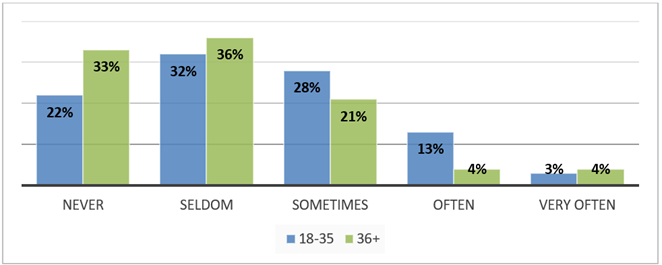
An initial
analysis of participants’ self-reported exposure to Indian culture revealed
minor differences between age groups, with a general trend of younger
participants reporting slightly higher exposure Chart 1. However, as the majority of participants
(about 60 %) across all groups reported rare exposure, age and cultural
familiarity were not treated as primary variables for the subsequent
association analysis.
|
Chart 1
|
|
Chart 1 Exposure to Indian Culture Among Age
Groups |
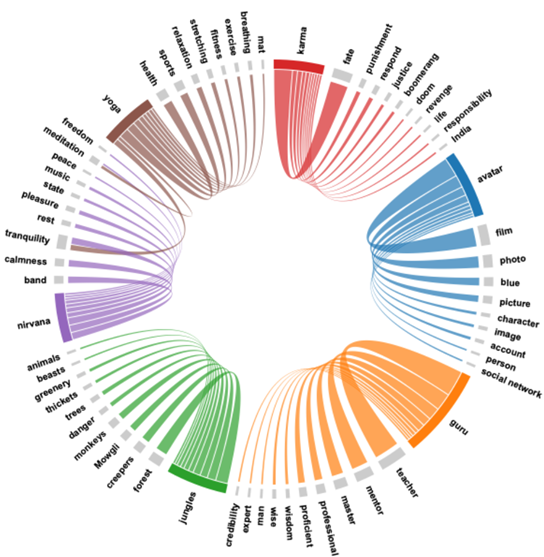
For each loanword,
the ten most frequent associations were analyzed quantitively, whole the full
set of responses, including single-occurrence associations, was subjected to
qualitative thematic analysis. The results are summarized below and visualized
(Mauri et al. 2017) in a network diagram Figure 1.
|
Figure 1
|
|
Figure 1 Network of Associations to Indian
Loanwords in Russian Language |
JUNGLE
(CONCRETE)
The associative
field for ‘jungles’ is dominated by its primary meaning. It is perceived as a
hyponym of лес, (forest’ – 10%), with associations clustering
around its physical constituents: geography and terrain type (e.g. tropics,
amazon, Amazonia, Africa, Vietnam); flora (e.g. palm trees, fruits, orchids,
bushes), fauna (snakes, tigers, crocodile, parrots, elephant, panther), and
atmosphere (e.g. dampness, rain, darkness, humidity, heat, warmth). A
significant cluster of associations (Mowgli (6%); Balu, Bagheera, Kipling –
single-occurrence associations) stems from Redyard Kipling’s The jungle book,
indicating the profound grounding of the concept as this literary work is
taught in primary schools of Russia. Popular culture (media), especially the
images of Mowgli and Tarzan, had a huge impact on perception and reflected in
the corresponding associations (e.g. Mowgli, Tarzan, Jumanji). The negative
transferred meaning (“a dangerous environment”) is represented in the
reactions: danger (4%), fear, impassability, unknown, death. Notably a positive, romanticized cluster
emerged (e.g. nature, adventure, mystery, vacation, hunting, hiking), which is
not yet evident in the corpus data, suggesting an emerging connotative shift.
AVATAR
(CONCRETE)
The associative
field of ‘avatar’ is divided between two modern, secular meanings, with its
original religious sense nearly eclipsed. The dominant cluster is media
related, driven by James Cameron’s film Avatar (e.g., film – 16%, blue – 7%)
and the animated series Avatar: The Legend of Aang (e.g., Aang, Cartoon,
Element, Water, Magic, Legend, Anime). The second major cluster is digital,
relating to online identity (e.g., photo – 8%, picture – 6%, account – 3%,
social network – 2%, character – 3%). The original religious meaning
(incarnation of a deity) was found only in single-occurrence responses (e.g.,
deity, incarnation, Buddhism, Hinduism, God, spirit, body), confirming a
near-complete semantic shift in popular consciousness from sacred to digital
and cultural spheres.
GURU
(CONCRETE/ABSTRACT)
The associations
for ‘guru’, confirm its metaphorical widening to secular contexts. The most
frequent responses, teacher (21%) and mentor (14%), align with its dictionary
definition as a transferred meaning (2. Transfer. About the teacher, mentor
[Dictionary of Foreign Words 2025]). A strong cluster signifies someone of high
expertise (master – 10%, professional – 7%, expert, credibility – 2%,
proficient – 6%, trainer <1%, etc.), who leads, teaches and transmits
knowledge (wisdom (3%), wise (3%),
knowledge (<1%), experience (<1%), intelligence (<1%), smart (<1%),
cognition (<1%), philosopher (<1%), visionary (<1%), prophet (<1%)
etc.). However, a distinct pejorative cluster also emerged (e.g. charlatan,
conman, sect, jerk, scam, submission), indicating a critical or skeptical view
of self-proclaimed experts. Associations related to the original Indian context
(e.g. India, yoga, meditation, philosophy, East, religion, monk, Tibet, Zen,
lotus, enlightenment, spirituality) were minor and of single-occurrence, highlighting
the concept’s detachment from its cultural origins.
YOGA
(CONCRETE/ABSTRACT)
The associative
field for ‘yoga’ demonstrates a clear dominance of its concrete, secular
meaning. The largest cluster frames it as a fitness activity (e.g., sport – 7%,
stretching – 7%, exercise – 3%, body flexibility <1%, body, pilates,
gymnastics, physical education, endurance, strength, exercise, aerobics) with
associations related to practice (e.g., breathing – 3%, mat – 2%, practice –
4%, pose – 1%, asanas, group, hobby – 1%, coach) and physical / mental benefits
(e.g., health – 8%, tranquility – 5%, relaxation – 5%, Meditation – 3%, harmony
– 2%, balance, confidence, beauty, benefit, stability, resilience, peace of
mind, rest, pacification, peace, enjoyment, happiness, freedom). However, there is a number of negative
responses (e.g. heresy, hard, sectarians, difficulties, a type of body abuse),
that reveal skepticism towards the practice and the philosophy. The abstract,
philosophical meaning associated with Indian spirituality was a minor cluster,
represented by single-occurrence words (e.g., Zen, nirvana, India,
spirituality, hatha, wisdom, Hinduism, Buddhism, mindfulness, asceticism,
purification, philosophy of being, self-discipline, east, lotus (symbol)). This
confirms a major conceptual shift where ‘yoga’ is primarily understood as a
wellness practice rather than a spiritual discipline.
NIRVANA
(ABSTRACT)
The associations
for ‘nirvana’ are split between two unrelated semantic poles. The first, and
dominant refers to the American rock band Nirvana and its leader Kurt Cobain
(e.g., band – 6%, music – 3%, Cobain, Kurt Cobain <1%, rock, song, Pank,
scene, t-shirt), sometimes with negative reactions (e.g., bullshit, cheating,
dope, drugs, addict, get drunk, forget). The second pole represents a
simplified, psychological understanding of the term as a state of extreme calm,
bliss and relaxation (e.g., state –3%, calmness – 6%, tranquility – 6% (shared
with stimuli ‘yoga’), peace – 2%, rest – 4%, blissout / pleasure – 6%). The
nirvana state is understood by means of related concepts like meditation (2%),
astral, trance, purification, self-discovery. This pole is represented by a
group of reactions that reveal the metaphoric comprehension of the notion (e.g.
harmony, freedom, goal, achievement, paradise, emptiness, nothingness,
everything, being, utopia, non-existent, detachment, indifference – like a lack
of passion) that range from neutral to meliorative. The original Buddhist meaning of cessation of
sufferings was found only in the periphery of associative field (e.g.,
Buddhism, enlightenment, Zen, buddha, extinction – the key aspect of nirvana is
the extinction of suffering, samsara, emptiness – sunyata is an important
concept, liberation, rebirth, atman, Tibet, India, Hinduism, philosophy,
spirituality). This reveals a profound transformation: a sacred, complex
concept was largely replaced by a band name and a vague synonym for relaxation
KARMA
(ABSTRACT)
The associative
field for ‘karma’, that “In Buddhism, Hinduism and other religions of the East,
is a set of actions committed by a person and their consequences that determine
his fate and the specificity of his rebirth and reincarnation” [Dictionary of Foreign
Words 2025], shows a near-total loss of its philosophical meaning. The
associations referring to the Indian origin are minor and primary
single-occurred (e.g., India – 2%, Buddhism, Esotericism, Energy, Aura, Soul,
Samsara, Rebirth, cyclicity, Moksha, Maya, Nirvana, Spirituality – 1%,
Philosophy – 1%). It is overwhelmingly assimilated into the Russian conceptual
domain of судьба [sud’ba] – fate (15%), a
concept characterized by fatalism (e.g., inevitability, predestination, the
cross, the burden, hopelessness, hopelessness) and external forces (e.g., doom
– 2%). Fate in Russian is defined as 1. «A course of events, a combination of
circumstances, that develops independently of a person's will; 2. Destiny,
doom, life path» [Kuznetsov, 2000]. A second major cluster frames it as
mechanism of retribution (e.g., punishment – 4%) respond – 4%, justice – 3%,
boomerang – 3%, revenge – 2%, responsibility – 2%), for person’s actions (e.g.,
act – 2%, action – 1%, sin – 1%, choice, mistakes, merit, be honest, right
etc.), almost exclusively with negative connotations (e.g., bad – 1%, negative
<1%, evil <1%, black, except for justice that is neutral in Russian
language). The associations highlight a fundamental cognitive reinterpretation:
the original Indian concept of ethical causality and personal responsibility
has been reshaped into a fatalistic notion of inescapable punishment for
misdeeds.
SYNTHESIS: CORPUS AND ASSOCIATIVE EXPERIMENT DATA ON SEMANTIC CHANGES
The open
associative experiment revealed some semantic changes in meaning structures of
Indian loanwords. The Table 2. synthesizes the semantic changes identified
through both corpus and associative analysis.
Table 2
|
Table 2 Semantic Changes of Indian Loanwords in
Russian |
|||||||||||||
|
|
concrete |
concrete/abstract |
abstract |
||||||||||
|
jungles |
avatar |
guru |
yoga |
nirvana |
karma |
||||||||
|
c |
a |
c |
a |
c |
a |
c |
a |
c |
a |
c |
a |
||
|
Conceptual semantic change |
Widening |
|
|
|
|
+ |
+ |
+ |
|
|
|
+ |
|
|
Narrowing |
|
|
|
|
|
|
|
|
|
|
|
|
|
|
Shifting |
|
|
+ |
+ |
|
|
|
+ |
+ |
+ |
|
+ |
|
|
Association change |
Metaphor |
+ |
+ |
|
|
|
+ |
|
|
|
|
|
|
|
Metonymy |
|
|
+ |
+ |
|
|
|
|
|
+ |
|
+ |
|
|
Pejoration |
|
|
|
|
+ |
+ |
|
+ |
|
+ |
+ |
+ |
|
|
Melioration |
|
+ |
|
|
|
|
|
|
|
|
|
|
|
|
Neutralization |
+ |
|
|
|
|
|
|
|
|
|
|
|
|
|
Legend: c – Based on
Corpus Analysis, a – Based on Open Associative Experiment Analysis |
|||||||||||||
The results
indicate that semantic narrowing was not observed for any of the target words.
Pejoration was the most frequent associative change, affecting ‘guru’
(perceived as charlatan), ‘yoga’ (as a hard workout exercise), ‘nirvana’ (as a
state if drug intoxication,) and ‘karma’ (as a hand of justice for bad
deals). Widening (e.g., ‘guru’ as a
professional in general, ‘yoga’ as a type of fitness and ‘karma’ as a synonym
of luck), and conceptual shifts, particularly secularization (e.g., ‘avatar’ –
a film character and image for social media, ‘yoga’ – secular practice
nowadays, nirvana’ – instant pleasure, and ‘karma’ as boomerang) were also
prevalent among abstract and dual-meaning words. Metaphor was a key mechanism
for concrete words like ‘jungles’ and ‘guru’, while metonymy was observed for
‘avatar’, ‘nirvana’, and ‘karma’. Melioration and neutralization are minor and
observed only in concrete ‘jungles’ (neighborhoods of big cities that are not
always dangerous but dense or illuminated, and place for adventures (that is
positive in Russian culture).
The data strongly
support the hypothesis that low-frequency, abstract loanwords are most
susceptible to semantic change. Abstract loanwords underwent more than three
types of changes on average, whereas concrete words underwent fewer than three.
As the target words were emotionally neutral, the results highlight word
frequency and concreteness as the primary factors driving semantic changes in
loanwords, confirming they behave similarly to native vocabulary in this regard
Li et al. (2024). The associative experiment also proved
valuable in capturing emerging changes (e.g., positive framing for ‘jungles’)
not yet fully conventionalized in written corpus.
CONCLUSION
The study provided
a comprehensive analysis of the integration and transformation of Indian
loanwords in the Russian language by combining corpus-based and
psycholinguistic experimental methods. The findings reveal a complex landscape
of semantic assimilation, characterized by significant semantic changes that
reflect the interplay between global cultural trends and local linguistic
tradition.
The research
confirms the hypothesis, aligned with Li et al. (2024), that less frequent and more abstract
loanwords are particularly prone to semantic change. The data demonstrates that
relevantly frequent concrete loanwords like ‘shampoo’ and ‘veranda’ are
resilient to semantic change. In contrast, abstract and less frequent terms of
religious or philosophical origine, such as ‘karma’, ‘nirvana’, ‘yoga’
underwent profound reconceptualization.
The key semantic
changes identified include:
Semantic shift
that could be called secularization. Sacred concepts largely lose their
original religious and philosophical meaning. ‘Karma’ is predominantly
understood in modern Russian as a mechanistic “boomerang” of punishment for
misdeeds or as inescapable fate, overlapping with the Russian concept of
судьба [sud’ba]. Similarly, ‘nirvana’ is
perceived either through lens of Western pop culture (the rock band) or as a
simplified state of blissful relaxation, a far cry from the Buddhist ideal of
suffering cessation.
Widening and
metaphorization that enabled several loanwords develop new meanings. The term
‘guru’ metaphorically extended to denote an expert in any field, but this
extension is accompanied by a potential pejorative sense, implying a
“charlatan” or “sect leader”. The semantic field of ‘yoga’ also widened to
emphasize, apart from spiritual, physical exercise and fitness, sometimes
viewed skeptically as difficult.
The unification of
corpus data with associative experiment results proved methodologically
fruitful. While the corpus provides evidence of established usage trends, the
associative experiment captures the living, often pre-lexicalized, perceptions
of speakers, revealing shifts – such as the romanticized view of ‘jungles’ as a
place of adventure – that is not yet fully reflected in written texts.
In summary, the
borrowing of Indian loanwords by Russian is an example of a profound cognitive
and cultural adaptation. These language units were not passively absorbed but
actively reconfigured, their meanings reshaped by frequency of their use, their
abstract nature, and their encounter with the dominant concepts of Russian and
globalized contemporary culture. This study underscores that lexical borrowing
is not merely a linguistic process but a core mechanism of cultural
translation.
While this study
achieved its goals, is not free from limitations, including its reliance on a
single dictionary and the use of only the basic subcorpus of the NCRL for
quantitative parameters. The associative experiment, while informative,
involved a limited number of participants (n=135). Future research could expand
the participant pool, incorporate data from other subcorpora (e.g., spoken or
regional), and undertake a comparative analysis with the assimilation of Indian
loanwords in other languages.
ACKNOWLEDGMENTS
None.
REFERENCES
Akulenko,
E. A., and Leontieva, V. N. (2021). Lexemes of Indian-American Origin in the Word-Base System of the
Modern Russian Language. In The Life of Language in Culture and Society:
Collection of Scientific Articles (105–111). Minsk State Linguistic University.
Barashenkov, V. (2003). Veren Li Zakon Nyurona? [Is Newton’s Law Correct?]. Znanie—Sila (Knowledge Is Power), (1), 85–91.
Barsalou, L. W. (2003). Situated Simulation in the Human Conceptual System. Language and Cognitive Processes, 18(5–6), 513–562. https://doi.org/10.1080/01690960344000026
Bußmann,
H., Kazzazi, K., and Trauth, G. (2006). Routledge Dictionary of Language and
Linguistics (Taylor and Francis e-Library ed.). Routledge.
Goncharov, I. A. (1859). Letters.
Gurova, T., and Lukashov, I. (2014). Regulyarnyy Fitnes [Regular Fitness]. Ekspert.
Institute of Linguistic Research, Russian Academy of Sciences. (2025). Dictionary of Foreign Words.
Julul, A. A., Rahmawati, N. M., Kwary, D. A., and Sartini, N. W. (2020). Semantic Adaptations of the Arabic Loanwords in the Indonesian Language. Mozaik Humaniora, 19(2), 135–147. https://doi.org/10.20473/mozaik.v19i2.14584
Karabash, A. (2002, February 4). Three Days in Monaco. Domovoy.
Kuznetsov, S. A. (2000). Bolshoy Tolkovyy Slovar Russkogo Yazyka [Large Explanatory Dictionary of the Russian Language]. Gramota.ru.
Latkin, A. (2003, January 22). Demonstrator Sovesti. Znamenitomu Khakeru Razreshili Vykhodit’ V Internet [A Demonstrator of Conscience. The Famous Hacker Was Allowed to Access the Internet]. Izvestia.
Li, Y., Breithaupt, F., Hills, T., Lin, Z., Chen, Y., Siew, C. S. Q., and Hertwig, R. (2024). How Cognitive Selection Affects Language Change. Proceedings of the National Academy of Sciences, 121(1), Article e2220898120. https://doi.org/10.1073/pnas.2220898120
Mauri, M., Elli, T., Caviglia, G., Uboldi, G., and Azzi, M. (2017). RAWGraphs: A Visualisation Platform to Create Open Outputs. In Proceedings of the 12th Biannual Conference on the Italian SIGCHI Chapter (Article 28). ACM. https://doi.org/10.1145/3125571.3125585
Miller, R. (2015). Trask’s Historical Linguistics (3rd ed.). Routledge. https://doi.org/10.4324/9781315728056
Moffat, M., Siakaluk, P. D., Sidhu, D. M., and Pexman, P. M. (2015). Situated Conceptualization and Semantic Processing: Effects of Emotional Experience and Context Availability in Semantic Categorization and Naming Tasks. Psychonomic Bulletin and Review, 22(2), 408–419. https://doi.org/10.3758/s13423-014-0696-0
Nashi Deti: Podrostki [Our Children: Teenagers]. (2004).
National Corpus of Russian Language. (n.d.). National Corpus of the Russian Language.
Oreshnikov, A. V. (1925). Dnevnik [The Diary].
Permyakov, A. (2016). Petushki—Moskva. Poyekhal [Petushki—Moscow. Gone]. Volga.
Pomerants, G. (1980). Son O Spravedlivom Vozmezdie (Moy Zatyanuvshiysya Spor) [A Dream of
Fair Retribution (My Protracted Dispute)]. Sintaksis, 8, 122–147.
Rogov,
O. G. (2012).
Kino, Kotoroye Mozhet Izmenit’ Zhizn’. Vashu? [A Movie That Can Change Your
Life. Yours?]. Volga.
Rostovsky, A. (2000). According to the Laws of the Wolf Pack. Vagrius.
Sharma,
R. (1994). Indian
Exotic Vocabulary in Russian [Abstract of the Dissertation of the Candidate of
Philological Sciences, Minsk State University].
Shchapova, G. (2020). Mir, Ne Trognutyy Tsivilizatsiey [A World Untouched by Civilization].
Znanie—Sila, 6, 45–51.
Shigapov,
A. S. (2013).
Bangkok I Pattaya. Putevoditel [Bangkok and Pattaya: Travel Guide]. AST.
Tolstoy,
L. N. (1878).
Anna Karenina.
Vzglyad Vladimira Bukovskogo [Vladimir Bukovsky’s View]. (1997). Znanie—Sila.
Yuniarto, H., and Marsono, S. U. (2016). Semantic Change Type in Old Javanese Word and Sanskrit Loan Word to Modern Javanese. LLT Journal: A Journal on Language and Language Teaching, 19(1), 1–11. https://doi.org/10.24071/llt.v16i1.262
|
|
 This work is licensed under a: Creative Commons Attribution 4.0 International License
© ShodhGyan 2026. All Rights Reserved.